

The true cost of in-house cleaning typically runs 30% to 50% higher than outsourced commercial cleaning once wages, benefits, equipment, training, supervision, and compliance liability are added in. Outsourced contracts convert those variable costs into a single line item with documented insurance, training, and SLAs, which is why most PA businesses above 5,000 sq ft outsource.
Ziva Cleaning Services has helped facility managers evaluate this exact decision for over 14 years, and the pattern is consistent: businesses that do the math properly almost always discover the in-house cost is well above the headline wage. This guide breaks down the full cost stack on both sides, the hidden costs in-house teams carry, where outsourcing genuinely loses, and the break-even threshold for switching. Use it as a worksheet before requesting a quote from any commercial cleaning provider.
What Goes Into the Real Cost of In-House Cleaning?
Most facility managers underestimate in-house cleaning costs because they only count direct wages. The complete cost stack has eight lines, and several of them are larger than people expect.
Cost Line | Typical Annual Range (per cleaner) | Notes |
|---|---|---|
Direct wages | $32,000 to $42,000 | Per BLS Janitors and Building Cleaners data, the U.S. median hourly wage is $16.62; PA tracks national averages closely. |
Payroll taxes (FICA, FUTA, SUTA) | $3,000 to $4,500 | Roughly 9% to 11% of wages in PA. |
Benefits (health, PTO, holidays) | $4,000 to $9,000 | Optional for hourly W-2; required for full-time at most mid-size firms. |
Workers compensation insurance | $1,500 to $4,500 | Cleaning is a higher-risk class; PA rates run $3 to $8 per $100 of payroll. |
Equipment, chemicals, consumables | $2,000 to $4,000 | Vacuums, floor machines, cloths, EPA-registered disinfectants, paper products. |
Training and certification | $500 to $2,000 | OSHA bloodborne pathogen, HAZCOM, equipment safety, plus refresher hours. |
Supervision and scheduling | 10% to 15% overhead | Manager time spent on hiring, scheduling, quality checks, complaints. |
Turnover replacement cost | $2,500 to $5,000 per departure | The cleaning industry averages 200%+ annual turnover; each replacement costs roughly 1.5x monthly wages. |
Adding the lines together, a single in-house cleaner typically costs $48,000 to $70,000 fully loaded per year, not the $34,000 wage figure most facility managers initially budget. For a comparable view of how outsourced labor is priced and packaged, see our janitorial cleaning pricing guide.
Outsourced Cleaning Cost Structure
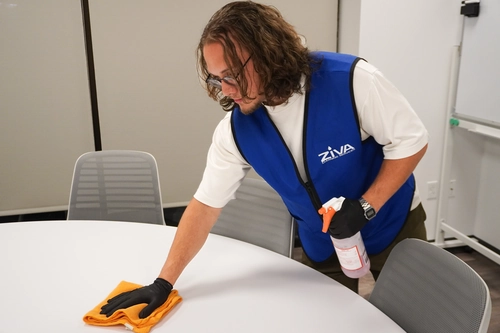
Outsourced commercial cleaning replaces the eight-line stack with a single contract price. The provider absorbs wages, taxes, benefits, insurance, equipment, training, and supervision, then bills a flat or per-square-foot rate.
Typical PA pricing patterns from our commercial cleaning pricing breakdown:
Hourly rates: $25 to $50 per cleaner-hour, depending on facility class and after-hours premium.
Per square foot: $0.05 to $0.20 per service for routine commercial cleaning.
Monthly contracts: $400 to $1,200 (under 5,000 sq ft), $1,200 to $3,000 (5,000 to 15,000 sq ft), $3,000+ (large facilities).
The provider carries general liability and workers compensation insurance on every cleaner, runs background checks, and replaces staff at no additional cost when someone leaves. Equipment, chemicals, and consumables are included unless the contract specifies otherwise. The fixed-fee structure makes budgeting predictable and removes the manager-time overhead that in-house teams require.
Side-by-Side Total Cost Comparison
For a 10,000 sq ft commercial facility cleaned five nights a week, here is how the two models compare on a typical PA contract:
Cost Element | In-House (1.5 FTE) | Outsourced Contract |
|---|---|---|
Direct labor | $54,000 | Included |
Payroll taxes | $5,400 | Included |
Benefits | $9,000 | Included |
Workers compensation insurance | $3,000 | Included |
Equipment, chemicals, supplies | $4,500 | Included |
Training and certification | $1,500 | Included |
Supervision overhead (15%) | $11,090 | Not applicable |
Turnover replacement (avg 1.5/year) | $5,250 | Not applicable |
Total annual cost | $93,740 | $28,800 to $36,000 |
The outsourced range above reflects $2,400 to $3,000 per month, the typical PA contract price for a 10,000 sq ft commercial facility on a five-night schedule. The gap between in-house and outsourced is $57,000 to $65,000 per year, which is roughly the cost of a second cleaner. This is why the math almost always favors outsourcing once a facility crosses 5,000 sq ft.
Hidden Costs Most In-House Calculations Miss
Three categories of hidden cost commonly skip the in-house budget but show up in the operating P&L anyway.
Compliance and liability exposure: In-house cleaning crews must follow OSHA 29 CFR 1910 general industry standards for workplace safety, bloodborne pathogen exposure, hazard communication, and PPE. Failure to maintain documented training programs creates legal exposure if a cleaner is injured or if a workplace incident occurs during cleaning. Outsourced commercial providers carry this liability under their own policies and training programs, transferring the exposure off your books.
Quality variance and complaint volume: In-house teams have no contractual SLA. When quality drops because of staff turnover, illness, or supervision gaps, the manager spends time fielding complaints, retraining, or backfilling. Outsourced contracts typically include defined scope, response times, and a quality-assurance process, which converts variable complaint volume into a predictable resolution path.
Coverage during PTO, illness, and vacancies: A single in-house cleaner on a 5-night schedule needs roughly 3 weeks of vacation and sick coverage per year. If you don't backfill, cleaning gaps appear; if you do, you're paying part-time fill-in wages plus management time. Outsourced providers handle coverage internally with no extra cost to the client.
Equipment depreciation and replacement cycles: Commercial vacuums, floor scrubbers, carpet extractors, and pressure washers carry meaningful capital cost over a 3 to 5 year replacement cycle. A mid-tier commercial vacuum runs $400 to $800; a propane buffer runs $2,500 to $4,000; a walk-behind auto-scrubber runs $4,000 to $8,000. In-house programs amortize these into the supply line but rarely track them as a depreciating asset. Outsourced providers absorb the equipment refresh cycle into the contract price, which removes a hidden capex line from your operating budget.
When Each Option Makes Sense
Outsourcing is not universally cheaper. There are specific scenarios where in-house teams remain the right call.
In-house typically wins when:
Cleaning is highly specialized and embedded in production (e.g., a clean-room manufacturing line where cleaners are also production technicians).
The facility runs 24/7 with continuous coverage requirements that exceed standard contract structures.
Security clearance, NDA, or classified-environment requirements make rotating outside staff impractical (some defense, healthcare, or financial settings).
Headcount is small enough (one part-time cleaner under 1,000 sq ft) that overhead lines stay marginal.
Outsourcing typically wins when:
The facility is over 5,000 sq ft with a defined, repeatable scope.
Compliance requirements demand documented training, background checks, and insurance certificates.
Multiple sites need consistent quality across locations.
Specialty services (carpet extraction, post-construction, kitchen hood cleaning, window cleaning) appear seasonally or monthly.
Management bandwidth is the binding constraint on operations.
For a structured walkthrough of how to evaluate a provider once outsourcing is on the table, see our guide on hiring a commercial cleaning company.
Break-Even Size for Switching to Outsourced
For most PA commercial facilities, the break-even point sits between 3,000 and 5,000 sq ft of cleanable space at a 3-to-5-night-per-week schedule.
Under 3,000 sq ft: a part-time in-house cleaner or a porter on shared rotation often wins on cost.
3,000 to 5,000 sq ft: a coin-flip on cost; outsourcing usually wins on quality consistency, compliance documentation, and management time.
Over 5,000 sq ft: outsourcing wins on cost almost universally, with the gap widening as facility size grows.
Multi-site operators: outsourcing wins on consistency and reporting at any size.
The threshold shifts down for facilities with high compliance requirements (medical, financial, education), where the documentation overhead of running an in-house program makes outsourcing favorable even at smaller footprints.
Homeowners weighing the same in-house question on a smaller scale can compare it against our house cleaning services in Reading, PA.
Ziva Cleaning Services has built outsourced commercial cleaning programs for offices, medical facilities, schools, and industrial sites across Reading, Wyomissing, Exton, Lancaster, and the wider Berks County markets for over 14 years. Our team is bonded, insured, background-checked, and OSHA-trained, and we provide line-itemized proposals so you can compare a real outsourced quote against your current in-house cost stack. Get a free on-site assessment and a customized cost comparison for your facility.

