

This guide covers what those protocols look like in practice: how to respond when something goes wrong, how to handle waste day to day, who is responsible for what, and where the regulatory floor sits. Ziva Cleaning Services has handled medical facility cleaning for more than 14 years across clinics, urgent care centers, dental practices, and long-term care facilities. The protocols below reflect what works operationally, not just what the standards say on paper.
How to Respond to a Biohazard Spill or Exposure Incident
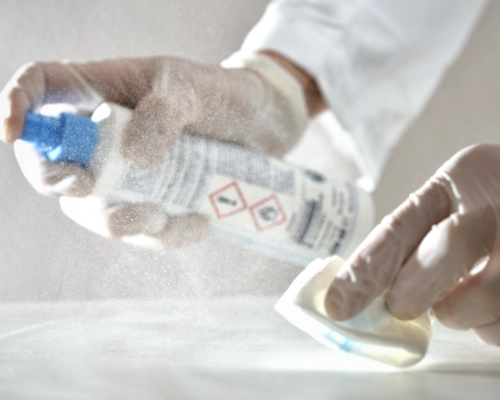
The first 60 seconds after a blood spill, needle stick, or splash exposure shape everything that follows. Most published guidance treats incident response as a later chapter, but the facility manager searching for biohazard cleaning protocols is usually trying to be ready for the moment one happens. That is where we start.
The first 60 seconds
When a biohazard incident occurs, the response sequence is short and specific:
Isolate the area: Block traffic, close the room or station, post a clear warning so no one walks through the spill.
Notify staff: The supervising clinician and the cleaning team lead both need immediate notification.
Retrieve the exposure control kit: Every medical facility should keep one in a known location, stocked with PPE, absorbent material, EPA-registered disinfectant, and a sharps container.
Treat any human exposure first: If a needle stick or splash hit a person, the affected individual flushes the exposure site with water for at least 15 minutes and reports to the supervisor for medical follow-up under the facility's exposure control plan.
Sequence matters more than speed. A controlled response in the right order beats a fast response that skips a step.
Containment, disinfection, and waste collection
Once the area is isolated and PPE is on, containment begins from the outside of the spill and works inward. Cover the spill with absorbent material. Apply an EPA-registered hospital-grade disinfectant rated for bloodborne pathogens and let it stand for the contact time on the product label, typically one to ten minutes depending on the agent. Wipe up the absorbed material and place all contaminated supplies into a red biohazard bag. Any sharps go directly into a puncture-resistant container, never back into a bag.
If the spill is on a porous surface or larger than a typical exam-room incident, the response escalates: repeated disinfectant applications, possible material removal, and in some cases professional remediation by a cleaning team trained in deep terminal cleaning after a known infectious exposure.
Documentation and post-incident reporting
OSHA requires recorded follow-up for any exposure incident under 29 CFR 1910.1030. The facility's exposure control plan should specify the recordkeeping format, the timeline for medical evaluation, and post-exposure prophylaxis referral protocols. Cleaning teams should log the incident, the response taken, and the waste generated as part of the environmental services record.
Types of Medical Biohazard Waste and How to Segregate Them
Not all medical waste is biohazard waste, and not all biohazard waste belongs in a red bag. Segregation at the point of generation drives the cost, compliance, and exposure profile of everything downstream. The CDC's regulated medical waste guidance covers the major categories used in US healthcare.
Waste stream | Container | Color | Examples | Treatment |
|---|---|---|---|---|
Infectious / regulated medical | Leak-resistant biohazard bag | Red | Blood-saturated gauze, contaminated PPE, suction canisters, lab specimens | Autoclave or incineration |
Pathological | Sealed bag in rigid secondary | Red or yellow | Tissues, organs, body parts from procedures or autopsy | Incineration only |
Sharps | FDA-approved puncture-resistant container | Red, biohazard label | Needles, syringes, scalpels, contaminated broken glass | Autoclave or incineration |
Trace chemotherapy | Yellow container | Yellow | Empty IV bags, gloves, gowns from chemo administration | Incineration |
RCRA hazardous pharmaceutical | Black container | Black | Bulk chemo, listed hazardous pharmaceuticals | Permitted hazardous waste disposal |
Why segregation matters
Mixing waste streams almost always defaults the entire load to the higher-cost treatment. A red bag dropped into a pathological-only container forces the whole batch to incineration. A few loose sharps in a red bag risks worker injury at every handoff downstream. Mislabeled containers can trigger fines under both OSHA and state medical waste rules. Clinical staff own segregation at the point of use; the cleaning team's job is to ensure that what reaches the storage area before pickup is correctly contained, sealed, and labeled.
Routine Biohazard Cleaning Protocol, Step by Step
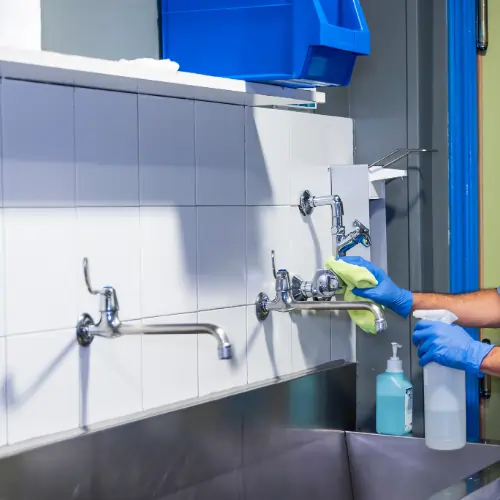
Routine biohazard cleaning runs every day in a healthcare facility, not just during emergencies. Exam room turnover after a patient with bloodwork done, surgical area cleaning after a procedure, lab surface decontamination at end of shift. The protocol sequence is the same in each case.
PPE requirements before any biohazard task
PPE goes on before any contact with potentially infectious material, never partway through. The standard set for routine biohazard work in a medical facility:
Disposable nitrile or latex gloves, double-layered for spill response
Fluid-resistant gown or apron, full coverage of work clothing
Splash goggles or face shield, depending on aerosolization risk
Surgical mask or N95 respirator when aerosols are possible
Closed-toe, fluid-resistant footwear
Donning order matters: gown first, then mask, then eye protection, then gloves. Reverse order on removal, with hand hygiene between each step. The facility's exposure control plan should specify the exact PPE set for each task type.
Cleaning before disinfection
Cleaning and disinfection are not the same step, and the order matters. Our medical cleaning services treat the practical difference between cleaning, sanitizing, and disinfecting as the operational backbone of every medical cleaning visit. Cleaning physically removes soil and organic material; disinfection kills remaining pathogens. Disinfecting a surface still covered in blood or biological residue wastes product and leaves germs in place.
The sequence runs: clean first with detergent or an enzymatic cleaner, then apply an EPA-registered hospital-grade disinfectant at the correct concentration. Respect the dwell time printed on the product label. If the surface dries before the dwell time is met, reapply. CDC guidance identifies dwell time as the single most-skipped step in healthcare environmental cleaning, and skipping it is the difference between a disinfected surface and a contaminated one.
Final waste handling and handoff
Once cleaning supplies have been used, they become regulated medical waste themselves. Place used cloths, absorbents, and disposable PPE directly into the red biohazard bag. Tie the bag in a single knot. If the bag is contaminated on the outside, place it into a second red bag and tie again. Sharps containers close at the fill line and never reopen. Bags and containers go to the facility's designated regulated medical waste storage area, where they sit in leak-resistant, labeled secondary containment until the licensed hauler's scheduled pickup. For the full routine cadence behind these tasks, a complete medical cleaning task structure breaks the daily, weekly, and monthly workflow out by frequency.
Sharps Disposal Protocols and Container Requirements
Sharps cause the highest share of bloodborne pathogen exposure incidents in healthcare. The disposal protocol exists to take the sharp object out of circulation before anyone else has the chance to encounter it.
Sharps containers must meet specific FDA-recognized criteria: rigid, puncture-resistant walls; a restricted opening that prevents items from being pulled back out; a lid that locks closed once the container is sealed; and the universal biohazard symbol clearly visible from any angle.
The 3/4 fill-line rule
CDC and most state regulations specify that sharps containers must be sealed and replaced once they reach three-quarters full. The reasoning is mechanical, not bureaucratic. Above the fill line, the opening can no longer accept new items without protruding sharps, which is the moment needle-stick injuries to the disposing staff member happen.
When the line is reached, close the container using its locking mechanism, do not force additional items in, and never reach in to make space. Replace it with a new container immediately. The sealed container goes to regulated medical waste storage for pickup.
Where sharps containers belong
Containers go at the point of use: every exam room, every procedure room, every phlebotomy station. Walking sharps across a room to a single shared container is a known injury pathway. Containers must be mounted or stable enough that a routine bump cannot tip them over.
Needles never get recapped, bent, or broken by hand before disposal. CDC guidance on sharps handling is explicit on this point: the device goes into the container in one motion, in the form it was used.
OSHA, EPA, and State Requirements at a Glance
Three regulatory layers govern medical biohazard cleaning in the United States:
OSHA 29 CFR 1910.1030 (Bloodborne Pathogens Standard): Governs worker exposure. Requires a written exposure control plan, mandates annual training, specifies PPE, sets recordkeeping rules, and applies to any facility where employees can reasonably expect to encounter blood or other potentially infectious materials.
EPA Medical Waste Tracking framework and state programs: A federal baseline plus state-specific medical waste regulations that often impose stricter rules on storage time, transportation, packaging, and treatment. Every state runs its own program.
DOT 49 CFR Parts 171–180: Governs off-site transport once waste leaves the facility, including packaging, labeling, and manifest requirements. Most of this falls on the licensed hauler rather than the generating facility.
Facilities should confirm current rules with their state environmental agency or department of health rather than assuming federal generator-quantity rules apply unmodified.
Who Handles What: Clinical Staff, Cleaning Crew, and Licensed Waste Haulers
The most common operational gap in medical facility waste management sits in the seams between roles. Clinical staff assume the cleaning crew handles disposal. The cleaning crew assumes the hauler handles everything once it is bagged. The hauler assumes the facility took care of containment. Exposure incidents happen in the middle of those assumptions.
Role | Owns |
|---|---|
Clinical staff | Segregation at the point of generation; placing sharps in container immediately; first response to a spill or exposure incident |
Professional cleaning service | Surface decontamination, terminal cleaning after exposures, support for spill response, ensuring containment is sealed and labeled before pickup |
Licensed medical waste hauler | State-permitted off-site transport, treatment by autoclave or incineration, final disposal, manifest documentation |
Most facilities already have a hauler contract and clinical staff trained on segregation. The gap is usually in the middle: who handles the actual cleaning when an exposure happens at 2 p.m. on a Tuesday, who runs terminal decontamination after a patient with a known bloodborne infection, who supports the facility when a biohazard spill happens in a public area. That is where our healthcare cleaning team operates: we handle the cleaning side and the exposure response, and we coordinate with whichever licensed medical waste hauler the facility already uses.
A reliable biohazard cleaning protocol is built into every visit, not bolted on after an incident. If your medical facility needs a cleaning partner who handles surface decontamination, exposure response, and terminal cleaning at healthcare-grade standards, our team can walk through your operation and build a scope that fits your hours, your room types, and your existing hauler contract. Schedule a free on-site assessment and we'll take it from there.


