

Ziva Cleaning Services has cleaned offices, medical facilities, schools, and industrial sites across Berks County for more than 14 years, and the questions our team hears most often about green cleaning come from facility managers being asked to prove their program meets specific environmental standards. The shift is real, sitting alongside the broader facility cleaning trends shaping the industry, and it is no longer a fringe request. This guide explains what green commercial cleaning actually means, which certifications carry weight, why it matters for your facility, and what to look for when evaluating a provider.
What Is Green Commercial Cleaning?
Green commercial cleaning is the practice of cleaning facilities using products, equipment, and protocols specifically designed to reduce harm to human health and the environment. The category covers four overlapping areas: chemical inputs, equipment efficiency, waste handling, and procedural standards.
A program qualifies as genuinely green when it uses cleaning agents recognized under the EPA Safer Choice program or certified by an independent body such as Green Seal or UL ECOLOGO. These programs verify that ingredients meet specific health and environmental criteria rather than relying on self-declared marketing claims like natural or eco-friendly, which have no regulatory definition.
Green cleaning is not the same as using a single bottle of plant-based spray. A compliant program covers the full operation: certified chemistry, microfiber and HEPA-filter equipment that captures rather than redistributes contaminants, color-coded systems that prevent cross-contamination, concentrated dilution to reduce packaging waste, and trained staff who follow the protocols consistently across every visit. Most commercial cleaning programs can be transitioned to a verified green standard without changing providers, as long as the chemistry, equipment, and documentation requirements are written into the contract.
How Green Cleaning Differs From Conventional Cleaning
Conventional commercial cleaning often relies on broad-spectrum disinfectants with strong volatile organic compounds (VOCs), petroleum-derived solvents, and single-use packaging. Green programs replace these inputs without compromising sanitation.
Element | Conventional Cleaning | Green Commercial Cleaning |
|---|---|---|
Disinfectant class | Quaternary ammoniums, bleach blends, broad-spectrum solvents | EPA Safer Choice or DfE-recognized; hydrogen peroxide-based where suitable |
VOC emissions | Often high; contributes to indoor air quality issues | Low or zero VOC formulations |
Packaging | Single-use plastic bottles | Concentrates with refillable dispensers |
Equipment | Standard mops, dust cloths, single-stage vacuums | Microfiber systems, HEPA-filter vacuums, low-noise machines |
Cross-contamination control | Inconsistent | Color-coded cloth systems; documented protocols |
Verification | Manufacturer claims | Third-party certified |
The performance gap that once existed between conventional disinfectants and certified green chemistry has largely closed. EPA Safer Choice and EPA's List N (registered disinfectants) overlap meaningfully, which means a properly designed green program can meet the same disinfection standards required across the full range of professional cleaning services Ziva Cleaning Services delivers, including medical, education, and food service environments.
Certifications That Define a Green Cleaning Program
Procurement teams, building owners, and tenants increasingly ask for proof. Three certifications carry the most weight in commercial cleaning specifications.
EPA Safer Choice. A U.S. Environmental Protection Agency program that vets every ingredient in a cleaning product against criteria for human health, aquatic toxicity, and biodegradability. Products bearing the Safer Choice label have been individually reviewed by EPA scientists, not self-certified. This is the most recognized U.S. mark for safer chemistry.
Green Seal. An independent nonprofit standard (greenseal.org) that certifies both individual products and full cleaning service programs. The GS-42 standard for Commercial and Institutional Cleaning Services specifies operational requirements (training, equipment, chemical use, communication), making it the most relevant certification when evaluating a service provider rather than just a product.
UL ECOLOGO. A certification program from UL Solutions covering environmental performance criteria across product life cycles. Common in Canadian and U.S. institutional procurement, particularly in education and healthcare.
LEED-aligned buildings often require Green Seal GS-42 or equivalent compliance for cleaning operations. Procurement-driven facilities (hospitals, school districts, government contracts) may require specific certified products on every visit. If your facility falls into either category, verify the certifications by name in your contract rather than accepting general green claims.
Why Green Cleaning Matters for Commercial Facilities

The case for green cleaning rests on five concrete outcomes that matter to building owners and facility managers.
1. Indoor air quality. VOC-emitting cleaners can contribute to elevated formaldehyde, ammonia, and chlorine levels in occupied spaces, particularly in offices with limited ventilation. Switching to low-VOC certified products is one of the most direct levers a facility has for measurable IAQ improvement.
2. Occupant health and absenteeism. Cleaning staff have the highest exposure to cleaning chemicals, but office workers, patients, and students share that air. Reducing irritant chemistry is associated with fewer asthma triggers, fewer skin reactions among cleaning crews, and reduced complaints about chemical odors. Programs that combine certified chemistry with HEPA-filter equipment also help reduce sick days and illness transmission by capturing fine particulates that conventional vacuums redistribute.
3. Lease and procurement compliance. Many newer commercial leases, particularly in Class A office buildings and LEED-certified properties, specify cleaning standards in the schedule. RFPs from healthcare systems, school districts, and corporate tenants frequently require Safer Choice or Green Seal compliance. Cleaning programs that cannot document compliance risk losing or failing to win contracts.
4. ESG and sustainability reporting. Tenants and corporate occupants increasingly report on Scope 3 emissions and supplier sustainability. A documented green cleaning program with named certifications gives building owners and tenants a defensible line item for sustainability disclosures, supplier scorecards, and internal sustainability targets.
5. Long-term operating risk. Concentrated certified chemistry typically reduces packaging volume by 60% to 80% versus single-use bottles, lowering disposal costs. Lower-VOC inputs reduce regulatory exposure as states tighten indoor air standards. Microfiber and HEPA systems reduce wear on finishes and HVAC filtration, which has small but cumulative cost effects over a building's life.
These outcomes do not require a separate, more expensive contract. A well-designed green program typically costs the same as a conventional program at scale, because concentrated chemistry and durable equipment offset the per-unit cost premium on certified products.
What to Look For in a Green Cleaning Provider
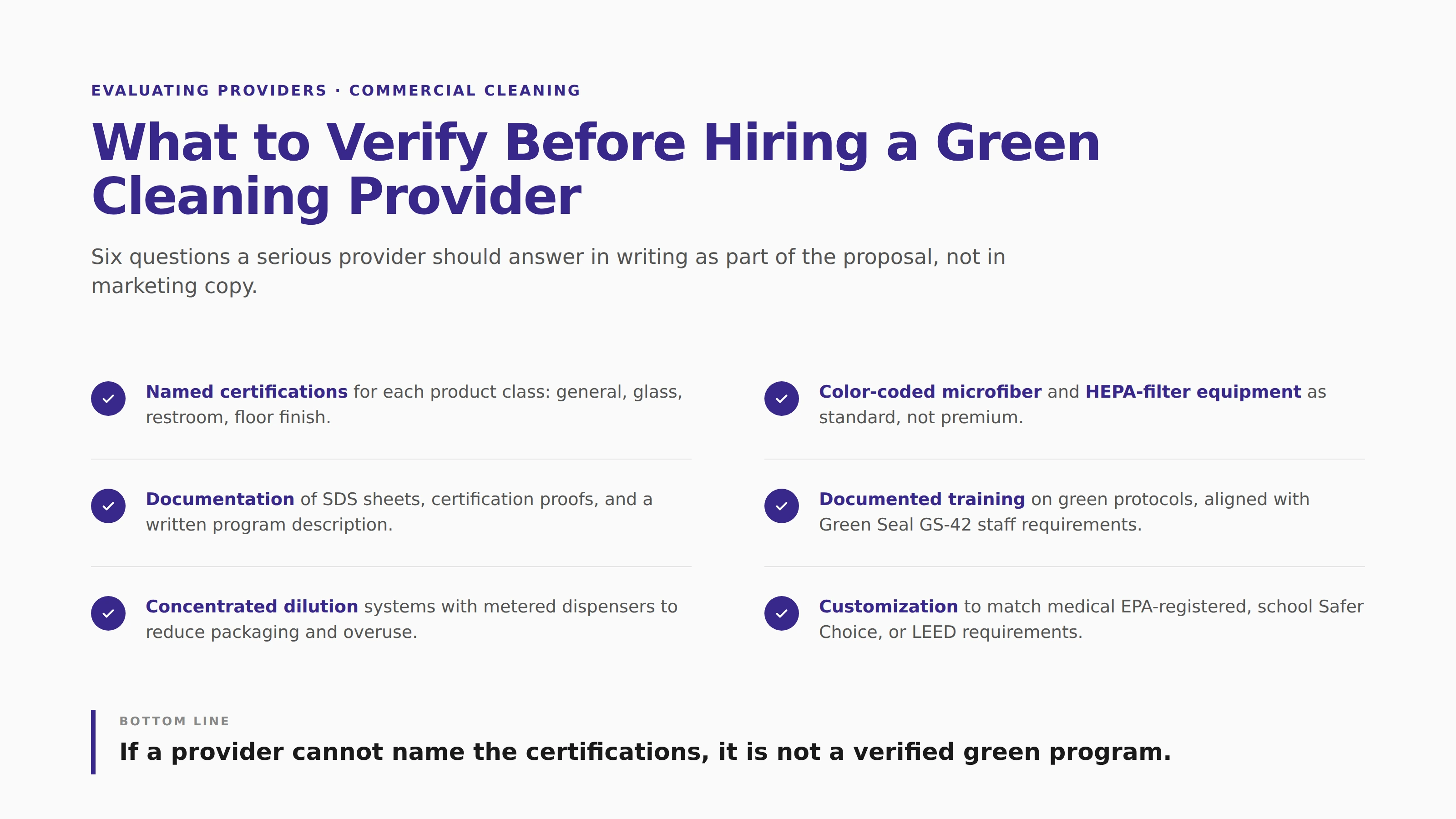
Generic eco-friendly claims are common; verifiable green programs are not. When evaluating a commercial cleaning provider for a green program, ask the following questions and require documented answers.
Which specific certifications cover your products and your service? A provider should be able to name EPA Safer Choice, Green Seal, UL ECOLOGO, or equivalent for each major product class (general cleaner, glass cleaner, restroom disinfectant, floor finish).
Do you use color-coded microfiber and HEPA-filter equipment as a standard? Microfiber captures more contaminants per pass and reduces chemical use; HEPA filtration prevents fine-particulate redistribution. Both should be standard, not premium add-ons.
How do you document compliance for tenant or audit requests? Look for a service that can produce SDS sheets, certification proofs, and a written program description on request. This is essential for LEED, ESG reporting, and procurement audits.
What training do your cleaners receive on green protocols? The Green Seal GS-42 standard requires documented staff training in green cleaning procedures. Ask to see the training program outline.
Are dilution systems concentrated and metered? Concentrate-and-dilute systems reduce packaging, transport emissions, and the risk of misuse from over-application.
Can you customize the program to my facility's specific compliance needs? Medical facilities require EPA-registered disinfectants; schools require Safer Choice products; LEED buildings require Green Seal-aligned operations. A provider should be able to tailor the chemistry mix to your specific requirements.
A serious green provider answers these questions in writing as part of the proposal, not in marketing copy.
Ziva Cleaning Services builds green cleaning programs around the specific compliance needs of your facility, from offices and schools to medical and industrial spaces across Reading, Wyomissing, Exton, Lancaster, and the wider Berks County area. Our team is bonded, insured, and trained on EPA Safer Choice and Green Seal-aligned protocols, and we provide written documentation of certifications and procedures for tenant audits, LEED reporting, and procurement reviews. Get a free on-site assessment and a customized green commercial cleaning proposal.


