

Property management cleaning compliance covers the federal, state, and industry standards that govern how multi-unit buildings are cleaned, including ADA Title III accessibility rules, NFPA 101 Life Safety Code, and EPA health guidance. Property managers share legal responsibility with their cleaning vendors, and documentation is the proof regulators look for first
What "Property Management Cleaning Compliance" Actually Covers
Multi-unit cleaning compliance sits at the intersection of three regulatory zones. Accessibility law (the Americans with Disabilities Act and the Fair Housing Act) governs how cleaning operations must accommodate residents and visitors with disabilities. Life safety code (NFPA 101 and the International Fire Code) governs how cleaning activities affect emergency egress, fire protection, and chemical storage. Health and sanitation standards (EPA mold guidance, OSHA bloodborne pathogen rules, HUD habitability requirements, and state or local health codes) govern indoor air quality and biohazard response.
Property managers cannot delegate ultimate liability to a cleaning vendor. Courts and regulators treat compliance as a shared duty, which means weak vendor documentation becomes the property owner's problem during an audit or a lawsuit. Ziva Cleaning Services builds its professional cleaning programs for multi-unit properties around this shared-liability reality, with written protocols and records that hold up under inspection.
ADA Title III: Accessibility Standards That Apply to Cleaning Operations
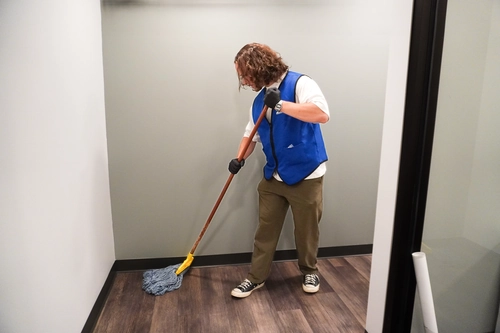
The ADA's structural accessibility rules are well documented, but Title III of the Act (28 CFR Part 36) also applies to how a property is operated, including how it is cleaned. The Fair Housing Act extends similar protections to covered multi-family properties. For property managers, the practical question is not whether the building was built to code, but whether daily cleaning activities preserve the accessibility features the law requires. Our team trains cleaning staff specifically on the accessibility implications of routine work.
Accessible Path of Travel During Cleaning
ADA requires an accessible route from public spaces to all functional areas of a building. Cleaning operations can obstruct that route in ways inspectors and tenants notice. Cleaning carts parked in corridors, buffer machines staged in elevator vestibules, mop buckets blocking restroom approaches, and signage placed in the path it warns about all create accessibility violations even when the underlying construction complies with code.
Two practical rules govern this. First, no cleaning equipment may occupy a 36-inch wide accessible route for longer than the active task requires. Second, when an accessible route must be temporarily blocked, an alternate accessible route must be identified and signed. Property cleaning services working in multi-unit buildings should plan their routes around accessible egress, not against it.
Wet Floor Signage and ANSI A1264.2
Wet floor signs are the most visible cleaning compliance element in any building, and they carry their own standards. ANSI A1264.2, the Standard for the Provision of Slip Resistance on Walking/Working Surfaces, sets expectations for slip and fall hazard marking, including sign placement, color contrast, and visibility from approach distance.
A single wet floor sign in the middle of a wet area is not enough. Signs must be placed at every approach to the wet area so residents and visitors see them before stepping onto the surface, not while standing on it. ADA reinforces this by requiring that warning signage not itself block the accessible route. The wet floor sign that warns of a hazard must not create a new one.
NFPA 101 and Fire Code: Cleaning Without Blocking Egress
NFPA 101, the Life Safety Code, is the most-cited life safety standard in the United States and is adopted by jurisdictions nationwide either directly or through the International Fire Code (IFC). For property managers, the most frequently cited NFPA 101 violations in multi-unit buildings involve egress and storage, both of which intersect directly with how cleaning operations are run. A building can be visibly spotless and still fail an inspection if cleaning practices block egress or store chemicals incorrectly.
Egress Path Obstruction (NFPA 101 Section 7.1.10)
NFPA 101 Section 7.1.10 prohibits any obstruction in the means of egress, defined as the continuous path from any occupied space to the public way. Cleaning operations create egress violations more often than property managers realize. Cleaning carts staged in corridors during overnight service, supply pallets left in stairwells after delivery, waste containers placed in front of fire-rated doors, and equipment chained to handrails for security all constitute obstructions under the code, even if they are removed at shift end.
Fire marshals look for these violations during routine inspections, and tenants increasingly photograph them and submit complaints. The remedy is operational discipline. Cleaning crews must stage equipment in designated storage areas, never in egress paths, and waste must be moved to the loading area or compactor within a defined window after collection.
Cleaning Chemical Storage and Combustibles
Where cleaning supplies are stored matters as much as how the cleaning is done. NFPA 101 and the IFC prohibit storage under stairs, in front of electrical panels, in dedicated egress paths, or within rated assemblies that have not been designed for storage occupancy. Many older multi-unit buildings have janitor closets that grew over time and now violate code in subtle ways.
Common issues include flammable cleaning solvents stored above the threshold quantity for the room's rating, aerosol cans stored near heat sources, gas-powered buffers stored indoors with fuel in the tank, and combustible cardboard or supply packaging stored in volumes that exceed combustible load limits. A vendor that understands NFPA 30 flammable liquid rules and the IFC's storage occupancy classifications will design supply storage that meets code.
Health Standards: Mold, Bloodborne Pathogens, and Indoor Air Quality
Health and sanitation standards form the third compliance pillar, and they create the most direct liability exposure for property managers. Three areas matter most: mold response, bloodborne pathogen cleanup in common areas, and indoor air quality. All three require trained personnel, documented procedures, and clear escalation criteria for when a routine cleaning vendor needs to step back and a specialist needs to step in.
EPA Mold Guidance and the 10 Sq Ft Threshold
The EPA's Mold Remediation in Schools and Commercial Buildings guidance is the de facto reference standard for mold response in multi-unit buildings, and it sets a practical line at roughly 10 square feet of contiguous mold growth. Below that threshold, in-house cleaning staff using EPA-registered disinfectants and proper PPE can typically handle remediation. Above it, professional remediation following the IICRC S520 standard is the recognized industry practice.
Property managers carry liability under HUD habitability standards and most state warranty-of-habitability laws when mold complaints are mishandled. A cleaning vendor without documented mold training should not be removing visible mold growth beyond the threshold. The vendor's role in that scenario is containment, communication, and handoff to a remediation specialist. Failing to make that handoff is the single most common error we see when reviewing other companies' multi-unit cleaning programs.
Bloodborne Pathogen Response in Common Areas
Cleaning services in multi-unit buildings encounter blood, bodily fluids, and sharps far more often than property managers expect. Overdose response in lobbies, injuries on stairs, broken needles in courtyards, and tenant incidents in shared spaces all create bloodborne pathogen exposure scenarios. OSHA 29 CFR 1910.1030 applies to any cleaning worker who could reasonably encounter blood or other potentially infectious materials.
The standard requires an exposure control plan, hepatitis B vaccination availability, bloodborne pathogen training at hire and annually, appropriate PPE, regulated medical waste handling, and post-exposure follow-up procedures. A cleaning service that cannot produce its exposure control plan, training records, and biohazard disposal documentation should not be servicing your common areas.
Indoor air quality compliance overlaps with cleaning through dust management, VOC emissions from cleaning products, and HVAC vent cleaning. ASHRAE 62.1 sets ventilation rates, but cleaning practices determine how well that ventilation actually performs. Green cleaning programs using EPA Safer Choice or Green Seal certified products reduce VOC load and support healthier indoor air.
Compliance Documentation Every Property Manager Should Keep
The single most predictable thing about a compliance audit is that it asks for paper, not promises. Property managers who treat documentation as a checkbox rather than a daily operational output struggle when an inspector, insurer, or attorney requests records.
A multi-unit cleaning program should generate and retain the following at minimum.
Safety Data Sheets for every cleaning chemical in use, available to crew members during every shift (this is a hard OSHA requirement, not a recommendation).
Cleaning logs with timestamps, location, scope of work, and crew member identification.
Incident reports for slip and falls, biohazard responses, mold complaints, chemical spills, and tenant interactions involving safety.
Vendor certificates of insurance with current effective dates and adequate coverage limits.
Vendor training records for OSHA compliance, bloodborne pathogen response, ADA awareness, and equipment certifications. Inspection findings, both internal walk-throughs and external regulator visits, with corrective action documentation.
Most records should be retained for three to five years. Mold and biohazard incident records should be retained longer, often seven years, to align with statute-of-limitations windows. Our service contracts include the documentation structure that satisfies the OSHA and EPA standards for commercial cleaning vendors most jurisdictions require.
Choosing a Cleaning Vendor for Multi-Unit Compliance

The fastest way to identify a compliance-capable cleaning service is to ask for documentation before signing. A vendor that hesitates, defers to a later date, or cannot produce specific records on request is a vendor whose compliance posture is a marketing claim, not an operational reality.
Verify the following before contracting:
Current general liability and workers' compensation insurance, with the property added as additional insured where applicable.
Documented OSHA training, including Hazard Communication and bloodborne pathogen protocols.
Written cleaning protocols specific to multi-unit common areas, not generic commercial cleaning checklists.
EPA-registered disinfectant usage with kill-claim documentation appropriate to the building's risk profile.
Background-checked staff with documented hiring procedures. Incident reporting and escalation procedures.
Common red flags include vendors who cannot produce Safety Data Sheets on the spot, vendors with no written training program, vendors who subcontract without disclosure, and vendors whose insurance certificates expire mid-contract.
Why Choose Ziva Cleaning Services
Our team is certified, bonded, and insured, with documented compliance protocols for multi-unit properties. Our professional property management cleaning services include the documentation structure that supports your audit-readiness, alongside year-round cleaning programs for multi-tenant properties calibrated to your building's compliance profile.
Multi-unit cleaning compliance is more than passing a checklist. It is the documentation, training, and standards your cleaning vendor can produce on demand. Schedule a free on-site assessment to review your building's cleaning program against ADA Title III, NFPA 101, and EPA health code standards, and to see the documentation structure we maintain for every multi-unit property we serve.


