

OSHA and EPA compliance for commercial cleaning requires facilities to meet standards in four areas: hazard communication (29 CFR 1910.1200), sanitation (1910.141), PPE (1910.132), and EPA-registered disinfectant use. Serious violations carry maximum penalties of $16,550 per citation as of January 2026. Ziva Cleaning Services helps facility managers understand what compliance looks like in practice.
What Does OSHA Require for Commercial Cleaning?
The Occupational Safety and Health Administration regulates workplace cleanliness through general industry standards under 29 CFR 1910. For facility managers overseeing commercial cleaning, four standards matter most: Hazard Communication (1910.1200), Sanitation (1910.141), Personal Protective Equipment (1910.132), and Walking-Working Surfaces (1910.22). These apply whether cleaning is performed by in-house staff or an outside vendor.
According to the U.S. Occupational Safety and Health Administration's cleaning industry standards, employers in NAICS code 561720 (janitorial services) are cited most frequently for failures in hazard communication, fall protection, and respiratory protection. When a commercial cleaning company is cited at your building, the facility owner can share liability depending on contract terms and which party controlled the hazard.
For facility managers, OSHA compliance is a shared responsibility that affects insurance, audit outcomes, and worker safety. A provider like Ziva Cleaning Services should produce documented training records, a written hazard communication program, and current safety data sheets on request.
OSHA Hazard Communication Standard (29 CFR 1910.1200)
Hazard Communication, often called HazCom, is the single most-cited OSHA standard in the cleaning industry. The standard requires employers to maintain a written program identifying every hazardous chemical used on site, label all containers consistently, keep current Safety Data Sheets (SDS) accessible to workers during every shift, and train employees on chemical hazards before they work with those products.
The current version of HazCom aligns with the Globally Harmonized System (GHS) for classification and labeling. OSHA finalized updates in 2024, and compliance deadlines are approaching: chemical manufacturers and importers must update labels and SDSs for substances by May 19, 2026, and for mixtures by November 19, 2027. Employers must update their workplace labels, written program, and training by November 20, 2026 for substances and May 19, 2028 for mixtures.
Practical implications for facility managers:
Every cleaning chemical used in your building, from general-purpose cleaners to specialty degreasers, must have a current SDS available on site.
SDSs must be accessible during every work shift, in paper or digital form, without workers needing permission.
Secondary containers (spray bottles filled from a concentrate) must be labeled with the same hazard information as the original.
Workers must be trained on chemical hazards in a language they understand before handling the product.
A provider that cannot produce SDSs for the products their staff uses in your facility is operating in violation of 1910.1200, which creates both vendor and facility liability during an inspection.
PPE Requirements for Commercial Cleaning Staff
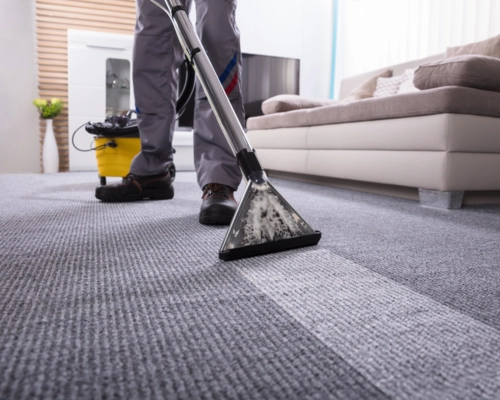
OSHA 29 CFR 1910.132 requires employers to conduct a hazard assessment of every task, provide appropriate personal protective equipment where hazards cannot be eliminated, and train workers on how to use PPE correctly. Our team documents PPE assignments by task category so facility managers can verify what protections are in place for their specific scope of work.
Common commercial cleaning tasks and their typical PPE requirements:
Task | Required PPE |
|---|---|
General surface cleaning with diluted products | Nitrile or latex gloves |
Disinfection with quaternary ammonium or bleach-based products | Chemical-resistant gloves, eye protection |
Floor stripping or wax removal | Chemical-resistant gloves, eye protection, slip-resistant footwear |
Restroom deep cleaning | Chemical-resistant gloves, eye protection, face covering |
Kitchen hood or degreasing work | Chemical-resistant gloves, eye protection, respirator (where applicable) |
Biohazard or bloodborne pathogen cleanup | Full body covering, nitrile gloves, eye protection, fluid-resistant mask |
Under 1910.132, the employer must pay for required PPE. Facility managers evaluating providers should ask: who supplies the PPE, and how is its use verified? A provider that expects cleaning staff to bring their own gloves or skips the documentation step is not compliant.
For a broader look at professional janitorial standards and what they cover, we maintain a separate guide.
Slip, Trip, and Fall Prevention Under OSHA
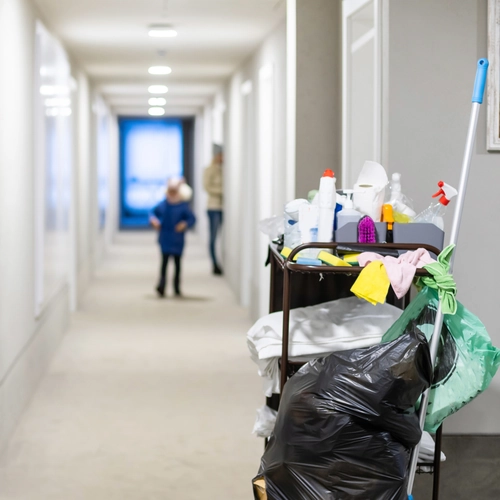
OSHA 1910.22 governs walking-working surfaces and is one of the top-cited standards across industries. The standard requires passageways, storerooms, and walking-working surfaces to be kept clean and sanitary, with floors maintained in a dry condition where feasible. When wet processes are used, the standard requires drainage and dry-standing provisions such as false floors, platforms, or mats.
For cleaning operations, this translates into concrete protocols:
Wet floor signage deployed before mopping begins and left in place until the floor is dry.
Cleaning schedules coordinated with facility hours to minimize wet-floor exposure during peak traffic.
Walk-off matting at entryways to reduce slip hazards from tracked-in water, snow, or debris.
Spill response procedures that remove standing liquid immediately and document the incident.
Facility managers should expect a cleaning provider to maintain a written slip-prevention protocol, not just verbal guidance to staff. During an OSHA inspection following a slip-and-fall incident, the absence of written procedures is itself a compliance issue.
What Does the EPA Require for Commercial Cleaning?
The Environmental Protection Agency regulates the chemicals used in commercial cleaning, particularly any product that claims to disinfect, sanitize, or kill pests. Under the Federal Insecticide, Fungicide, and Rodenticide Act (FIFRA), any product marketed as a disinfectant or sanitizer must be registered with the EPA and display an EPA registration number on its label. Products without an EPA registration number cannot legally make antimicrobial claims.
EPA-registered disinfectants
Every disinfectant used to kill viruses, bacteria, or fungi in your facility must be EPA-registered for that purpose. The label specifies which pathogens the product is approved to kill, the required dwell time, and the surfaces it can be used on. The EPA maintains several product lists, including List N for pathogens of concern. A cleaning provider should identify the EPA registration number of every disinfectant they use and explain the required dwell time.
Safer Choice and DfE programs
The EPA Safer Choice program identifies cleaning products made with safer chemical ingredients. The Design for the Environment (DfE) program does the same for antimicrobial products. Facilities like schools, healthcare offices, and childcare centers often specify Safer Choice products because the certification indicates lower risk to occupants and cleaning staff. EPA updated the Safer Choice Standard in 2024 and introduced a new Cleaning Service Certification for providers using Safer Choice and DfE-certified products as their primary cleaning agents.
Chemical storage and disposal
EPA regulations govern how hazardous cleaning chemicals are stored, handled, and disposed of. Pressure washing runoff, solvent disposal, and bulk storage all carry environmental compliance obligations that can overlap with local and state rules. For facilities governed by food service sanitation standards, EPA requirements intersect with FDA and local health code rules, and providers must demonstrate knowledge of all three.
How OSHA and EPA Compliance Affects Your Cleaning Contract
When evaluating a commercial cleaning provider, facility managers should treat compliance as a baseline qualification, not a bonus feature. A provider that cannot demonstrate compliance on the items below should not be shortlisted, regardless of price.
Before signing a cleaning contract, request the following from every bidder:
Written hazard communication program specific to the products used in your facility.
Current SDS binder or digital access for every chemical brought on site, available during every shift.
Proof of PPE assignment and training for the tasks in the scope of work.
General liability insurance at appropriate limits, plus workers' compensation coverage for all cleaning staff.
Bonding where security-sensitive work is performed (financial, medical, government).
Background check documentation for all staff assigned to the account, particularly in healthcare and educational facilities.
EPA registration numbers and dwell times for all disinfectants on the product list.
We provide professional commercial cleaning services with transparent documentation so facility managers can verify compliance during audits rather than scrambling after a citation.
Common OSHA Violations in Commercial Cleaning
Understanding the most frequently cited violations helps facility managers spot weak points before an inspector does. For businesses under NAICS 561720 (janitorial services), recurring citations fall into five categories:
Hazard Communication (1910.1200). Missing or outdated SDSs, unlabeled secondary containers, no written program, inadequate training documentation.
Respiratory Protection (1910.134). Using products that require respirators without providing them, or without medical evaluation, fit testing, and training.
Walking-Working Surfaces (1910.22). Unmarked wet floors, blocked egress paths, inadequate housekeeping in storage and break areas.
PPE (1910.132). No documented hazard assessment, missing PPE for identified hazards, workers supplying their own protection.
Bloodborne Pathogens (1910.1030). Inadequate exposure control plan for staff who may encounter blood or other potentially infectious materials during cleaning.
As of January 2026, the maximum penalty for a serious violation is $16,550 per citation, and the maximum for willful or repeated violations is $165,514 per citation. A single inspection identifying multiple serious violations can exceed $100,000 in exposure. Penalty amounts are adjusted annually for inflation.
For facility managers overseeing industrial cleaning safety protocols, violations can cascade into general industry citations beyond the cleaning contract itself. A hazard created by a non-compliant cleaning operation that injures a non-cleaning employee is still the facility's problem.
Compliance is not a feature to pay extra for. It is the baseline every commercial cleaning provider should meet before they quote your facility. With more than 14 years of experience serving Pennsylvania businesses, our background-checked, bonded, and insured team documents every element of our OSHA and EPA compliance program so facility managers can verify it rather than trust it. Contact us for a customized estimate to schedule your free on-site assessment.


