

A year-end deep cleaning checklist covers the heavy tasks routine janitorial service skips: floor and carpet restoration, restroom grout, overhead dusting, vents, entrance mats and high-touch disinfection. Schedule it for the holiday closure, and plan for salt and slush, because OSHA 29 CFR 1910.22 requires workplace floors to be kept clean and, where feasible, dry.
This checklist applies to any business in Pennsylvania. Ziva Cleaning Services is a commercial cleaning company based in Reading, PA, with over 15 years of experience. We clean commercial buildings across Berks County, including our Reading service area, and in West Chester, in Chester County, and the scheduling and winter guidance below reflects that operating experience.
What Is a Year-End Deep Cleaning for a Commercial Building?
A year-end deep cleaning is a one-time, scoped restoration of a commercial building, performed after the busy season ends and before the new year begins, that addresses the surfaces and concealed areas nightly janitorial service does not reach: floor finish, carpet fibers, restroom grout, ventilation grilles, light fixtures and the tops of furniture. It does not replace routine service; it resets the baseline that routine maintenance then sustains through winter, and our daily, weekly and monthly task list covers that recurring work.
Routine janitorial service | Year-end deep clean | |
|---|---|---|
How often | Daily to weekly | Once a year, before January |
When it happens | After hours, around staff | During a holiday closure or another low-occupancy window |
Floors | Sweep, mop, vacuum | Scrub and recoat or refinish, carpet extraction |
Reach | Surfaces within arm's reach | Overhead, behind equipment, inside storage rooms |
Goal | Keep the baseline | Reset the baseline |
When Should a Business Schedule Its Year-End Deep Clean?
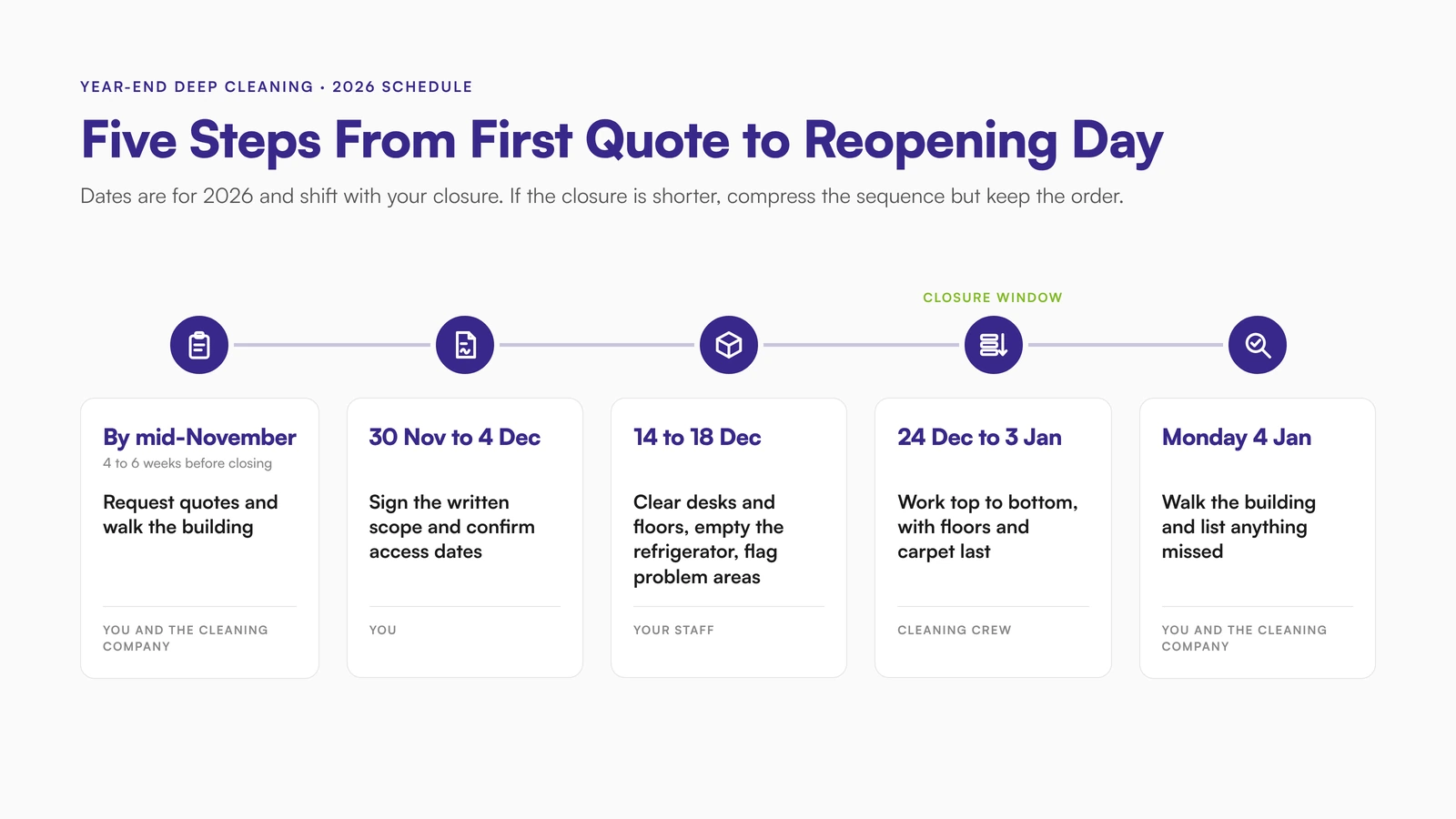
Schedule the work for the longest period in which your building is vacant or lightly occupied, which is often the holiday closure. Because Christmas Day and New Year's Day both fall on a Friday in 2026, a continuous block of days from Thursday 24 December to Sunday 3 January is available to a crew. An unoccupied building allows technicians to relocate furniture, operate floor machines without foot traffic and give new finish adequate time to cure, none of which is practical during a normal overnight shift. Begin planning four to six weeks ahead so that the written scope, access arrangements and a pre-work walkthrough are finalized before the closure starts.
When | Who | What happens |
|---|---|---|
By mid-November, four to six weeks before closing | You and the cleaning company | Request quotes and walk the building |
30 November to 4 December | You | Sign the written scope and confirm access dates |
14 to 18 December | Your staff | Clear desks and floors, empty the refrigerator, flag problem areas |
24 December to 3 January | Cleaning crew | Work top to bottom, with floors and carpet last |
Monday 4 January | You and the cleaning company | Walk the building and list anything missed |
These dates apply to 2026 and shift with your closure. If the closure is shorter, compress the sequence but preserve the order of the stages.
Should the Deep Clean Happen During the Closure or After It?
Both approaches are defensible, and the trade-off is genuine. Cleaning during the closure gives the crew vacant rooms and lets newly applied floor finish cure undisturbed, but grit and dust carried in by returning staff on the first day will undo part of the result. Cleaning during the first week back captures that resettled soil and any winter damage already visible, but occupied rooms restrict floor work and limit noise-generating tasks. A practical compromise is to complete floors and overhead work during the closure and schedule a brief touch-up of entrances and restrooms for the first week back.
What Should a Year-End Deep Cleaning Checklist Include?
This is the complete checklist in the sequence a crew follows it, from the ceiling downward, so that falling dust lands on surfaces not yet cleaned, and the right-hand column indicates which items staff can handle and which require a professional crew with specialized equipment.
Area | Tasks | Who |
|---|---|---|
Ceilings, vents and fixtures | Dust light fixtures, vent covers, return grilles and the tops of cabinets and shelving. Overhead surfaces need extension poles or a lift, as covered in reaching overhead fixtures and vents. | Professional crew |
Windows and glass | Clean interior glass, partitions, entry doors, sills and door tracks | Staff or crew |
Walls, doors and switches | Spot-clean marks, door frames, switch plates and handles | Staff or crew |
Workstations and common areas | Clear and wipe desks, phones, keyboards and chair arms. The crew cleans behind and under equipment and inside storage rooms. | Staff prepare, crew finishes |
Breakroom | Clean inside the refrigerator and microwave, cabinet fronts, the sink and trash bins | Staff or crew |
Restrooms | Scrub tile and grout, descale fixtures, clean partitions, dispensers and floor drains | Professional crew |
Upholstery | Vacuum and spot-treat lobby seating and chairs | Professional crew |
Hard floors | Scrub and recoat, or strip and refinish where the finish is worn through, so the new coat can cure over the closure | Professional crew |
Carpet and mats | Hot water extraction for entrance carpet and traffic lanes, plus laundering or replacing mats | Professional crew |
High-touch surfaces | Disinfect door handles, switches, handrails, shared equipment and restroom fixtures, after cleaning | Crew, final step |
The sequence matters. Debris from every task performed above floor level settles on the floor, so floors and carpet are always completed last. Disinfection follows everything else because a disinfectant belongs on a cleaned surface, and EPA's six-step guidance on disinfectant use says to pre-clean any surface that is visibly dirty or whose label calls for pre-cleaning. Follow the label's contact time as well: the same guidance says the surface should remain wet for the whole contact time.
How Do Pennsylvania Winters Change a Year-End Deep Clean?
Road salt and ice-melt compounds are the principal difference, because once tracked indoors they leave a white residue that degrades floor finish and penetrates carpet fibers, and the cumulative damage increases throughout the season. A year-end cleaning should therefore begin winter with restored finish and effective entrance matting rather than attempt to repair both in March. Three elements belong in the scope:
Floor finish. Recoat worn traffic lanes during the closure so the new coat cures before heavy winter foot traffic returns. Remove residual salt with a neutral floor cleaner or a neutralizer formulated for ice melt, because plain damp mopping redistributes the film instead of lifting it.
Entrance matting. Install two mats in series, a coarse scraper mat outside and an absorbent wiper mat inside, with sufficient combined length that most people take several steps across them. Replace saturated mats promptly rather than allowing them to hold water against the floor.
Carpet. Extract entrance and corridor carpet so that dissolved salt is flushed from the fibers instead of remaining in them and accelerating wear.
Wet entrances are also a compliance matter. The same OSHA standard lists snow, ice and spills among the hazards from which walking-working surfaces must be kept free, so a dry, well-matted entrance protects employees as well as flooring.
How Does a Year-End Deep Clean Differ by Industry?
The core checklist applies to every building, and each industry adds one or two specialized tasks that reflect how its occupants use the space and which standards govern it.
Industry | Add to the checklist |
|---|---|
Office | Printer stations, document storage rooms and conference tables. Clear client files before the crew arrives and leave them in your own storage. |
Medical practice | Exam rooms and waiting-room seating, cleaned and disinfected under the practice's own infection-control plan. Agree access to records areas with the practice manager beforehand. |
Restaurant | Kitchen hood and exhaust cleaning. NFPA 96 ties how often exhaust systems must be inspected to cooking type and volume, so check your inspection interval and schedule cleaning against it instead of waiting for year-end. |
Industrial and warehouse | Overhead dust on beams and racking, loading dock floors and equipment cleaning, planned around the production shutdown. |
Retail | Fixture tops, fitting rooms and entrance glass before the post-holiday returns rush. See our week-by-week holiday plan for stores. |
What Can Staff Handle, and When Do You Need a Professional Crew?
Staff can prepare the building, and a professional crew should handle any task requiring equipment, chemicals or work above floor level. Staff responsibilities include clearing desks and floors, emptying refrigerators, removing perishables and trash, labeling equipment that must not be moved and noting problem areas. A professional crew handles floor refinishing, carpet extraction, restroom grout restoration, overhead and lift work and final disinfection, because those tasks require machines, trained operators and surface-appropriate products.
Put the scope in writing before work begins. Price follows scope: labor, supplies, equipment and the actual time each task consumes all sit behind a quote, so the productive question is what standard of cleanliness the building requires. We put every scope in writing and agree it before a single shift is worked. A written scope for a year-end deep clean specifies each area, the tasks within it, the access dates, who signs off at completion and how missed items are handled.
Because cleaning quality cannot be judged from a walkthrough before you hire, evaluate the process instead: a signed scope, a named supervisor and a closing walkthrough on the day you reopen, at which every area is inspected against the written scope.
Where Do We Provide Year-End Deep Cleaning?
We provide year-end deep cleaning for commercial buildings in Berks County, Reading and West Chester. If your building is elsewhere in Pennsylvania, the checklist above still applies and can serve as the basis for scoping the work with a local provider. For buildings within our service area, we begin with a free on-site assessment, agree the scope in writing and schedule the crew around your closure dates, holiday weeks included. Schedule your free on-site assessment.


