

A final clean walkthrough is the inspection a contractor runs after the cleaning crew finishes and before the owner or code official arrives. Walk nine zones top to bottom, test each against a pass or fail standard, photograph every miss, and collect a written sign-off. Also ask how floors were cleaned, because OSHA 29 CFR 1926.1153(f) restricts dry sweeping.
This guide is for general contractors, superintendents and project managers closing out commercial work. Ziva Cleaning Services provides commercial post-construction cleaning in Reading and Berks County, and the checklist below is built around what a contractor needs to verify before putting a name on the handover. It gives you nine zones with a pass standard for each, a log for deficiencies, and a method for separating cleaning misses from trade defects.
When Is a Space Ready for the Final Clean Walkthrough?
A space is ready for inspection once the cleaning is complete and no remaining activity can recontaminate it. Walking too early means logging deficiencies that the next trade will recreate, while walking with the lighting or air handling off hides the particulate film and haze that only appear under working conditions. Confirm the five conditions below before anyone picks up a clipboard.
Condition | Why it matters |
|---|---|
Trades are off site and no work is under way | Anything still in progress will leave new dust and debris after you sign. |
Permanent power and lighting are on | Glass, fixtures and finishes can only be judged under the light the tenant will use. |
HVAC is running in normal operation | Air handlers redistribute fine construction dust, so a space that passes with the system off can show a film once it cycles. |
Every room is unlocked and reachable | Mechanical, electrical and janitor closets are part of the walk, and nothing gets skipped by default. |
The cleaning scope and punch list are on paper in your hand | You are checking the work against what was agreed, not against memory. |
The walkthrough sits between the end of the final clean and the first visit from the owner or the code official, and it assumes the rough and final stages were completed in sequence; how the rough and final stages differ explains that sequence if you need a refresher. Airborne dust is the reason the HVAC condition matters, and why dust control matters after construction covers the background. If the walkthrough precedes a code inspection, how occupancy inspections work in Berks County explains what the official verifies after you.
Who Should Walk the Space?
The contractor's superintendent or project manager leads the walk, and the cleaning crew's supervisor attends so that every deficiency is assigned to a named party before anyone leaves. Our crews complete a quality-control check against a checklist, with supervisor approval, before the client walkthrough, so the space you inspect is one we have already inspected ourselves.
Contractors disagree about whether a closeout needs one walkthrough or two. The case for a single walkthrough with the owner present is genuine: it produces one list, one conversation, and a shared view of the condition of the space. The case against it is that every deficiency the owner discovers first is counted against the contractor. We recommend an internal walk first, with findings logged and corrected, followed by the walk with the owner, so that the owner's inspection confirms the work instead of discovering it.
What Do You Need to Carry?
Six items cover the whole walk:
An angled flashlight: Light raked across a surface at a low angle shows film, haze and streaks that overhead light hides.
A white cloth for wipe tests on ledges and sills.
Painter's tape to mark each miss where it sits.
A camera. A phone is enough.
The floor plan, to number zones and give every miss a findable location.
The closeout scope and punch list, so you inspect against what was agreed.
The Final Clean Walkthrough Checklist
Use this table as the walk itself. Each row names what to inspect and the standard that counts as a pass, so a miss is a documented fact rather than an opinion. The table covers inspecting and accepting the finished work; for the list of tasks the crew performs, see the cleaner's task-by-task checklist.
Zone | What to inspect | Pass standard |
|---|---|---|
1. Overhead | Ceiling grid and tiles, diffusers and return grilles, light fixtures and lenses, exposed structure | No visible film or debris on grid edges or grille faces, and none inside lenses |
2. Walls, doors and trim | Door faces and frames, hinges and hardware, baseboards, wall surfaces | No smears, tape, adhesive or dust lines, and hardware free of residue |
3. Glass and frames | Interior and exterior glass, sills, window tracks, frames | Streak-free under angled light, no labels or stickers, tracks clear of grit |
4. Floors | Hard floors, carpet, thresholds, corners and edges | No grit underfoot, no residue at edges or thresholds, no tracked footprints |
5. Restrooms | Fixtures, mirrors, partitions, dispensers, floor edges | No residue inside fixtures, no film on mirrors or partitions |
6. Millwork and casework | Counters, cabinet interiors, drawers, shelving | Inside surfaces free of dust and shavings, no adhesive on faces |
7. Back of house | Mechanical, electrical and janitor closets, stairwells, loading areas | Swept clear, with no packaging or stored debris |
8. Horizontal surfaces, high and low | Ledges, sills, rails, door-frame tops, equipment tops, anything below knee height | A white cloth drawn across the surface comes away clean |
9. Left-behind items | Protective covers on devices, packaging, spare materials | Nothing remains that is not meant to stay |
On floors, ask how the work was done as well as how it looks. OSHA's construction silica standard, 29 CFR 1926.1153(f)(1), says the employer shall not allow dry sweeping or dry brushing where that activity could contribute to employee exposure to respirable crystalline silica, unless wet sweeping, HEPA-filtered vacuuming or other methods that minimize the likelihood of exposure are not feasible. A short question to the crew supervisor about floor method belongs in every walkthrough.
Zone 8 is the one that settles arguments. Draw the white cloth along a ledge at eye level and again below knee level, since both are easy to skip on a fast walk, and treat any gray transfer onto the cloth as a failure regardless of how the surface looked from standing height.
Zone 9 holds items that are not cleaning at all. Protective covers on smoke detectors and caps on sprinkler heads belong here because they can stop an inspection, and they should be routed to the responsible trade before the owner or the code official sees them.
How Should You Route the Walk?
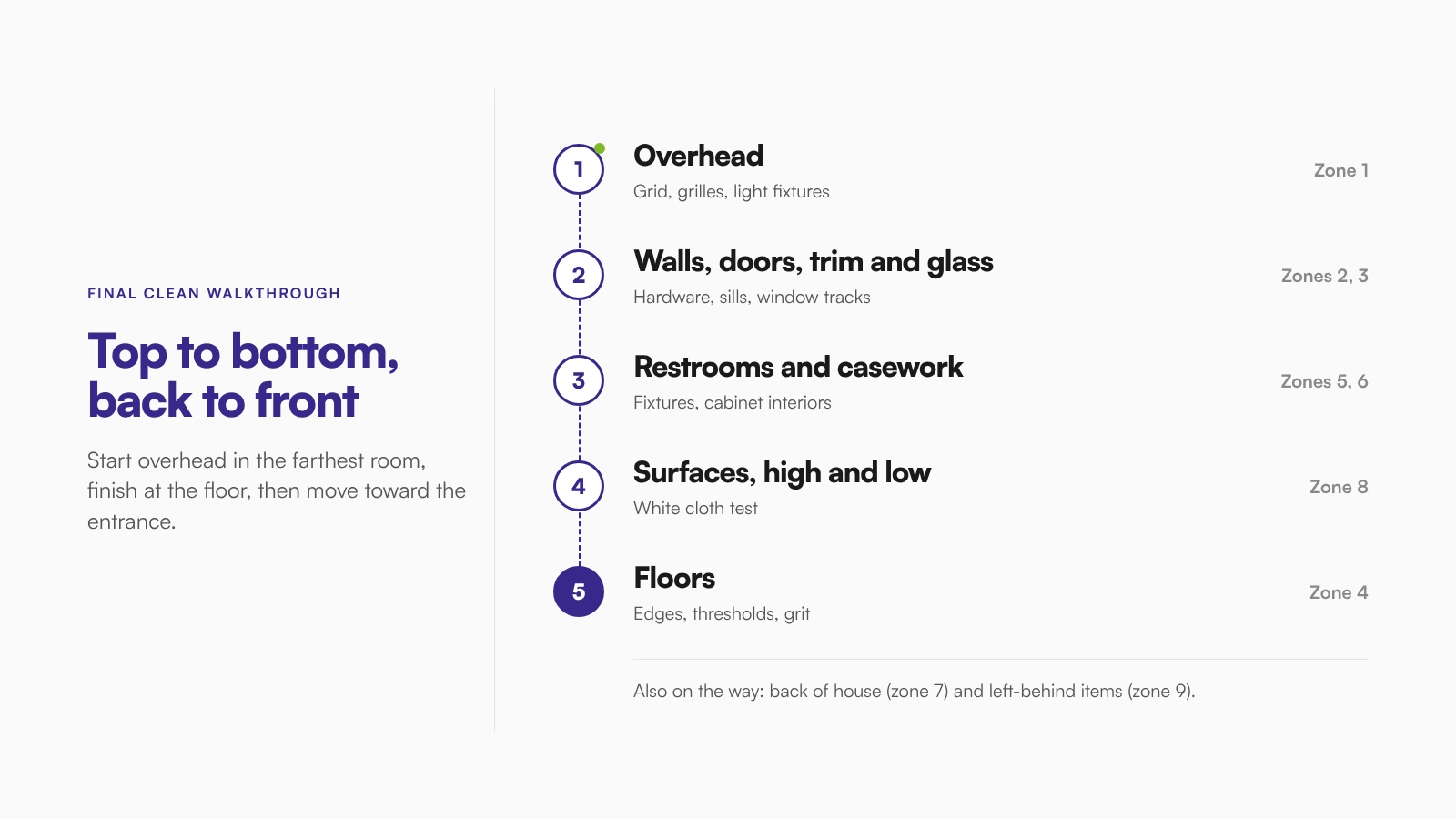
Walk top to bottom and back to front: start overhead in the farthest room, work down through walls, glass and surfaces, finish at the floor, and move toward the entrance so that you never cross a floor you have already inspected. Take the flashlight into every room even when the lighting is on, because angled light is what reveals film and haze.
How Do You Log Deficiencies?
Log every deficiency the moment you find it, so the touch-up crew works from a written list rather than from memory. Use one line per item, with a location someone else can find, a photo number, a description and a single named owner. The log below shows the format with example entries rather than entries from a real project.
Item | Location | Photo | What was found | Who fixes it | Re-checked |
|---|---|---|---|---|---|
1 | Room 204, ceiling grid | IMG 0412 | Dust film on the top edge of three tiles | Cleaning crew | Pending |
2 | Lobby, door D-3 glass | IMG 0415 | Adhesive residue from a label, lower left | Cleaning crew | Pending |
3 | Room 210, window W-2 | IMG 0419 | Scratch in the glass that cleaning cannot remove | Glazing trade, punch list | Pending |
The third row shows why the log matters: not every deficiency belongs to the cleaner, and marking trade defects when you find them routes them to the punch list instead of back to the cleaning crew.
Is It a Cleaning Miss or a Trade Defect?
Closeout disputes usually reduce to one question: whose item is this? Sorting each deficiency at the walkthrough keeps the cleaning crew from re-cleaning what cleaning cannot correct, and keeps genuine trade defects from being lost.
Cleaning miss | Trade defect (punch list) | Decide in the scope |
|---|---|---|
Dust film on ledges and grid edges | Chipped or scratched finishes | Grout haze |
Mop streaks and floor residue | Scratched or cracked glass | Paint overspray on glass |
Adhesive from labels and tape | Unfinished caulk or touch-up paint | Protective-film residue |
Debris in closets and stairwells | Damaged hardware | Stains from trade materials |
The third column is where disagreements start, because the answer depends on what each contract says. Specify in writing before the job which party removes grout haze, paint overspray and protective film; how to choose a construction cleaning company covers the scope questions worth asking at the contract stage.
What Happens After a Failed Walkthrough?
A failed walkthrough is a normal part of closeout, and the corrective sequence is short:
Touch up the logged items.
Re-inspect only those items.
Sign the sheet.
Re-walking the entire building wastes the day and invites new objections, so the log is what keeps the second inspection narrow. For tenant fit-outs where a second pass is built into the plan, see two-pass cleaning for tenant fit-outs.
The sign-off sheet should record four things:
The date of the walkthrough
The areas accepted
Any exceptions, listed with their log numbers
Signatures from the contractor and the cleaning supervisor
Settle two questions in the scope before the job rather than at the walkthrough: whether re-cleaning of walkthrough deficiencies is included, and who is responsible if a later trade soils an area that has already been signed off. Neither answer is universal, so write it down.
What to Track and What to Ignore
Track the number of items logged per walkthrough, the items that repeat across zones, and whether re-inspection cleared them; repeats point to a method problem rather than a missed spot. Ignore crew headcount, hours on site and square feet covered per hour, because those measure activity and none of them shows whether the space passed.
Closing Out a Commercial Project in Berks County?
Schedule your free on-site assessment and we will look at the space, the schedule and your closeout scope together.


