

Build-out cleaning is the cleanup of a tenant fit-out inside a building that is still operating, which makes it different from cleanup on a vacant site. OSHA 29 CFR 1926.1153 prohibits dry sweeping where it could raise silica exposure, so the work runs on HEPA vacuuming and wet methods instead.
What Makes Build-Out Cleaning Different From Cleaning an Empty Site?
On a ground-up project, the building is empty and the cleaning crew has the run of it. A tenant fit-out is the opposite situation. The suite next door is open for business, the shared HVAC system is running, and the corridors and elevators carry customers and staff all day.
That single constraint changes the whole job. Dust cannot be allowed to migrate past the work zone. Loud or dust-heavy tasks have to fit into windows when the neighbors are closed. Debris cannot be staged in a shared corridor. A crew that treats a fit-out like an empty shell will generate complaints from tenants who have no involvement in the project and no patience for it.
Standard construction cleanup services still apply underneath all of this, and the rough and final cleaning stages still structure the work. The difference is that every step has to be planned around people who are trying to work, shop, or see patients twenty feet away.
How Do You Clean a Build-Out Without Disrupting Open Tenants?
There is a published standard for this. The Sheet Metal and Air Conditioning Contractors' National Association issues IAQ Guidelines for Occupied Buildings Under Construction (ANSI/SMACNA 008-2007), and Chapter 3 defines six control measures for construction work in occupied space. Ziva Cleaning Services builds fit-out scopes around that framework rather than improvising containment on site.
Control measure | What it means on a retail or office fit-out |
|---|---|
HVAC protection | Supply and return vents in the work zone sealed before any dry cleanup begins |
Source control | HEPA vacuuming and wet methods in place of sweeping or compressed air |
Pathway interruption | Barriers, door seals, and tacky mats at every zone exit |
Housekeeping | Debris removed at the end of each shift rather than stockpiled to the end of the job |
Scheduling | Dust-generating tasks moved into after-hours or weekend windows |
Occupant relocation | The last resort when containment cannot hold the dust |
The equipment those measures require is straightforward: HEPA-filtered vacuums, air scrubbers or negative air machines vented away from occupied areas, zippered barriers and poly sheeting, and tacky mats replaced on a set schedule rather than when someone notices they are dirty. What matters is that the containment is set up before the first pass, not added after a neighboring tenant complains.
Why Does Construction Dust Spread Beyond the Suite?
Fine construction dust does not stay where it is made. It moves through shared return-air paths, plenum spaces above a dropped ceiling, gaps under doors, and on the boots and carts of every trade walking in and out. Drywall dust in particular stays airborne long enough to travel well past the work zone, then settles slowly over days.
This is why a single clean at the end of a fit-out rarely holds. Dust that migrated into the plenum or the ductwork keeps returning to horizontal surfaces for weeks afterward, which reads to the tenant as a cleaning failure even when the final clean was done properly. Containment during the work is what prevents that, and it is the part most often skipped. Our team treats it as the first line item on a fit-out scope, not an add-on. The same principle drives why construction dust control matters on any project, and it carries into the inspection: what Berks County code officials check before signing off on occupancy includes fire and life-safety components that residual dust can obscure.
What Does OSHA's Silica Rule Prohibit During Cleanup?
Cutting, grinding, or drilling concrete, masonry, tile, and some engineered surfaces produces respirable crystalline silica, and the cleanup of that debris is regulated. OSHA 29 CFR 1926.1153 prohibits dry sweeping and dry brushing where the activity could contribute to silica exposure, unless wet sweeping or HEPA-filtered vacuuming is not feasible. The same paragraph prohibits using compressed air to clean surfaces unless it is paired with a ventilation system that captures the resulting dust cloud.
Both of those methods, the push broom and the air hose, are the fastest way to clear a floor and the two most common defaults on a job site. On a fit-out inside an occupied building they are also the two most reliable ways to send silica into a neighbor's air supply.
When Should Build-Out Cleaning Be Scheduled Around Fixture Installs?
Most fit-out schedules budget one clean at substantial completion, and most of those schedules end up paying for a second one anyway. Fixtures, millwork, casework, and furniture all arrive after the trades finish, and every one of those installs generates its own packaging waste, drill dust, and adhesive residue.
Planning two passes from the start costs less than booking one and reacting to the mess the installers leave. It also matters for inspection, because the space a code official walks is the space after the installs, not before.
The Pre-Fixture Clean
This pass happens after the trades are out and before anything gets installed on the floors, walls, or ceilings. It covers overhead surfaces first, then walls, then floors: duct grilles, light fixtures, exposed structure, window frames, and the full floor deck. Cleaning overhead work after fixtures are set means cleaning around obstacles and re-cleaning everything underneath them.
The Pre-Opening Detail Clean
This pass happens after fixture and furniture installation is complete. It covers glass, fixture surfaces, restrooms, appliance interiors, remaining adhesive and label residue, and the floor finish. This is the clean the tenant, the landlord, and the inspector actually see, and it is the one that determines whether the space reads as finished.
How that sequence plays out depends on what the space is going to be.
What Does Retail Build-Out Cleaning Involve?
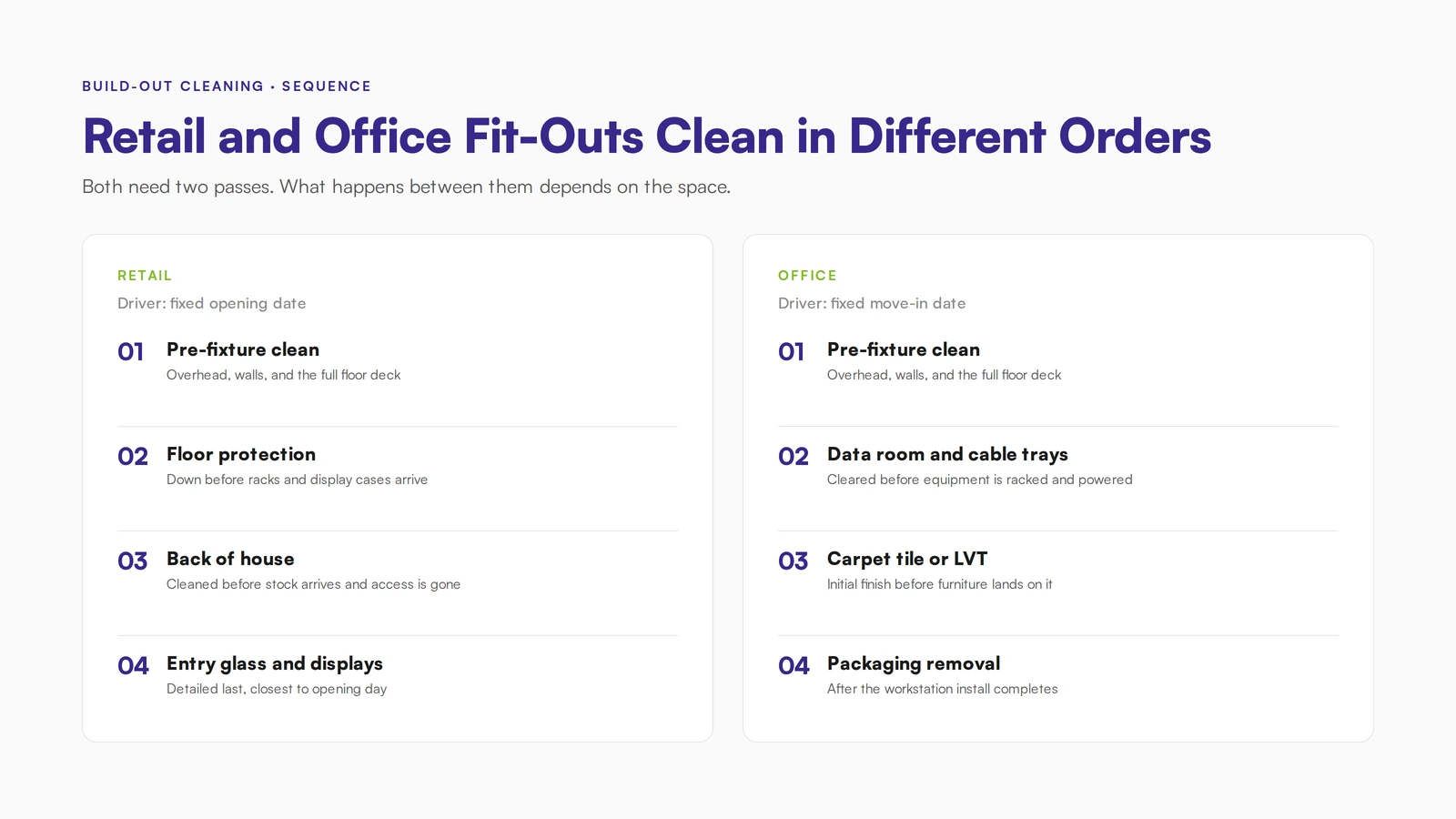
A retail fit-out runs against a fixed opening date, and everything sequences backward from it. Floor finish protection goes down before the fixture crew arrives, because gondolas, racks, and display cases scratch a new floor faster than anything else in the process. The pre-fixture clean has to be complete before that protection is installed, since anything left under it stays there.
Back-of-house gets cleaned before stock arrives rather than after, when the stockroom is full and access is gone. Entry glass, storefront windows, and display cases get detailed last, closest to opening, because they collect fingerprints from every person still working in the space. Once the store is open, the cleaning shifts to an ongoing retail cleaning program built around trading hours.
What Does Office Build-Out Cleaning Involve?
An office fit-out runs against a move-in date and a different set of details. Data rooms and cable trays collect drywall dust that has to be removed before equipment is racked and powered, and that cleaning has to be coordinated with the IT installer rather than scheduled against them.
Carpet tile and luxury vinyl tile both need an initial clean and finish before furniture lands on them. Workstation and systems furniture installs generate a substantial volume of cardboard and film packaging, which is why the second pass exists. After the move-in, the space transitions to recurring office cleaning on a schedule that fits the tenant's hours.
How Much Does Build-Out Cleaning Cost?
Fit-out cleaning is priced the same way as other construction cleanup, by square footage and by the level of detail the space needs. Standard post-construction cleaning runs $0.15 to $0.40 per square foot and deep cleaning runs $0.50 to $0.90 per square foot, with most commercial projects landing between $2,000 and $5,000 or more depending on size and finish level.
Two factors push a fit-out toward the upper end. Containment equipment and after-hours scheduling both add cost that a vacant-site project does not carry. A two-pass sequence is also two line items rather than one. Where a given project lands inside those bands depends on the finish level and on how much of the square footage needs deep-clean detail rather than standard cleanup.
Who Handles Permits and Inspections for Wyomissing Fit-Outs?
Wyomissing Borough routes commercial building permits, code review, and permit-related inspections through Kraft Municipal Group, with commercial zoning matters handled by McCarthy Engineering. Property owners are directed to contact the commercial zoning officer before starting a project to confirm whether a permit is required.
For a tenant working in a Wyomissing retail corridor or office building, the practical effect is that the cleaning schedule has to be set against the inspection schedule rather than assumed around it. Booking the detail clean after the final install and before the inspection walkthrough is what keeps the two from colliding.
Schedule a Free Build-Out Cleaning Assessment
Every fit-out has a different footprint, finish level, and set of neighbors to work around, which is why fit-out cleaning is quoted after a walkthrough rather than from a price list. Ziva Cleaning Services offers free on-site assessments across Wyomissing and Berks County. Get a free quote and we will scope the containment, the sequence, and the passes your project needs.


