

Grease trap maintenance is the scheduled removal of fats, oils and grease before they reach the sewer line. Most FOG programs require service once grease and solids reach 25% of a trap's liquid depth. The EPA attributes 47% of reported sewer blockages to grease, and a single restaurant generates between 800 and 17,000 pounds of it annually.
What that figure does not establish is which party is accountable for which portion of the system. That is the question most kitchen managers in Berks County actually need answered, and it is the one almost nobody writes about.
How Often Should a Restaurant Grease Trap Be Cleaned?
The governing standard across most municipal FOG programs is the 25% rule: service the trap once the grease layer and the solids layer together occupy a quarter of the total liquid depth. The calculation is straightforward.
(grease layer depth + solids layer depth) ÷ total liquid depth
When that figure reaches 0.25, the trap is due. In practice this usually corresponds to roughly three inches of accumulated floating grease, though the measurement is what governs, not the estimate.
Intervals vary by the type of device your kitchen runs:
Device type | Typical maximum interval |
|---|---|
Indoor units under 100 gallons | Inspect weekly to monthly; empty fully at least monthly |
Indoor hydromechanical interceptors | At least monthly, unless you can demonstrate the 25% threshold is not reached |
Outdoor gravity interceptors, 500 gallons and up | Pump and inspect at least quarterly |
Automatic grease removal devices | Daily, per manufacturer specification |
These intervals are maximums rather than recommendations, and municipal FOG programs such as the City of Lawrence interceptor maintenance standard require operators to shorten them wherever grease or deposits appear downstream of the device.
The trap itself is only one part of the system. For restaurants and commercial facilities across the borough, the grease that reaches the trap has already travelled through a drain network that needs its own attention, which is where most operators lose ground.
Who Services What: Staff, Cleaners, Plumbers and Haulers
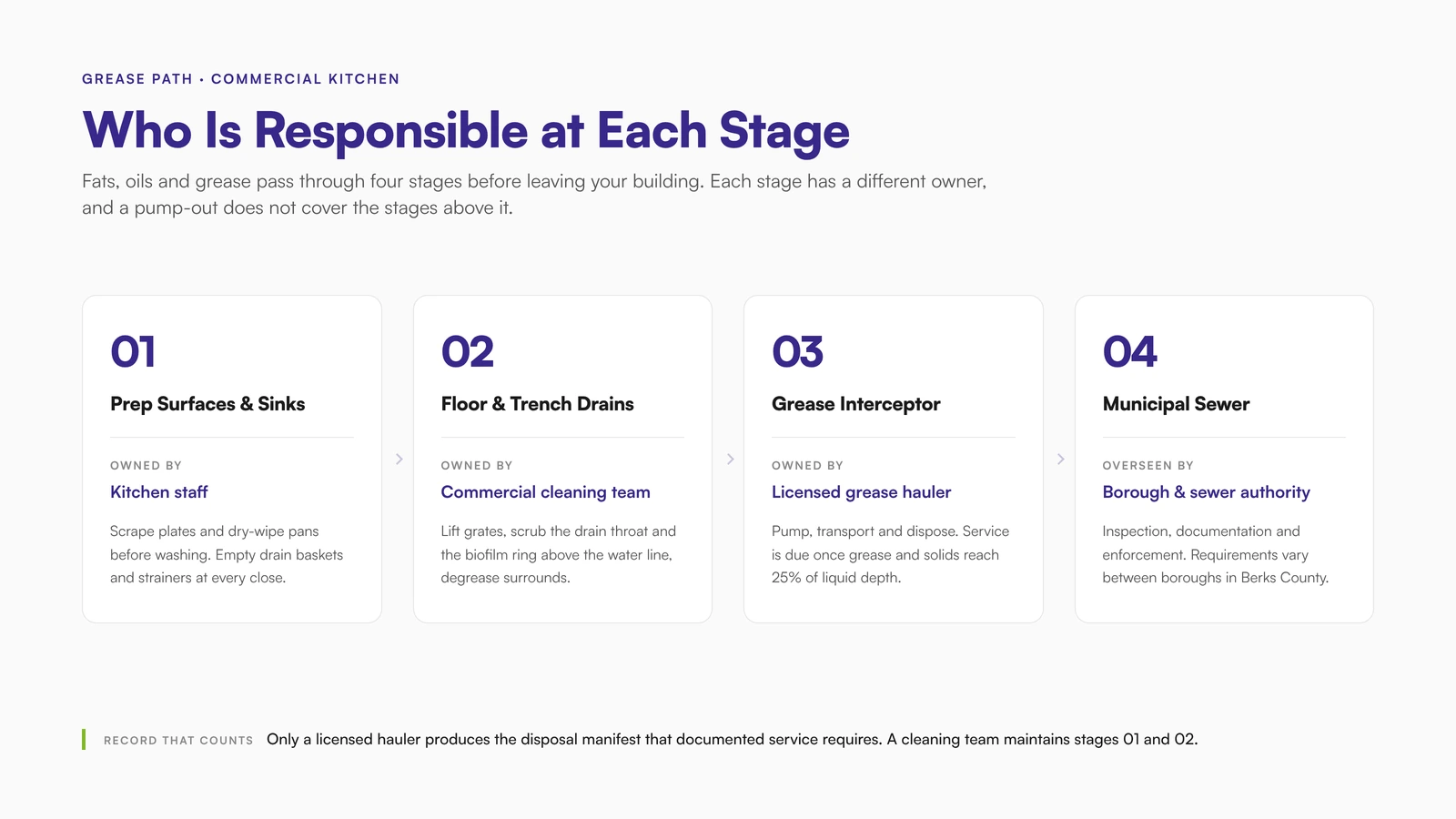
This is the part the rest of the internet leaves out. Four different parties touch grease in a commercial kitchen, and each has a different scope, a different qualification, and a different record requirement.
Task | Closing staff | Commercial cleaning team | Licensed plumber | Licensed grease hauler |
|---|---|---|---|---|
Scrape and dry-wipe before washing | ✓ | |||
Empty and clean drain baskets and strainers | ✓ | |||
Scrub floor drains, grates and drain throats | ✓ | |||
Degrease floors, coving and grout around drains | ✓ | |||
Clean trench drains and dish pit surrounds | ✓ | |||
Skim small point-of-use traps | ✓ | ✓ | ||
Pump and haul interceptor contents | ✓ | |||
Manifest and dispose of grease waste | ✓ | |||
Clear a blocked or backed-up drain line | ✓ | |||
Repair, resize or reinstall a trap | ✓ | |||
Keep the on-site maintenance log | ✓ | ✓ |
What a commercial cleaning team covers
Ziva Cleaning Services does not pump grease traps. Pumping an interceptor is licensed liquid-waste work that ends in a manifested disposal record, and it belongs with a hauler who can produce that paperwork. Any vendor who blurs that line is one you should ask harder questions of.
What our team does own is everything upstream: the floor drains, the trench drains, the dish pit, the mop sink, the grates and baskets, and the surfaces around them where grease migrates and sits. That work is what determines how fast your trap fills, and it is the part of an ongoing back-of-house cleaning program that most kitchens under-resource.
What requires a licensed hauler
Pump-outs, transport and disposal. The hauler's manifest, showing service date and receiving facility, is the document an inspector asks for. A cleaning performed by your own staff generally does not satisfy a professional service-record requirement, so if your municipality requires documented service, the hauler visit is the one that counts.
Why Your Floor Drains Matter More Than Your Grease Trap
The trap is the last line of defense. The drain network is where the problem is actually won or lost, and it is almost entirely absent from the published guidance on this topic.
Grease does not arrive at the trap as a clean slug of liquid. It travels through floor drains, trench drains, the dish pit and the mop sink, cooling and adhering as it goes. Inside those drains, a biofilm ring forms on the wall just above the standing water line. That ring is the part a hose rinse never reaches, because the water passes straight through the middle.
That biofilm is what produces the odor at the front of house, what sustains drain fly populations, and what a health inspector identifies when they lift a grate. None of those symptoms originate in the interceptor, and consequently none of them are resolved by pumping it.
Effective drain work means lifting grates rather than rinsing through them, removing and scrubbing baskets, mechanically scrubbing the drain throat and the wall above the water line, and degreasing the surrounding floor, coving and grout where migrating FOG collects. The exhaust side of the same grease problem is covered separately in our guide to hood and exhaust system servicing.
What Drain Flies and Kitchen Odors Are Telling You
Operators rarely go looking for a grease problem. They notice a symptom and work backward. Here is where each one usually leads.
What you notice | Where it usually starts | Who resolves it |
|---|---|---|
Small flies near the dish pit or bar | Biofilm in a floor drain, not the trap | Commercial cleaning team |
Sour odor at the host stand or dining room | Dry or fouled floor drain trap seal | Commercial cleaning team |
Dish pit draining slowly | Partial line restriction downstream | Plumber, after drain cleaning is ruled out |
Standing water at a trench drain | Blocked grate or line, or an overfull interceptor | Cleaning team first, then hauler or plumber |
Grease visible at the trap outlet | Interceptor past the 25% threshold | Licensed hauler |
Inspector flags the floor around a drain | Grease migration into coving and grout | Commercial cleaning team |
The pattern worth noticing: most of what gets reported as a "grease trap problem" is a drain problem, and paying for a pump-out does not resolve it. That is how restaurants end up in a repeat-call cycle, treating the same symptom at the wrong layer.
Which Rules Apply to Wyomissing Restaurants
Two things make Wyomissing different from Reading, and both are worth knowing before you assume a rule applies to you.
Inspection: Reading and Muhlenberg Township employ their own food safety inspectors. Everywhere else in Berks County, Wyomissing included, retail food inspections are conducted by the Pennsylvania Department of Agriculture, and the resulting reports are published on the department's retail food inspection portal. Guidance written for city restaurants is therefore describing a different inspecting authority and a different enforcement process than the one that will arrive at your kitchen.
Sewer: Wyomissing's wastewater is treated at the Wyomissing Valley plant, operated by the Joint Municipal Authority of Wyomissing Valley under NPDES permit PA0026638. The Pennsylvania DEP permit fact sheet identifies Wyomissing Borough as the plant's largest single contributor, and records that the same facility also serves West Reading, Shillington, Mohnton, Spring Township and Cumru Township. That document notes no required federal pretreatment program at the plant, which means your obligations originate in borough ordinance and the plumbing code rather than in a plant-level FOG program.
Requirements vary borough to borough even among municipalities discharging to the same treatment plant. West Reading, immediately adjacent and served by the same facility, requires under Chapter 363 § 363-21 of its borough code that food service facilities install an interceptor at their own expense, service it quarterly or more frequently at the code enforcement officer's direction, and submit a certification accompanied by the hauler's manifest by January 30 and July 30 annually. The borough conducts no fewer than two inspections each calendar year, timed to coincide with those submissions.
The practical step: call Wyomissing Borough and ask three questions. What interval applies to my facility, what documentation do you require and when, and are additives permitted on this system.
A Daily, Weekly and Monthly Kitchen Drain Schedule
Prevention advice usually arrives as five loose bullets. What a kitchen with staff turnover actually needs is an assignment with an owner on every line.
Frequency | Task | Owner |
|---|---|---|
Every shift | Scrape and dry-wipe pans and plates before washing | Line and dish staff |
Daily, at close | Pull and empty drain baskets and strainers | Closing staff |
Daily, at close | Flush floor drains and verify nothing is standing | Closing staff |
Daily | Verify the log was signed | Closing manager |
Weekly | Lift grates, scrub drain throats and the ring above the water line | Cleaning team |
Weekly | Degrease floor, coving and grout around all drains | Cleaning team |
Monthly | Deep clean trench drains and dish pit surrounds | Cleaning team |
Monthly | Measure the trap against the 25% threshold and record it | Manager or hauler |
Per municipal interval | Pump, haul and manifest | Licensed hauler |
Twice yearly | Confirm filings are current with the borough | Owner or manager |
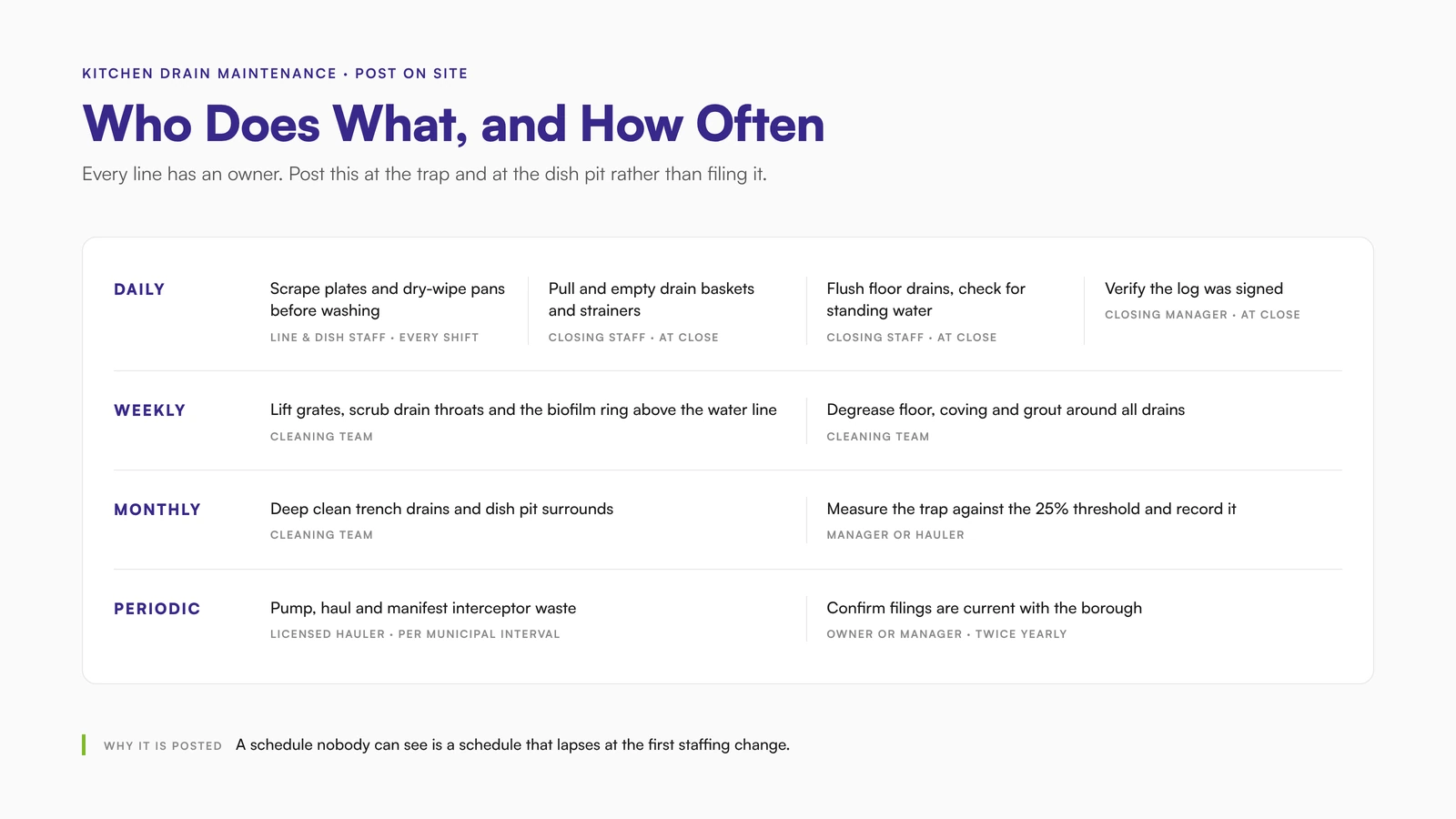
Post it at the trap and at the dish pit rather than filing it. A schedule nobody can see is a schedule that lapses at the first staffing change. For the wider front and back of house routine this sits inside, see our full restaurant task list.
What a Defensible Service Record Looks Like
Municipalities that require documentation want more than an assertion that the work happened. A record that holds up contains the service date, the device serviced, the volume removed, the name and license of the hauler, the receiving disposal facility, and a signature.
Keep the log on site rather than at a corporate office or in a vendor's portal, because the inspection happens in your kitchen. Retain at least two years unless your municipality specifies longer. The first thing most inspectors ask for is the most recent manifest, and the second is the one before it, because the interval between them is what demonstrates compliance.
Do Enzymes and Bacterial Additives Work?
The guidance here genuinely conflicts, and the conflict is worth understanding rather than resolving with a blanket answer.
Chemical manufacturers promote bacterial dosing as a way to extend the interval between pump-outs. Some municipal FOG programs restrict or prohibit additives outright, on the reasoning that an emulsified grease load does not disappear, it simply moves further down the line and becomes the treatment plant's problem instead of yours.
Two practical cautions. First, permitted or not is a question for your own sewer authority, and the answer is local. Second, some haulers treat additive use as grounds to dispute a service record, so confirm before you start a dosing program rather than after. Additives are not a substitute for mechanical cleaning in any case. Nothing dissolves the need to physically remove what has accumulated.
Get a Free Kitchen Assessment
If you are uncertain where your current coverage ends and your hauler's responsibility begins, that gap is usually identifiable in a single walkthrough. Our team has maintained Berks County kitchens for more than 14 years with background-checked, insured technicians and customizable plans structured around your service hours. Schedule a free on-site assessment and we will map your drain network, document what we cover, and tell you plainly what belongs with a licensed hauler instead.


