

Warehouse cleaning services in Berks County, PA keep distribution center floors, rack bases, shipping areas, restrooms, and break rooms clean on a schedule built around shifts rather than a fixed calendar. The need is large here: transportation, warehousing, and utilities accounted for 11,100 jobs in Berks County in April 2026, according to the county's monthly labor force report.
Ziva Cleaning Services is a family-owned commercial cleaning company based in Reading, and we have cleaned Berks County facilities for more than 14 years. This guide explains what a warehouse cleaning program should cover zone by zone, how shifts and peak season change the schedule, how floor finish changes the method, and where a cleaning crew's job ends. It is written for operations managers and EHS leads running distribution centers along the county's freight corridors.
What Do Warehouse Cleaning Services Include?
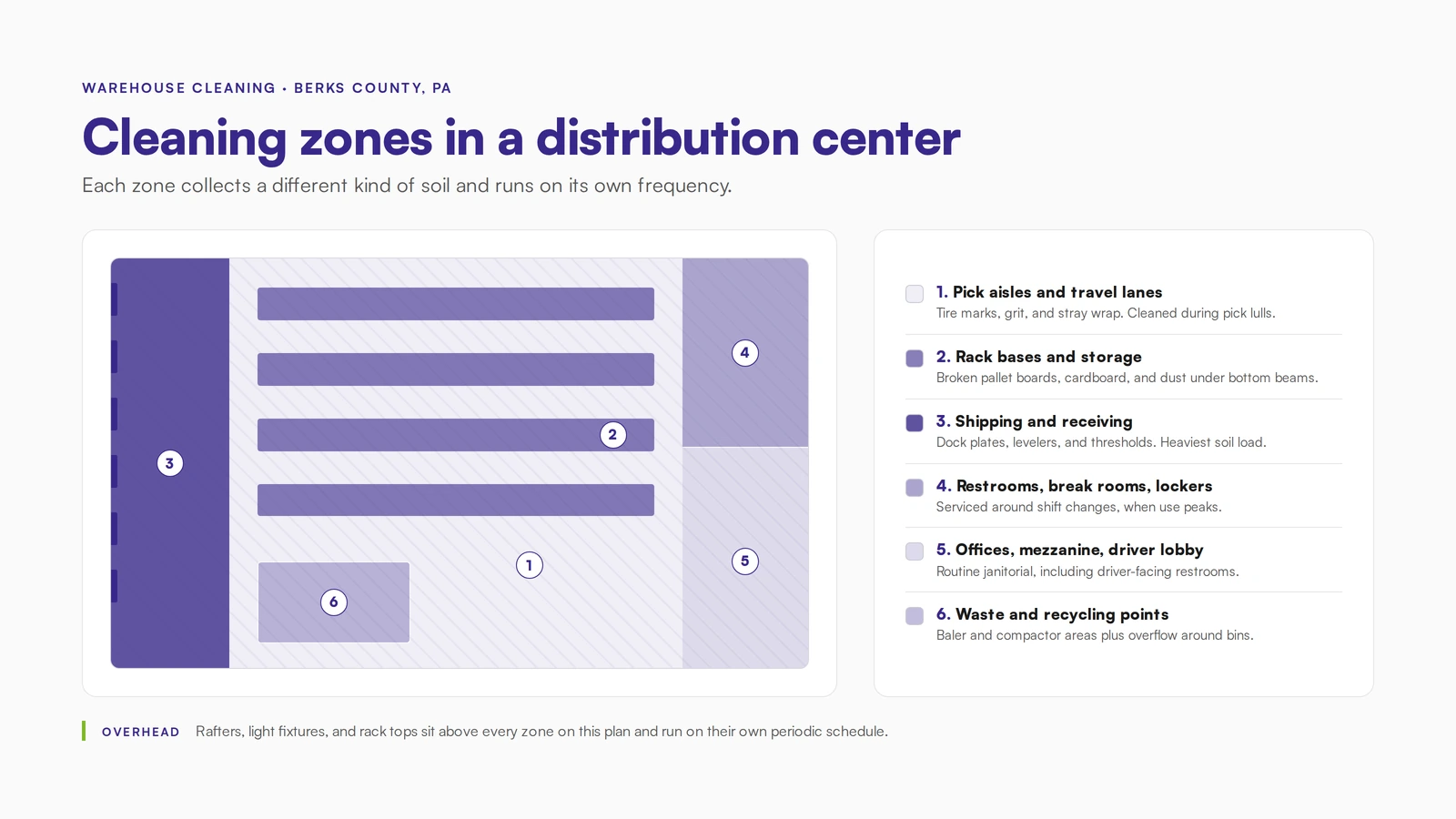
A warehouse cleaning program is a set of zones, and each zone collects a different kind of soil: pick aisles collect tire marks and stray stretch wrap, rack bases collect broken pallet boards and cardboard, and restrooms absorb most of a shift's traffic in the minutes around each changeover. Scoping by zone is what lets a provider staff and schedule the work accurately, and it is how we build our industrial cleaning services for distribution center accounts.
Zone | What gets cleaned |
|---|---|
Pick aisles and travel lanes | Sweeping, auto-scrubbing, tire mark removal, and spill response |
Rack bases and storage areas | Broken pallet pieces, stretch wrap, cardboard, and dust under bottom beams |
Shipping and receiving | Staging lanes, dock plates, levelers, and door thresholds |
Restrooms, break rooms, and locker areas | Disinfection, restocking, trash removal, and floor care |
Offices, mezzanines, and driver lobbies | Routine janitorial work, including driver-facing restrooms |
Overhead structure | Rafters, light fixtures, ductwork, and rack tops on a periodic schedule |
Waste and recycling points | Baler and compactor areas, cardboard staging, and overflow around bins |
Rack bases deserve more attention than they usually get. OSHA 29 CFR 1910.176(c) requires storage areas to be kept free of accumulated materials that create tripping, fire, explosion, or pest harborage hazards, and the debris that gathers under bottom beams is exactly that kind of accumulation. It also tends to be missed, because a crew focused on open aisles rarely reaches under loaded racking unless the scope names it.
Two zones work better as separate line items: shipping and receiving carries a heavier soil load than the rest of the floor, so dock plates, levelers, and aprons get their own methods and intervals. Overhead dust on rafters, light fixtures, and rack tops requires lifts and fall protection planning, so it runs on a periodic schedule rather than as part of the routine warehouse janitorial crew's nightly work.
What Makes Berks County Distribution Centers Harder to Keep Clean?
Freight volume is the main reason, and Berks County's Long Range Transportation Plan identifies Routes 422, 222, and 61 as the county's primary inter-county truck freight corridors and reports that trucks make up 45 percent of traffic on its section of I-78. The same plan expects warehouse and distribution center development along I-78 in Berks to keep growing as sites to the east become harder to find. Every trailer and every shift that moves through those buildings brings grit, packaging waste, and foot traffic with it.
Operating hours compound the problem. A distribution center running two or three shifts has no quiet overnight window of the kind an office building offers, so cleaning happens while the building is working, using zoned cleaning around live equipment adapted to aisles and staging lanes. Winter adds a Pennsylvania-specific layer: road salt and slush ride in on boots through personnel entrances and on tires from the docks, leaving a chloride film that damp mopping alone tends to spread rather than remove. For how the rest of the county's plants and processors approach industrial cleaning, see our guide for Reading facility managers.
How Often Should a Distribution Center Be Cleaned?
The right frequency depends on how hard each zone works rather than on a calendar, since a single-shift bulk storage building and a three-shift fulfillment center can share the same square footage and need different schedules. We set distribution center cleaning frequency zone by zone during the walkthrough, using the drivers below.
Zone | What sets the frequency |
|---|---|
Pick aisles and travel lanes | Number of shifts and the density of forklift and pallet jack traffic |
Rack bases | Pallet turnover and how much wrap and cardboard the pick process generates |
Shipping and receiving | Daily trailer volume and weather |
Restrooms and break rooms | Headcount per shift and the number of shift changes per day |
Offices and driver lobbies | Visitor and driver traffic |
Overhead structure | Dust generated by product and packaging, and how sensitive stored product is to settling dust |
Product type raises the baseline for every zone, because food, beverage, and pharmaceutical storage often carries customer or auditor requirements that set minimum cleaning intervals regardless of traffic, so those requirements should be written into the scope before the schedule is built. For task lists at each interval, a task-by-task industrial checklist is a practical starting point that can then be tuned to the drivers above.
Frequency is something to revisit rather than set once, since restroom complaints clustered around shift changes, tire marks that return within a day of scrubbing, and visible dust on stored cartons are all signs that a zone's interval no longer matches its workload. Reviewing those signals quarterly keeps the schedule aligned with how the building actually runs.
How Do Cleaning Crews Work Around 24/7 and Multi-Shift Operations?
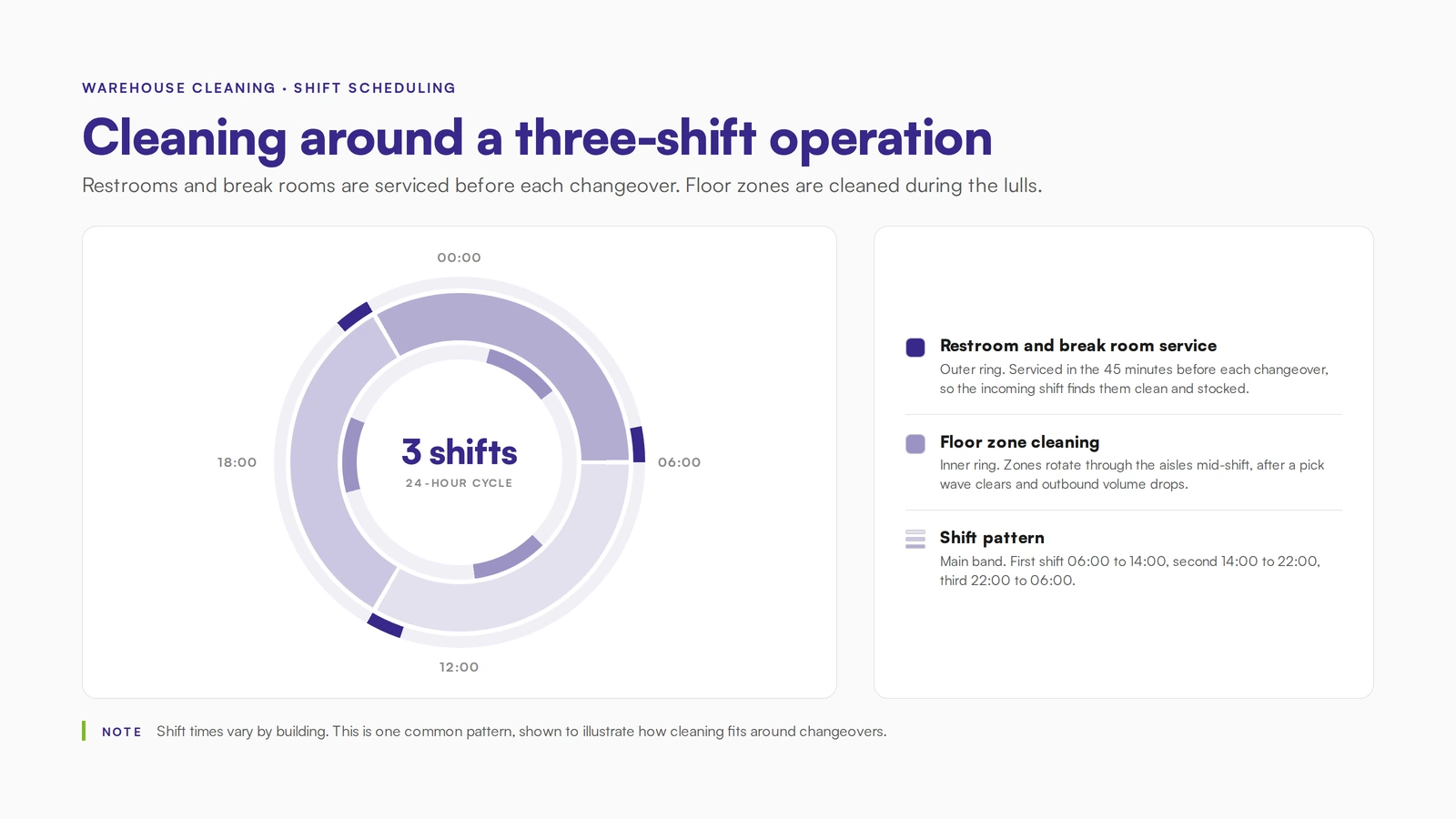
In a building that never closes, cleaning has to fit into the operation's rhythm rather than wait for it to stop. Our team runs overnight and shift-change crews for distribution center accounts, and each site plan is built from its shift schedule, pick waves, and dock appointments, and three practices keep that work from slowing the floor down.
Build the Plan Around Shift Changes
Restrooms and break rooms see their heaviest use in the minutes around a shift change, when one crew is leaving and the next is arriving. Servicing those rooms just before each changeover means the incoming shift finds them clean and fully stocked. Floor zones are scheduled for the lulls instead, such as the stretch after a pick wave clears or the hours when outbound volume drops.
Rotate Floor Zones With the Pick Schedule
Large floors are cleaned in sections rather than all at once, with a zone rotation that follows the pick path so the crew is always working an area that is idle for that window and moves on as activity shifts. It is the same zoned approach manufacturing plants use around live production lines, applied to pick aisles and staging lanes.
Keep Crews and Forklifts Apart
Separation is planned before the shift rather than improvised during it: crews barricade the zone they are working, stage carts and scrubbers outside travel aisles, and place wet floor signs before any wet work begins, which also keeps aisles clear of obstructions as OSHA 29 CFR 1910.176(a) requires. Each shift opens with a check-in with the shift supervisor to confirm which aisles are live and where trailers are moving.
What Changes About Warehouse Cleaning During Peak Season?
Peak season changes the load on every zone that people touch: nationally, transportation and warehousing employers added 303,700 seasonal jobs in the fourth quarter of 2024, according to a Challenger, Gray & Christmas analysis of BLS data. More people per shift means restrooms and break rooms need restocking more often, trash and cardboard volumes climb, and entry mats saturate faster.
In Berks County, peak also runs into the start of winter, so salt and slush arrive just as headcount rises. The practical adjustments are to add restock rounds at each shift change, increase pickups around balers and compactors, and put extra entry mats into rotation. Adding a day porter during peak shifts means spills and overflowing bins get handled while the floor is running rather than at the next scheduled clean. Planning these changes in early fall, before seasonal hiring starts, avoids renegotiating the scope in the middle of the rush.
How Does Floor Type Change Warehouse Floor Cleaning?
Most distribution centers sit on concrete, but concrete finishes are not all maintained the same way. The finish determines the pad, the chemistry, and the balance between sweeping and scrubbing, and the wrong choice can dull a polished floor or wear through a coating, which is why we confirm the finish during the walkthrough before any equipment is specified.
Bare or sealed concrete: Sweeping removes dry debris first, then auto-scrubbing lifts tire marks and grime. This is the most forgiving finish, but unsealed slabs absorb spills quickly, so fluid drips need prompt attention.
Densified or polished concrete: Daily dust removal matters most, because grit acts as an abrasive that dulls the polish over time. Auto-scrubbing uses a pH-neutral cleaner and soft pads, since strongly acidic or alkaline products can etch the surface.
Coated floors (epoxy or urethane): Cleaning follows the coating manufacturer's care guidance on chemistry and pads. We clean coated floors, but installing or recoating them is a separate trade.
Forklift drips need their own step regardless of finish: hydraulic fluid and oil spots are treated with a degreaser before the scrubber passes, otherwise the machine spreads a thin film across the aisle and creates a slip hazard where there was only a spot. Checking forklift parking and charging rows first, where drips concentrate, keeps the rest of the aisle network cleaner between scrubs.
Where Does a Warehouse Cleaning Crew's Job End?
A clear scope protects both the facility and the crew. Some conditions in a warehouse call for the facility's own trained staff or a licensed specialist, and a well-written cleaning contract names them so that nobody improvises. These are the boundaries most distribution centers should define:
Battery charging and changing areas: Where batteries are changed or serviced, OSHA 29 CFR 1910.178(g)requires facilities for flushing and neutralizing spilled electrolyte. Electrolyte spills belong to the facility's trained personnel using that equipment, while the cleaning crew handles general housekeeping in the area and reports any spill it finds.
Hazardous material spills: Chemicals stored as product follow the site's own spill response procedures, not the routine cleaning scope.
Damaged racking: Bent uprights or beams are reported to the shift supervisor and left in place for inspection, not cleared around or moved.
Pest activity: Droppings or signs of nesting are reported so a licensed pest control operator can respond.
Forklift washing: Washing the forklifts themselves follows its own procedure and is scoped separately from floor care.
Writing these lines into the scope at the start keeps responsibilities clear on every shift. It also gives supervisors a simple rule for new hires and temporary staff during peak: report it, do not handle it.
Schedule a Free Walkthrough of Your Distribution Center
Every distribution center runs on its own shift pattern, product mix, and floor finish, so a cleaning plan should start with a walk through the building. Our team will map your zones, shift changes, and peak season needs, then build a schedule that works around the operation instead of interrupting it. Our crews are certified, bonded, insured, and background checked, and as a family-owned company you work directly with ownership rather than a call center. Schedule your free on-site assessment to see what warehouse cleaning built around your shifts looks like.


