

High dusting is the removal of dust, cobwebs, and debris from surfaces above normal reach: structural beams, ductwork exteriors, light fixtures, sprinkler heads, and exposed conduit. Because OSHA requires fall protection in general industry at 4 feet, most of this work sits outside what a standard janitorial crew is equipped to reach safely.
What Is High Dusting?
High dusting targets the horizontal surfaces a facility's daily cleaning routine never touches. Dust settles on every flat plane in a building, but only the ones at eye level get wiped. Everything above accumulates undisturbed, sometimes for years.
The standard scope covers:
Ceiling tiles, grids, corners, and suspended fans
Structural beams, joists, trusses, and rafters
Exteriors of ductwork, pipes, and electrical conduit
Light fixtures, exit signs, and ceiling-mounted speakers
HVAC diffusers, return grilles, and vent covers
Sprinkler heads and fire suppression piping
Ledges, soffits, door frame tops, and tall shelving
The exclusions matter just as much. High dusting does not cover duct interiors, which is a separate mechanical service, or exterior building surfaces. It is also distinct from post-construction cleanup, which remediates a one-time debris event rather than ongoing settled particulate. High dusting is one of several specialty cleaning services that sit alongside a recurring janitorial contract rather than inside it.
How High Does a Surface Have to Be for High Dusting?
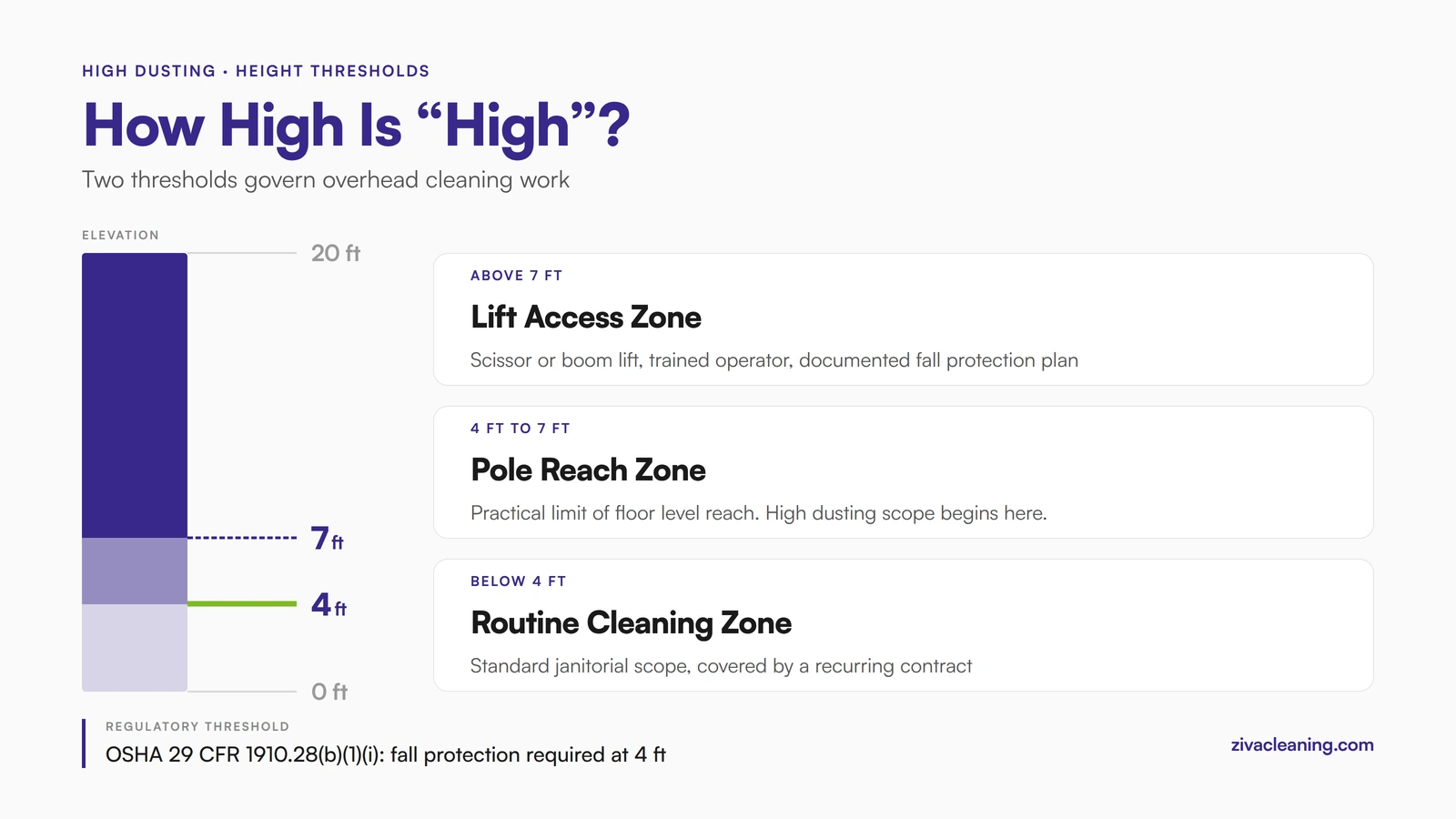
Two thresholds matter, and they answer different questions.
The regulatory threshold is 4 feet: Under 29 CFR 1910.28(b)(1)(i), general industry employers must provide fall protection for any employee working on a walking or working surface with an unprotected edge 4 feet or more above a lower level. That number governs how the work gets crewed, what equipment comes on site, and what training the technicians need. It is the line that separates routine cleaning from work with a documented safety plan.
The practical threshold is roughly 7 feet: Below that, a technician can reach the surface from the floor with a standard duster or a step stool, and the task folds into normal cleaning. Above it, reaching the surface requires either an extension pole system or elevated access, which changes the tools, the time, and the crew size.
The gap between those numbers is where most scoping confusion lives. A surface at 8 feet sits out of arm's reach but does not put a worker at height if it is cleaned from the ground with a pole. A surface at 20 feet on an open-deck warehouse ceiling almost always does. The height of the surface determines the method; the height of the worker determines the safety requirement.
High Dusting vs. Regular Dusting vs. Air Duct Cleaning
Facility managers routinely conflate these three services when scoping work. They address different surfaces and produce different results.
Regular Dusting | High Dusting | Air Duct Cleaning | |
|---|---|---|---|
What it covers | Desks, sills, low surfaces under 7 feet | Overhead structure, fixtures, duct exteriors | Interior of supply and return ductwork |
Typical frequency | Daily to weekly | Quarterly to annually | Every 3 to 5 years |
Equipment | Microfiber cloths, standard dusters | Extension poles, HEPA high-reach vacuums, lifts | Negative air machines, rotary brushes |
Who performs it | Janitorial crew | Trained specialty crew | HVAC or NADCA-certified contractor |
Included in janitorial contract? | Yes | Usually no | No |
A recurring janitorial contract handles the first column, while the second requires a separate line item, which is precisely why it gets overlooked; the third is a mechanical trade rather than a cleaning service. Any proposal that bundles all three under one heading warrants questioning before signing, and a detailed commercial cleaning checklist makes the boundaries between daily, weekly, and periodic work explicit.
Why Overhead Dust Is a Safety Problem, Not a Cosmetic One
Dust on a beam reads as a housekeeping issue. In several facility types it is a fire and air quality issue first.
Settled dust does not stay settled. HVAC cycling, door swings, forklift traffic, and vibration from production equipment all re-entrain particulate into the breathing zone, where it circulates until it deposits somewhere else. That cycle is a measurable contributor to indoor air quality in offices and a persistent complaint source in buildings where the floors are spotless and the air still feels stale.
Accumulation also degrades equipment. Dust on light fixtures reduces lumen output and traps heat; dust drawn into HVAC returns loads filters faster and extends run times. Neither surfaces as a line item until something fails.
The Combustible Dust Threshold Most Facilities Never Check
The recognized housekeeping action level is a dust layer of approximately 1/32 inch, roughly the thickness of a paper clip, across 5 percent or more of a room's floor area, with accumulation below 1/64 inch generally treated as negligible. The underlying concern is secondary explosion: a small primary ignition event sends a pressure wave through the space, lifts years of settled dust off the overhead structure, and generates a fuel cloud considerably more destructive than the original event.
The governing document has changed recently, and much of the published guidance has not caught up. NFPA 660, Standard for Combustible Dusts and Particulate Solids, took effect December 6, 2024 and consolidated six predecessor standards: NFPA 61, 484, 652, 654, 655, and 664. Any guidance still citing NFPA 652 or 654 as current is referencing a superseded document.
What makes this directly relevant to high dusting is the surface list. The legacy standard language named ledges, beams, ducts, pipes, hoods, and spaces above suspended ceilings as the surfaces where accumulation must be controlled. That is the high dusting scope, written into a fire standard. Facilities running woodworking, metal processing, food production, agricultural handling, or plastics operations should treat overhead cleaning as part of their industrial cleaning program rather than an appearance item.
What Tools Do Cleaners Use for High Dusting?
The tool has to match the surface, or the job creates a bigger mess than it removes.
Surface | Tool | Why it works |
|---|---|---|
Ceilings, walls, open structure | Telescoping pole with microfiber head | Traps particulate instead of pushing it airborne |
Pipes, conduit, ductwork exteriors | Static or bristle brush attachment | Conforms to round surfaces and lifts bonded dust |
Heavy accumulation, beams, joists | HEPA-filtered high-reach vacuum | Captures at the source rather than displacing |
Light fixtures, diffusers, delicate surfaces | Microfiber sleeve, low-pressure wipe | Cleans without scratching or damaging finishes |
High-bay ceilings above pole reach | Scissor or boom lift with trained operator | Provides a stable working platform at height |
The distinction that matters most is capture versus displacement. Compressed air and dry brushing relocate dust from the beam into the air, where it redeposits on inventory, work surfaces, and floors. HEPA-filtered extraction removes it from the building. In occupied spaces, clinical environments, and food production, capture is the only defensible method.
How Often Should a Facility Schedule High Dusting?
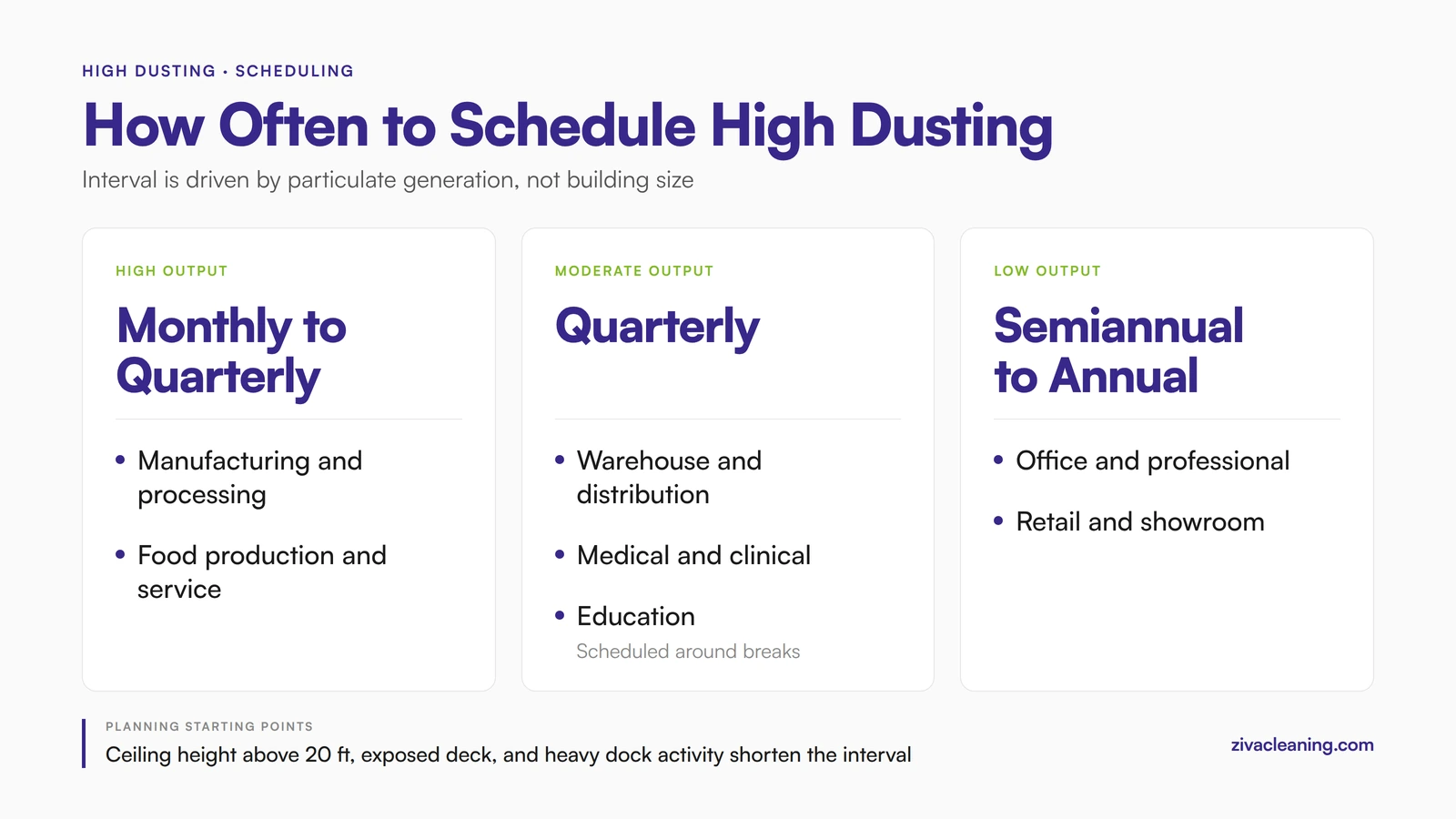
Frequency is driven by how fast a facility generates airborne particulate rather than by the calendar, which is why two buildings of identical square footage can need service six months apart.
Facility type | Typical planning interval | Primary driver |
|---|---|---|
Warehouse and distribution | Quarterly | Forklift traffic, open deck structure, dock door airflow |
Manufacturing and processing | Monthly to quarterly | Process dust generation, combustible load |
Medical and clinical | Quarterly | Infection control, air handling requirements |
Food production and service | Monthly to quarterly | Contamination risk, regulatory inspection |
Office and professional | Semiannual to annual | Low particulate generation, closed ceilings |
Retail and showroom | Semiannual | Visible merchandising surfaces, customer perception |
Education | Semiannual, scheduled around breaks | Occupancy density, access windows |
Treat these as planning starting points, not fixed rules. Conditions that compress the interval include ceiling heights above 20 feet, exposed structural deck, heavy dock door activity, aging or undersized HVAC, and any process that grinds, cuts, mixes, or conveys dry material.
Renovation deserves its own trigger. Construction drives fine particulate into overhead structure that no daily routine reaches, which is why dust control after construction and a follow-up high dusting pass belong in the same project budget.
How Professional High Dusting Is Done, and Why Order Matters
Ziva Cleaning Services approaches high dusting as a sequenced process rather than a single task. Skipping steps is what turns a half-day job into a two-day recovery.
Assessment: Map accumulation zones, measure heights, and identify obstructions such as live electrical, sprinkler heads, and sensitive equipment, which together determine access method and crew size.
Isolation and protection: Section off the work area, cover inventory and finished surfaces below, and confirm access routes are clear.
Top-down execution: Work downward in zones: ceilings and structure first, then fixtures and duct exteriors, then ledges and upper shelving.
Floor recovery: Everything released from the overhead structure lands below, so the floor pass runs last, once the dust has settled.
Verification: Inspect each zone against the accumulation map from step one, using lighting adequate to reveal what was missed.
Sequencing is the step most often ignored. High dusting has to precede floor care and detail cleaning rather than follow it, because running them in the wrong order means the floors get done twice, which shows up on the invoice as both a scheduling and a labor cost. When we coordinate overhead work alongside recurring service, we schedule it ahead of the floor program rather than around it.
What to Require in a High Dusting Scope of Work
A vague proposal is the most common reason overhead cleaning underdelivers. Before signing with a high dusting provider, the scope should specify:
Surface inventory by zone: naming what is included and excluded rather than referring generally to elevated areas
Access method and fall protection plan: documenting how each height band is reached and what protection applies above 4 feet
Capture method: stating where HEPA extraction is used versus dry displacement
Containment approach: covering protection of occupied areas, inventory, and equipment
Post-work verification: defining who inspects, against what standard, and what happens when a zone fails
Frequency logic: tying the proposed interval to documented facility conditions rather than a default schedule
Insurance and training documentation: confirming coverage for work at height
A proposal that cannot answer those seven points is a price quote, not a scope of work.
Get a Free Facility Assessment
Every building accumulates overhead dust at a different rate, which makes a walkthrough more useful than a quote sheet. Our team evaluates ceiling height, structure type, particulate sources, and access constraints, then recommends a scope and interval matched to what your facility generates. Schedule a free on-site assessment to get started.


