

Loading dock cleaning is the scheduled removal of oil, hydraulic fluid, debris, and weather residue from dock aprons, plates, leveler pits, seals, and staging areas. OSHA 29 CFR 1910.22 requires walking-working surfaces to stay clean, orderly, and free of hazards such as spills, snow, and ice, which makes dock housekeeping a compliance duty.
What Does Loading Dock Cleaning Include?
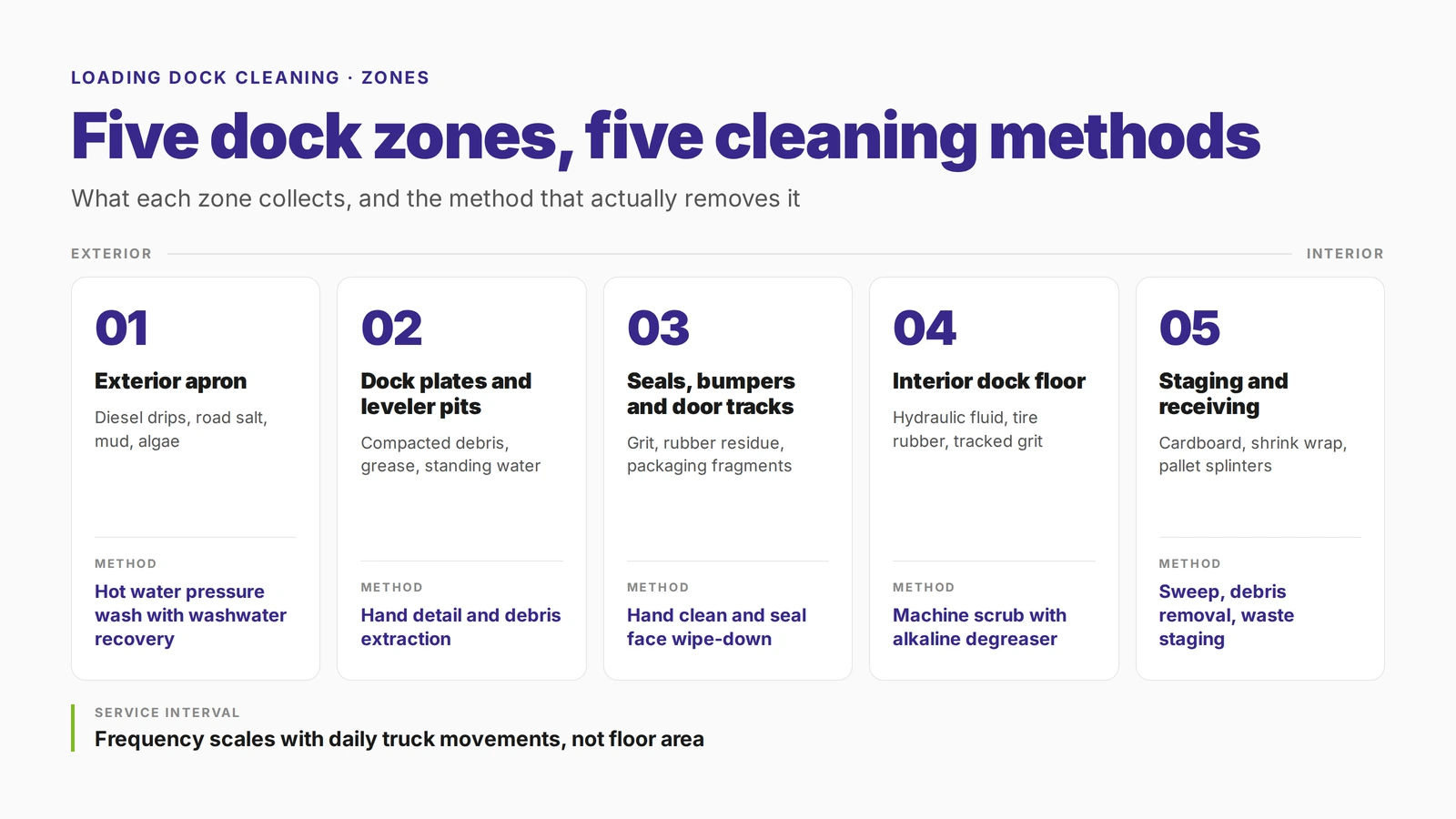
Dock cleaning covers a defined set of zones, each with a different contaminant profile and a different method. Treating the whole dock as a single surface is a scoping error, because the apron, the leveler pit, and the door track deteriorate through different mechanisms and respond to different chemistry.
Zone | Primary contaminant | Cleaning method |
|---|---|---|
Interior dock floor and apron | Hydraulic fluid, tire rubber, tracked grit | Machine scrubbing with alkaline degreaser |
Dock plates and leveler pits | Compacted debris, grease, standing water | Manual detail work, debris extraction |
Bumpers, seals, and door tracks | Grit, rubber residue, packaging fragments | Hand cleaning, seal face wipe-down |
Staging and receiving areas | Cardboard, shrink wrap, pallet splinters | Sweeping, debris removal, waste staging |
Exterior apron and truck approach | Diesel drips, road salt, mud, algae | Hot water pressure washing with containment |
Trench drains and grates | Sediment, oil sheen, organic debris | Grate removal, sediment extraction |
Ziva Cleaning Services scopes these zones separately in every proposal, because a facility running eight bays of dry freight has a different profile than one receiving refrigerated food product. Our industrial facility cleaning programs treat the dock as its own service line rather than folding it into a general janitorial line item, and exterior apron work runs through the same crews that handle pressure washing for concrete and exterior surfaces.
Why Loading Docks Get Dirtier Than the Rest of the Building
A dock functions as a transition zone between an uncontrolled exterior yard and a controlled interior environment, which means every contaminant the yard accumulates is transferred inward on trailer tires and lift truck wheels. That combination produces a contaminant load and a deposition rate that interior aisles never experience.
Four inputs drive it. Lift truck traffic deposits hydraulic fluid and battery residue. Trailers track in road salt, mud, and diesel drips from the yard. Freight handling generates cardboard dust, shrink wrap, strapping, and pallet splinters at volume. Weather enters every time a door opens, which means rain, snow, and pollen land on a surface that is already oily.
Overhead structure compounds it. Dock doors, tracks, chains, and the joists above them collect airborne dust that daily sweeping never reaches, which is why overhead structure and door tracks collect dust faster in dock areas than in office or production space.
How Often Should a Loading Dock Be Cleaned?
Frequency should track truck movements, not square footage. A 40,000 square foot warehouse turning six trailers a day needs a different cadence than one turning forty. This is how we scope service intervals during an on-site assessment.
Daily truck movements | Housekeeping | Degrease and scrub | Exterior apron wash |
|---|---|---|---|
Under 10 | Once per shift | Monthly | Twice yearly |
10 to 30 | Once per shift, mid-shift spill check | Weekly | Quarterly |
Over 30 | Multiple times per shift | Weekly, with mid-week spot degreasing | Quarterly, monthly in winter |
Three tasks sit outside any schedule and happen on occurrence. Spill response begins immediately, because oil left on concrete migrates into the pores and stops being a housekeeping issue. Weather response follows precipitation rather than the calendar. Damage reporting happens the shift it is found, since a cleaning crew is usually the first to notice a torn seal or a leveler that will not seat. For task-level breakdowns across the wider facility, our daily, weekly, and monthly task frequencies apply the same logic to production and storage areas.
What OSHA Requires for Loading Dock Housekeeping
Two standards carry most of the obligation, and neither is optional for a facility with a dock.
29 CFR 1910.22 covers walking-working surfaces. Employers must keep places of employment, passageways, storerooms, and walking-working surfaces clean, orderly, and sanitary. Floors must be kept clean and, so far as is feasible, dry. Surfaces must stay free of hazards including leaks, spills, protruding objects, snow, and ice. A dock apron with standing hydraulic fluid is a documented violation, not a cosmetic problem.
29 CFR 1910.176 covers materials handling and storage. Aisles and passageways must be kept clear and in good repair, with no obstruction that could create a hazard. Subsection (c) requires storage areas to be kept free from accumulations of material that create tripping, fire, explosion, or pest harborage hazards.
Pest harborage is the clause most facilities overlook. Stacked cardboard and shrink wrap against a dock wall is not just clutter under this standard, it is a named hazard category, which is why waste staging belongs in the cleaning scope rather than being left to receiving staff. Equipment itself falls under a separate standard, and our guidance on safe forklift washing procedures covers the lift truck side.
Where Dock Washwater Goes, and Why It Matters in Pennsylvania
Pressure washing a dock apron generates wastewater, and in Pennsylvania that wastewater is a regulated discharge rather than incidental runoff. The PA DEP fact sheet on managing cleaning wastewater is explicit that water used to clean vehicles, equipment, and structures becomes wastewater that must be managed to prevent pollution, and that the Clean Streams Law prohibits discharging pollutants to waters of the Commonwealth without a permit.
The detail that catches facilities out is that waters of the Commonwealth include storm sewers and groundwater. A storm drain in the dock apron is not a disposal point. DEP states that if any cleaning agent is used, allowing the wastewater to reach storm sewers is generally unacceptable.
DEP lists acceptable management options in order of preference:
Collect the wastewater and reuse or recycle it.
Collect it for transport to a sewage treatment facility, or discharge to a public sewer system with the system owner's authorization.
If wastewater generation is infrequent, direct it to a well vegetated ground area for infiltration.
If generation is infrequent, no vegetated area is available, and no cleaning agents were used, discharge to storm sewers.
Obtain a DEP permit for routine discharges to surface waters or routine land application.
Degreasers may be used on a dock, provided the wastewater is captured and kept out of waters of the Commonwealth. Where DEP determines that cleaning wastewater management has caused pollution, the responsible party can face civil penalties of up to $10,000 per day under the Clean Streams Law. Any contractor quoting apron pressure washing in Berks County should be able to explain its containment and recovery method before it quotes a price.
How to Clean a Dock Bay Without Shutting Down Receiving
No facility can close its receiving operation for a cleaning visit, so the work is sequenced bay by bay. We take one dock bay out of rotation at a time, confirm no trailer is engaged and the bay is locked out, complete the scrub and detail work, then return it before moving to the next.
Three rules govern the sequence. Crews work only in bays with no trailer at the door and no active loading. Degreasing and machine scrubbing run on off-shift hours where the receiving schedule allows, because wet concrete and lift traffic do not mix. Exterior apron washing is scheduled against the yard calendar rather than the building calendar, since it needs trailer parking clear.
Facilities running continuous operations get the same treatment we apply when cleaning around live operations elsewhere in the plant: the schedule bends around production, not the reverse.
What Winter Does to a Dock Apron in Berks County
Pennsylvania winters put a specific load on dock surfaces that facilities in milder markets never plan for. Every trailer arriving from I-78, US 222, or Route 61 carries road salt in its tire treads and undercarriage, and it deposits that chloride residue directly onto the apron and interior dock floor.
Chloride residue creates three distinct problems. It leaves a crystalline haze that ordinary damp mopping redistributes rather than removes, because the chlorides dissolve and redeposit as the surface dries. It retains moisture against the concrete, accelerating surface scaling through repeated freeze-thaw cycling. It also migrates deep into the building on lift truck wheels, transferring the contamination into aisles and staging areas well beyond the dock.
Ice at the dock lip is the second winter issue. Melt water running off a trailer roof refreezes in the gap between the dock face and the trailer, exactly where a dock plate seats. That constitutes a fall exposure at elevation, and ice is one of the surface conditions 1910.22 names explicitly. Winter dock service in Berks County means neutral pH chloride removal on a shortened interval, not the same scrub cycle used in July.
Choosing a Loading Dock Cleaning Company in Reading, PA
Reading sits at the intersection of several major freight corridors, and Berks County facilities with docks span far more than warehousing. Distribution centers, food processing plants, manufacturers, grocery back rooms, and hospital receiving areas all run docks, and each carries different contaminant and access constraints.
Where in-house housekeeping ends and contracted service begins
In-house staff handle what happens continuously: immediate spill response, debris pickup between trailers, keeping lanes clear, and reporting damage. That work has to happen on the shift it is needed, and no contractor visit schedule can substitute for it.
Contracted service handles what needs equipment, chemistry, or containment your team does not carry. Machine scrubbing with alkaline degreaser, leveler pit extraction, hot water apron washing with wastewater recovery, and overhead high dusting all sit here. The dividing line is not facility size, it is whether the task needs a machine and a trained operator.
What to confirm before signing
Ask any prospective provider four questions. How is dock scope written, zone by zone or as a single line item? What is the containment and recovery method for apron washwater, and does it satisfy DEP guidance? What is the response commitment for spills and weather events? Who owns the equipment, and is dock-grade machinery included in the rate?
Ziva Cleaning Services has cleaned Berks County facilities since 2011. We are certified, bonded, and insured, our technicians are background checked, and you speak directly with our team rather than a national call center. For facilities weighing dock work against the wider facility scope, our guidance on how facility managers evaluate a local cleaning team covers the broader evaluation, and budgeting for industrial facility cleaning breaks down what drives cost.
Get a Dock Cleaning Assessment for Your Facility
Every dock scopes differently, which is why we walk the site before quoting. We look at bay count, daily truck movements, floor condition, drain locations, and your receiving schedule, then build a plan around them. Schedule a free on-site assessment and we will put a zone-by-zone scope in writing.


