

Pennsylvania's Uniform Construction Code sets no cleaning standard for a certificate of occupancy. Cleaning still decides the outcome, because code officials cannot verify egress, life-safety devices, or equipment labels buried under construction debris. Under 34 Pa. Code § 403.46, an official must issue the certificate within five business days of a passing final inspection report.
Does Berks County Require Cleaning for a Certificate of Occupancy?
No municipality in Berks County enforces a cleanliness standard as a condition of occupancy, because no such standard exists in the building code. The Uniform Construction Code contains no mopping requirement and no dust threshold.
Cleaning still governs the outcome through two separate mechanisms. The first is verification. A building code official signs off on egress width, sprinkler coverage, panel labeling, and dozens of other items that have to be visible and reachable to be approved. The second applies to existing buildings, where municipal use and occupancy inspections are run against property maintenance ordinances that do regulate sanitation directly.
Which mechanism applies determines what the cleaning scope has to accomplish and when. Ziva Cleaning Services handles commercial post-construction cleaning in Berks County on both paths, and the sequencing differs substantially between them.
Two Occupancy Inspections in Berks County: Which One Applies to You
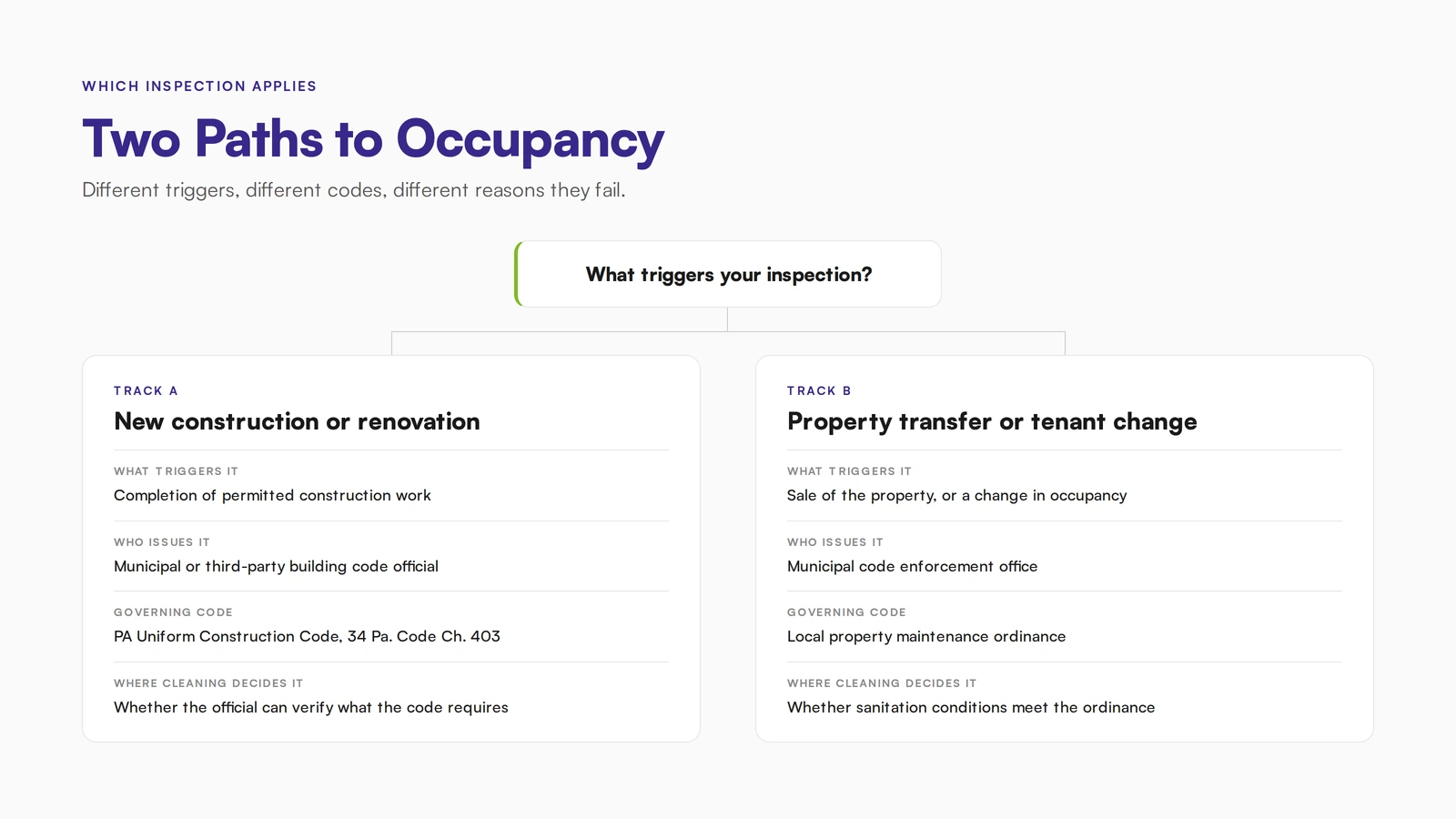
Facility managers routinely conflate these two processes. They are triggered by different events, issued under different authority, and fail for different reasons.
New construction or renovation | Property transfer or tenant change | |
|---|---|---|
What triggers it | Completion of permitted construction work | Sale of the property, or a change in occupancy or use |
Who issues it | Municipal or third-party building code official | Municipal code enforcement office |
Governing code | PA Uniform Construction Code, 34 Pa. Code Chapter 403 | Local property maintenance ordinance adopted by the municipality |
Where cleaning decides it | Whether the official can verify what the code requires | Whether sanitation conditions meet the ordinance |
Timing | Certificate due within five business days of a passing final inspection | Varies by municipality, and not every municipality requires one |
The first path affects general contractors, developers, and any business finishing a build-out. The second affects buyers, sellers, landlords, and property managers turning a space over. Businesses across Reading and greater Berks County encounter both.
What a Code Official Checks Before Signing Off on Occupancy
A final inspection is an exercise in confirmation. The official walks the space with a plan set and verifies that what was approved on paper exists in the building. Anything blocking that verification becomes a deficiency, regardless of whether the underlying work is correct.
The items most often obscured by construction leftovers include:
Egress paths and exit widths. Stacked drywall scrap, pallets, or staged furniture in a corridor makes the clear width unmeasurable.
Door hardware and closers. Fire-rated doors have to swing, latch, and self-close, which packaging debris and protective wrapping prevent.
Electrical panel schedules and equipment labels. Joint compound over a panel directory or a covered disconnect label reads as missing labeling.
Accessible clearances at fixtures. Floor protection left in place changes measured clearances at restrooms and service counters.
Ceiling plenum and above-grid conditions. Officials lift tiles, and debris left on the grid becomes a finding.
Fire and Life-Safety Components Cleaning Can Obscure
Life-safety items draw the closest scrutiny and are most commonly compromised by dust. Sprinkler heads coated in drywall dust or still wearing protective caps, smoke detectors with construction covers left on, exit signage obscured by scaffolding, and extinguisher cabinets blocked by staged material all stop an inspection cold. None of these represent defective work, only work an official cannot verify.
Why Construction Dust Is the Most Common Reason Occupancy Inspections Stall
Construction dust does not stay where it settles. Drywall, concrete, and joint compound particulate is fine enough to remain airborne for hours and to redistribute every time an HVAC system cycles. A space cleaned on a Tuesday can carry a visible film by Friday if air handlers were commissioned in between, which is why the crew that cleaned it gets blamed for work it actually performed correctly.
That redistribution turns a single failed item into a schedule delay. Reinspections happen at the municipality's convenience, not the project's, and a tenant with a signed lease absorbs the delay directly. Understanding how settled construction dust travels through a finished space separates a final clean that holds from one that has to be repeated.
Standard janitorial crews are generally not equipped for this. Construction particulate requires HEPA filtration, sealed vacuum systems, and a top-down sequence, because conventional equipment redistributes fine dust rather than capturing it.
When to Schedule the Final Clean Before an Occupancy Inspection
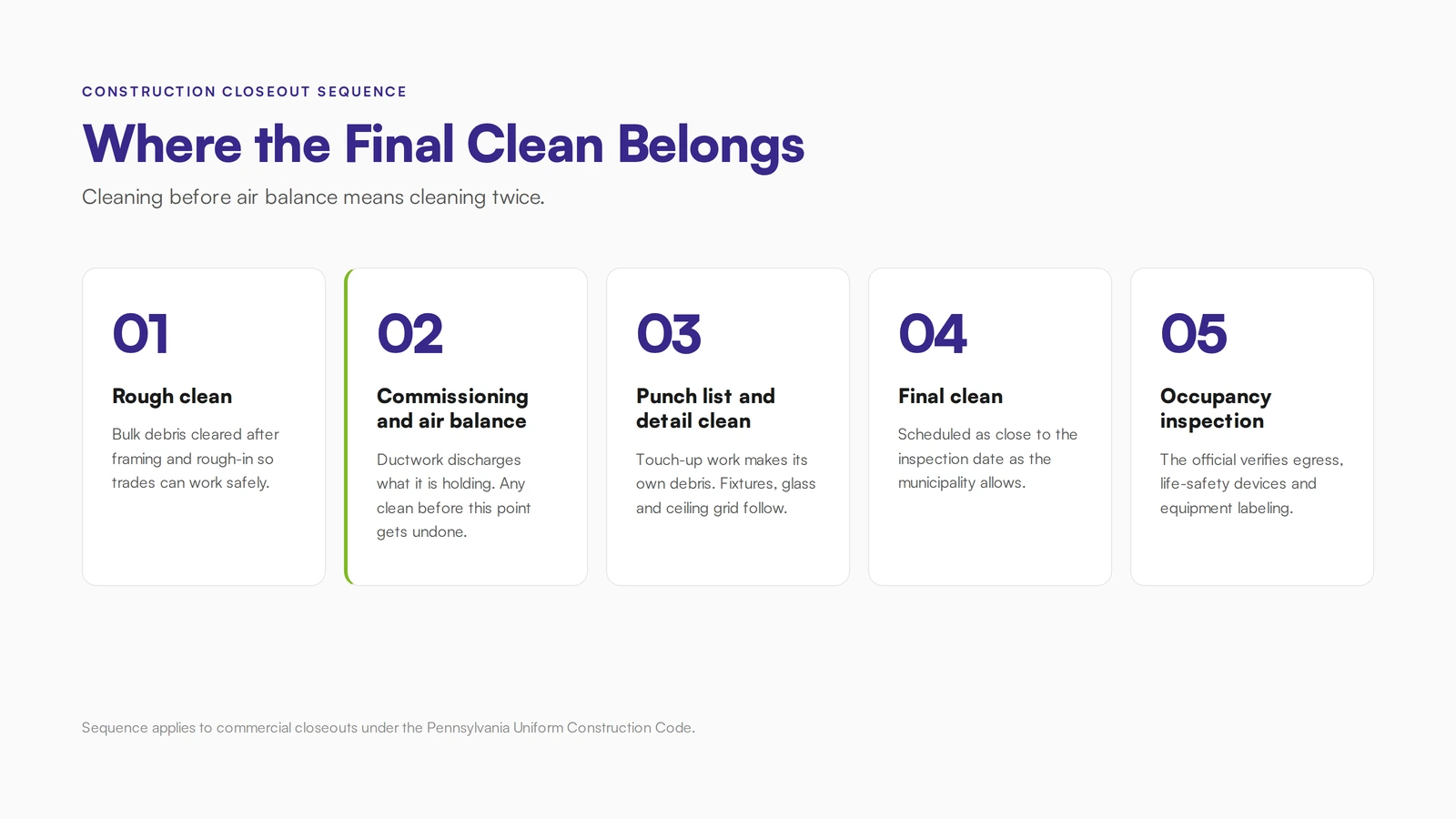
Sequencing is where most projects lose money. Cleaning before mechanical commissioning wastes the entire spend, because the first full air-balance cycle pushes accumulated duct and plenum dust into a space that was just finished.
A defensible closeout sequence runs in this order:
Rough clean after framing and rough-in, clearing bulk debris so trades can work safely.
Systems commissioning and air balance, so ductwork discharges whatever it is holding before finish cleaning.
Punch list walkthrough, generating the touch-up work that will create its own debris.
Detail clean covering fixtures, glass, ceiling grid, and interior surfaces.
Final clean as close to the inspection date as scheduling allows.
Occupancy inspection.
The gap between steps five and six should be as short as scheduling permits. Understanding the difference between the rough and final stages helps project managers budget each phase instead of treating cleaning as one line item at the end, and a room-by-room commercial closeout checklist gives a contractor something concrete to hold a vendor to.
Use and Occupancy Inspections When a Berks County Property Changes Hands
The second path has nothing to do with construction. Many Berks County municipalities require a use and occupancy inspection when a property is sold or when the occupancy changes, and the requirement varies by municipality rather than applying county-wide.
West Reading is a clear example. The borough requires a certificate of use and occupancy on the sale of any residential, commercial, or industrial building, regardless of whether the occupancy is changing, and it inspects against its property maintenance code. Financial institutions taking property through foreclosure are exempt. Purchasers are given twelve months from the date of purchase to reach compliance, and the borough can negotiate a longer period.
Property maintenance codes, unlike the building code, address sanitation head-on. The model code language requires exterior premises to be kept clean and sanitary, requires interior surfaces to be maintained in good, clean, and sanitary condition, prohibits accumulation of rubbish or garbage inside or outside a structure, and makes owners responsible for exterminating pests before a unit is leased. Landlords carrying ADA, NFPA, and health code obligations already work inside this framework, and our property management cleaning support is built around turnover deadlines.
Because adoption happens municipality by municipality, confirm the requirement with the code office where the property sits before assuming it applies or does not.
Can a Berks County Municipality Deny Occupancy Because a Property Is Dirty?
Generally not, and this is where the assumption most sellers carry turns out to be wrong. Pennsylvania's Municipal Code and Ordinance Compliance Act, Act 133 of 2016, effective January 2, 2017, limits what a municipality can do with a use and occupancy inspection triggered by a sale. Once the inspection is conducted, the municipality has to issue a certificate that allows settlement to proceed. It cannot withhold one over minor violations, and it cannot require escrowed funds or a posted bond as a condition of issuance.
The act defines a condition rendering a property unfit for habitation as one that is dangerous or injurious to the health, safety, or physical welfare of an occupant, evidenced by fire hazards, inadequate sanitary facilities, vermin infestation, or structural defects costing more than half the purchase price to repair. Chipped paint and worn finishes do not clear that bar. Vermin infestation and failed sanitary facilities do, which is where sanitation stops being cosmetic and becomes a genuine code matter.
Standard, Temporary, and Temporary Access Certificates
Three outcomes are possible under the act. A standard use and occupancy certificate is issued when no violations exist and allows immediate occupancy. A temporary certificate is issued where basic violations are found but no substantial ones, letting the buyer occupy fully while making repairs. A temporary access certificate applies where substantial violations exist, permitting access to perform repairs but prohibiting occupancy in the meantime.
What Pennsylvania's 2026 Building Code Update Changed
Pennsylvania adopted the 2021 International Codes into the Uniform Construction Code effective January 1, 2026, replacing the 2018 edition that had governed since February 2022. The Pennsylvania Department of Labor and Industryadministers the code statewide, and Berks County municipalities enforce it through their own officials or a third-party agency.
A transition provision under UCC § 304(c)(4) allowed projects with contracts executed before January 1, 2026 to proceed under the prior code if a permit application was filed within six months of the effective date. That window has closed, so any Berks County project permitted from mid-2026 forward is inspected against the 2021 codes. Closeout expectations carried over from a project completed two years ago are no longer a reliable guide.
Who Owns the Final Clean: Contractor, Owner, or Tenant?
This is the gap that costs projects their opening date. General contractors often scope a broom-clean handover, which clears debris but leaves the dust film, fixture residue, and adhesive an inspection walkthrough surfaces. Tenants assume the space arrives inspection-ready. Owners assume the contract covered it.
Read the closeout scope before the schedule gets tight. If the contract says broom clean, someone still has to fund a detail and final clean, and the party holding the occupancy deadline absorbs the delay when nobody does. Knowing what to look for in a construction cleaning contractor is worth more at contract stage than at punch list stage.
We have worked construction closeouts and property turnovers across Berks County for more than fourteen years. Our crews are bonded, insured, and background-checked, and we build each scope around the inspection date.
Get Your Building Inspection-Ready
Occupancy deadlines do not move because a final clean was scoped late. For a build-out closing out in Wyomissing, a tenant space turning over in Exeter, or a property going to settlement in Reading, we will walk the site and build a cleaning scope around your inspection date.
Schedule a free on-site assessment and we will tell you what the space needs before the official arrives.


