

A restaurant deep cleaning checklist is a schedule of the periodic tasks a nightly close does not reach, set out by area and by frequency. The FDA Food Code requires the food-contact surfaces of cooking equipment to be cleaned at least every 24 hours, but it sets no deep-clean interval, so that schedule is yours to build.
Ziva Cleaning Services has worked in commercial cleaning for 15+ years, and this guide sets out the schedule we recommend as part of our restaurant cleaning programs. It covers the kitchen, dining room, bar and restrooms, shows which jobs suit closing staff and which need a crew or a licensed specialist, and includes a printable checklist.
What Is a Restaurant Deep Clean?
A restaurant deep clean is the periodic work that reaches behind, under and inside the equipment and fixtures a nightly close only wipes around. Daily cleaning resets the surfaces that staff and guests touch. A deep clean removes the grease, scale and residue that build up out of sight, in places such as the wall behind the fryers, the walk-in floor, the floor drains and the seams of the dining room booths.
The Food Code describes the result without naming a method. Section 4-601.11 requires the food-contact surfaces of cooking equipment to be kept free of encrusted grease deposits, and section 4-602.13 requires non-food-contact surfaces to be cleaned often enough to prevent a buildup of soil residues. The Pennsylvania Department of Agriculture states that it has adopted the most current version of the FDA Model Food Code, so those sections apply to restaurants here. A deep clean is how a kitchen meets them in the places a closing shift cannot reach.
What Should Closing Staff Still Clean Every Day?
A deep cleaning schedule is added to the daily close and does not replace it. The daily baseline belongs to the restaurant's own team, because it has to happen on every shift whether or not a cleaning crew is on site. At a minimum it covers:
Food-contact surfaces, cutting boards and utensils washed, rinsed and sanitized
Cooking equipment surfaces cleaned, which the Food Code requires at least every 24 hours
Kitchen and dining room floors swept and mopped, with floor drains flushed
Tables, chairs, menus and the host stand wiped and sanitized
Restrooms cleaned and restocked
Trash removed and bins washed
The printable checklist below carries the full daily list alongside the deep-clean tasks. If the daily close is slipping, fix that first, because a monthly deep clean cannot make up for thirty missed closes.
How Often Should a Restaurant Be Deep Cleaned?
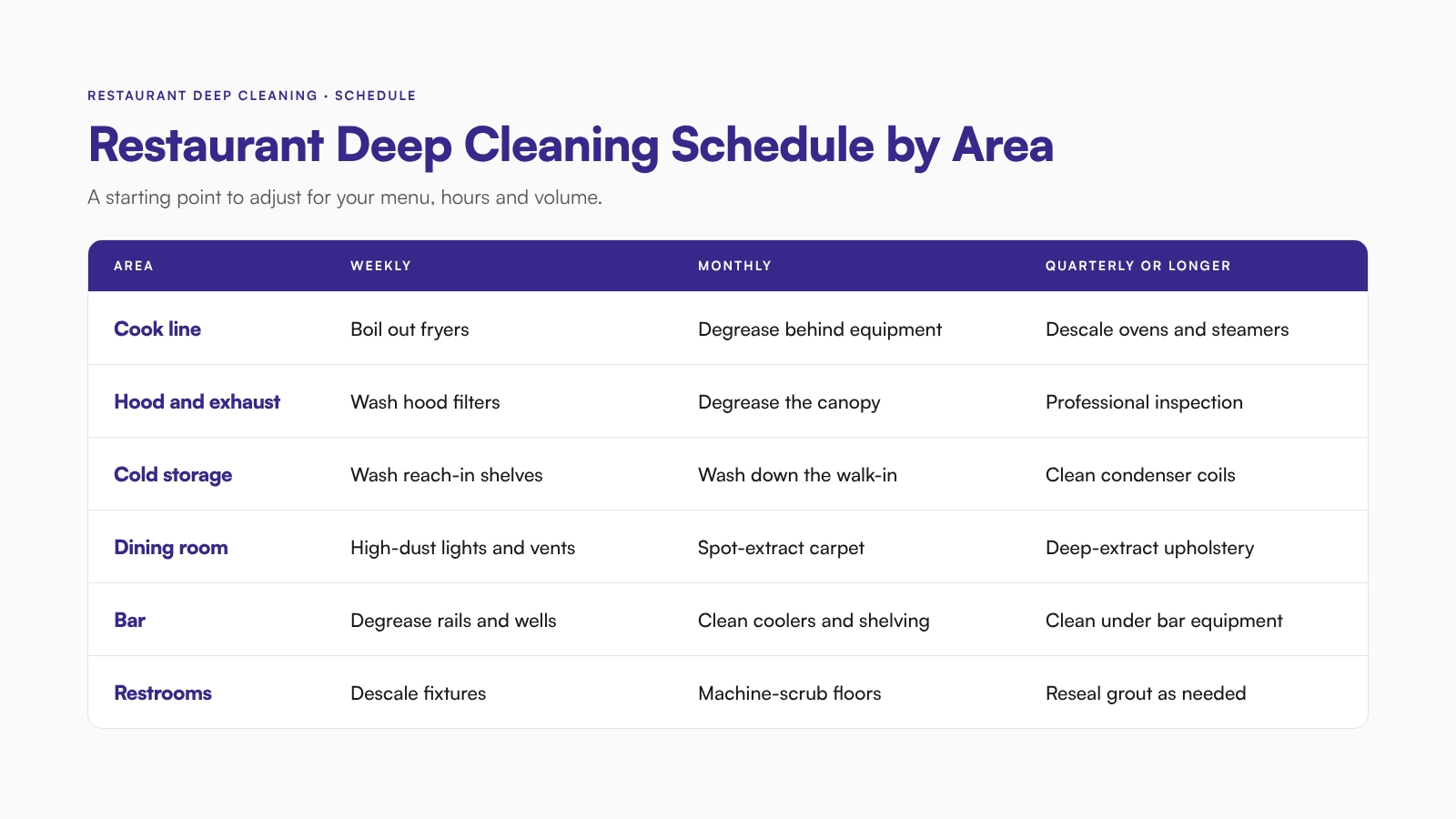
The Food Code sets no single deep-clean interval for a whole restaurant, and the right frequency depends on what each area collects. A high-volume kitchen with fryers and a charbroiler loads grease far faster than a cafe that bakes and brews, which is why a schedule by area works better than one date on the calendar. Treat the schedule below as the starting point we recommend, then adjust it to your menu, hours and volume.
Area | Weekly | Monthly | Quarterly or longer |
|---|---|---|---|
Cook line | Boil out fryers; degrease between equipment | Pull equipment; degrease the floor and wall behind it | Descale and detail ovens and steamers per the manual |
Hood and exhaust | Wash or exchange hood filters | Degrease the canopy inside and out | Professional inspection, with cleaning when buildup is found |
Cold storage and prep | Wash reach-in shelves, gaskets and door tracks | Empty and wash walk-in shelving, walls and floor | Clean condenser coils and fan guards |
Dish area and drains | Delime the dish machine; scrub floor drains | Scrub walls and the floor under the machine | Service drain lines as needed |
Kitchen floors, walls and ceilings | Scrub floors edge to edge, under equipment legs | Degrease walls; wash ceiling vents | Machine-scrub floors; wash ceiling tiles and light covers |
Ice machine and beverage lines | Wipe exteriors and nozzles | Follow the manufacturer's cleaning frequency | Follow the manufacturer's cleaning frequency |
Dining room | High-dust lights, vents and ledges; detail table bases | Spot-extract carpet and upholstery; polish hard floors | Deep-extract carpet and upholstery; wash walls and baseboards |
Bar | Degrease speed rails, wells and floor mats | Empty and clean coolers and back-bar shelving | Pull equipment; clean the floor and drains beneath |
Restrooms | Descale fixtures; scrub grout and partitions | Machine-scrub floors; detail vents and dispensers | Reseal grout as needed |
Three items are not ours to set. The Food Code says ice machines and beverage lines are cleaned at the frequency the manufacturer specifies, and grease trap and floor drain upkeep follows its own schedule and local rules. For the exhaust system, NFPA says hoods are inspected for grease buildup typically twice a year for most restaurants, more or less often depending on the type and volume of cooking, and cleaned when that inspection finds buildup. For the detail on each, see how a hood and duct cleaning is done and what a deep cleaning session costs.
What Goes on a Kitchen Deep Cleaning Checklist?
A kitchen deep cleaning checklist lists results a manager can check, zone by zone. Each line below describes what finished looks like, so the person signing off does not have to judge effort.
Cook line
Fryers boiled out and the cabinet interiors degreased
Equipment pulled forward, with the floor and wall behind it degreased
Oven, range and grill interiors cleaned to bare metal, including racks and drip trays
Hood filters washed or exchanged, and the canopy wiped inside and out
Gas hoses, casters and equipment legs degreased
Cold storage and prep
Walk-in emptied by section, with shelving, walls and floor washed and sanitized
Reach-in gaskets, door tracks and drain lines cleaned
Condenser coils and fan guards cleared of dust and grease
Prep table undershelves, drawer slides and can opener blades detailed
Dish area and drains
Dish machine delimed, with wash arms and filter screens removed and cleaned
Floor drains opened, scrubbed and flushed, covers included
Walls, splash zones and the floor under the machine scrubbed
What Goes on a Front-of-House Deep Cleaning Checklist?
A front-of-house deep cleaning checklist covers the surfaces guests see up close and the ones they never see but can smell. Guests judge a kitchen they cannot see by the room they can, so this side of the schedule earns the same discipline as the cook line.
Dining room
Light fixtures, vents, ledges and picture frames high-dusted
Booth seams, chair frames and table bases detailed
Carpet and upholstery extracted
Hard floors machine-scrubbed, then polished or refinished as the finish requires
Walls, baseboards and window tracks washed
Bar
Speed rails, wells, sinks and floor mats degreased and sanitized
Coolers emptied and cleaned, including shelving and door gaskets
Bar equipment pulled out, with the floor and drains beneath cleaned
Ice bins and beverage nozzles cleaned at the manufacturer's frequency
Restrooms
Fixtures descaled, including under rims and around bases
Tile, grout and partitions scrubbed
Vents, dispensers and door hardware detailed
Floor drains cleaned and floors machine-scrubbed
Who Should Do the Deep Clean: Staff, a Cleaning Crew or a Specialist?
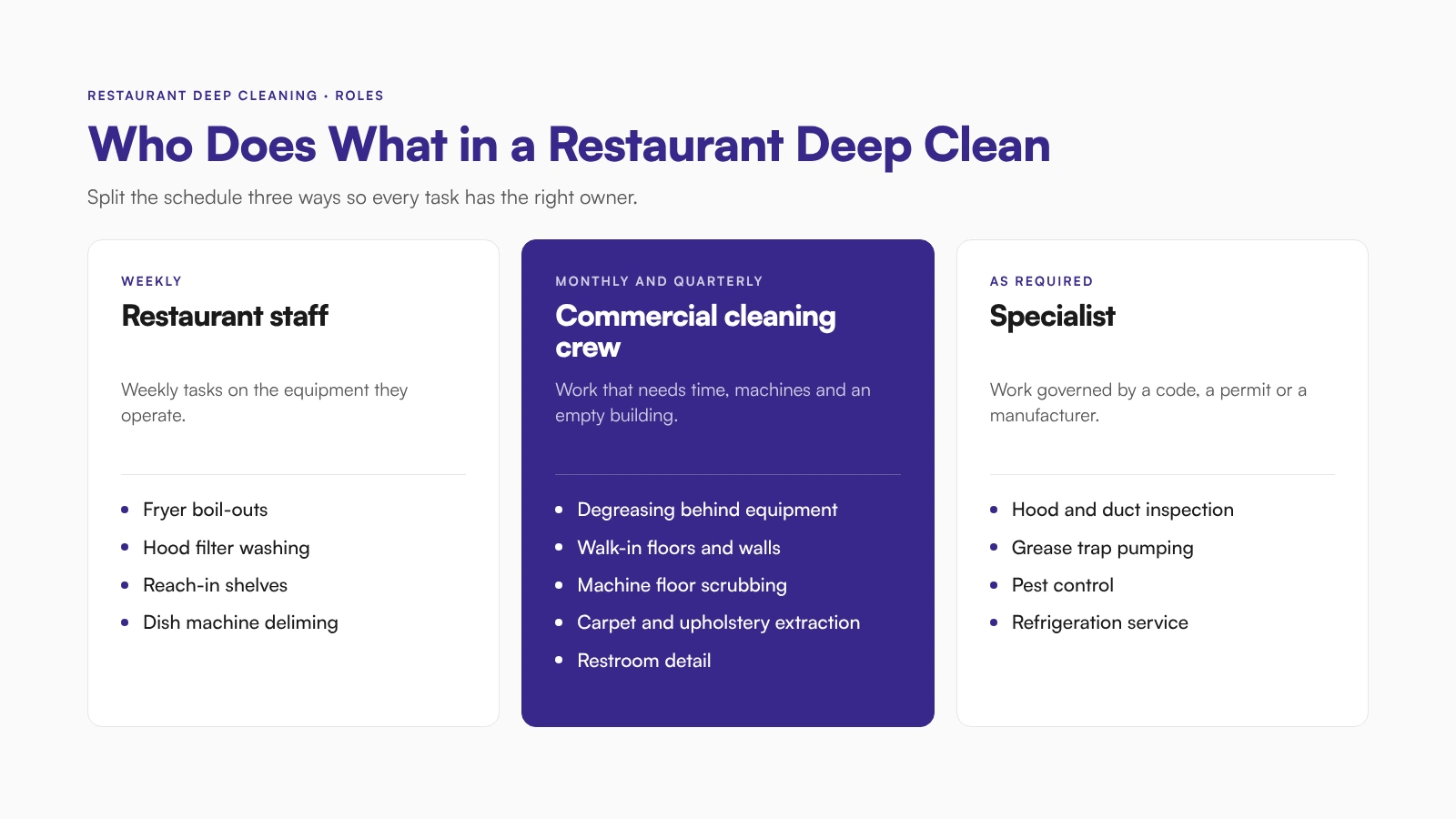
Most deep cleaning schedules work when the tasks are split three ways. Closing staff keep the weekly tasks, a commercial cleaning crew takes the labor-heavy monthly and quarterly work, and a licensed or certified specialist handles the jobs that carry a code, permit or manufacturer requirement.
Who | Suited to | Examples |
|---|---|---|
Restaurant staff | Weekly tasks on equipment they operate | Fryer boil-outs, filter washing, reach-in shelves, dish machine deliming |
Commercial cleaning crew | Monthly and quarterly work that needs time, machines and an empty building | Degreasing behind equipment, walk-in floors, floor scrubbing, carpet and upholstery extraction, restroom detail |
Specialist | Work governed by a code, a permit or a manufacturer | Hood and duct inspection and cleaning, grease trap pumping by a licensed hauler, pest control, refrigeration service |
The split is practical. A line cook at the end of a double shift is the wrong person to degrease a wall, and a cleaning crew should not open a grease interceptor. Putting each task with the right party is also what keeps the schedule going after the first month.
When Is the Best Time to Schedule a Restaurant Deep Clean?
The best time is after closing or on a day the restaurant is closed. Section 6-501.12 of the Food Code says cleaning should be done when the least amount of food is exposed, "such as after closing," and a deep clean also needs equipment switched off, cooled and moved. We suggest booking the monthly session overnight before the slowest day of the week and adding a longer session ahead of the busy season. Before the crew arrives, the kitchen team should:
Store or cover all food, and clear the prep surfaces and shelving due to be cleaned.
Switch off and cool the cooking equipment.
Empty the sections of the walk-in scheduled for that visit.
Unlock storage areas and leave the equipment manuals where the crew can find them.
Walk the crew lead through the task list and agree what finished means for each line.
Schedule by buildup, not by a guess at the next inspection date. Our guide to how restaurant inspections work in Reading and Berks County explains why the gap between visits is longer than most operators assume.
How Do You Document a Deep Clean?
Document a deep clean with a dated log that names the area, the task, who did it and who checked it. A log turns the checklist into a record, and it gives a manager something to show an inspector that a wall chart cannot. A workable log looks like this:
Date | Area | Task | Done by | Checked by | Notes |
|---|---|---|---|---|---|
March 2 | Cook line | Fryers pulled; wall and floor degreased | Cleaning crew | Kitchen manager | Gas hose on fryer 2 worn |
March 2 | Walk-in | Shelving, walls and floor washed | Cleaning crew | Kitchen manager | None |
March 4 | Hood and exhaust | Inspection; no cleaning required | Hood contractor | General manager | Report filed |
Keep specialist paperwork, such as hood inspection reports and grease hauler receipts, with the log. Record what the crew found as well as what it cleaned, because a worn gasket or a slow drain is cheaper to fix when it is caught early.
Where Do We Provide Restaurant Deep Cleaning?
We provide restaurant cleaning across Berks County, including Reading, Wyomissing, West Reading, Sinking Spring and Exeter. We also serve the Lehigh Valley, Lancaster, the Chester County corridor around Exton and West Chester, and King of Prussia in Montgomery County. Our crews work after closing and on closed days, so a deep clean does not cost you a service.
A free on-site assessment is the place to start. We walk the kitchen and dining room with you, mark up this checklist for your equipment and volume, and put the schedule in writing. Our staff are bonded, insured and background-checked, and you deal directly with the owners of a family-owned company. Schedule your free on-site assessment and we will build the deep cleaning schedule around your hours.


