

Restaurants inside Reading city limits are inspected by the City of Reading Health Office, not the Pennsylvania Department of Agriculture, which covers most of Berks County. Pennsylvania law sets a minimum of one inspection per year for every eating and drinking establishment, with extra visits triggered by complaints or a failed inspection.
Who Inspects Restaurants in Reading, PA?
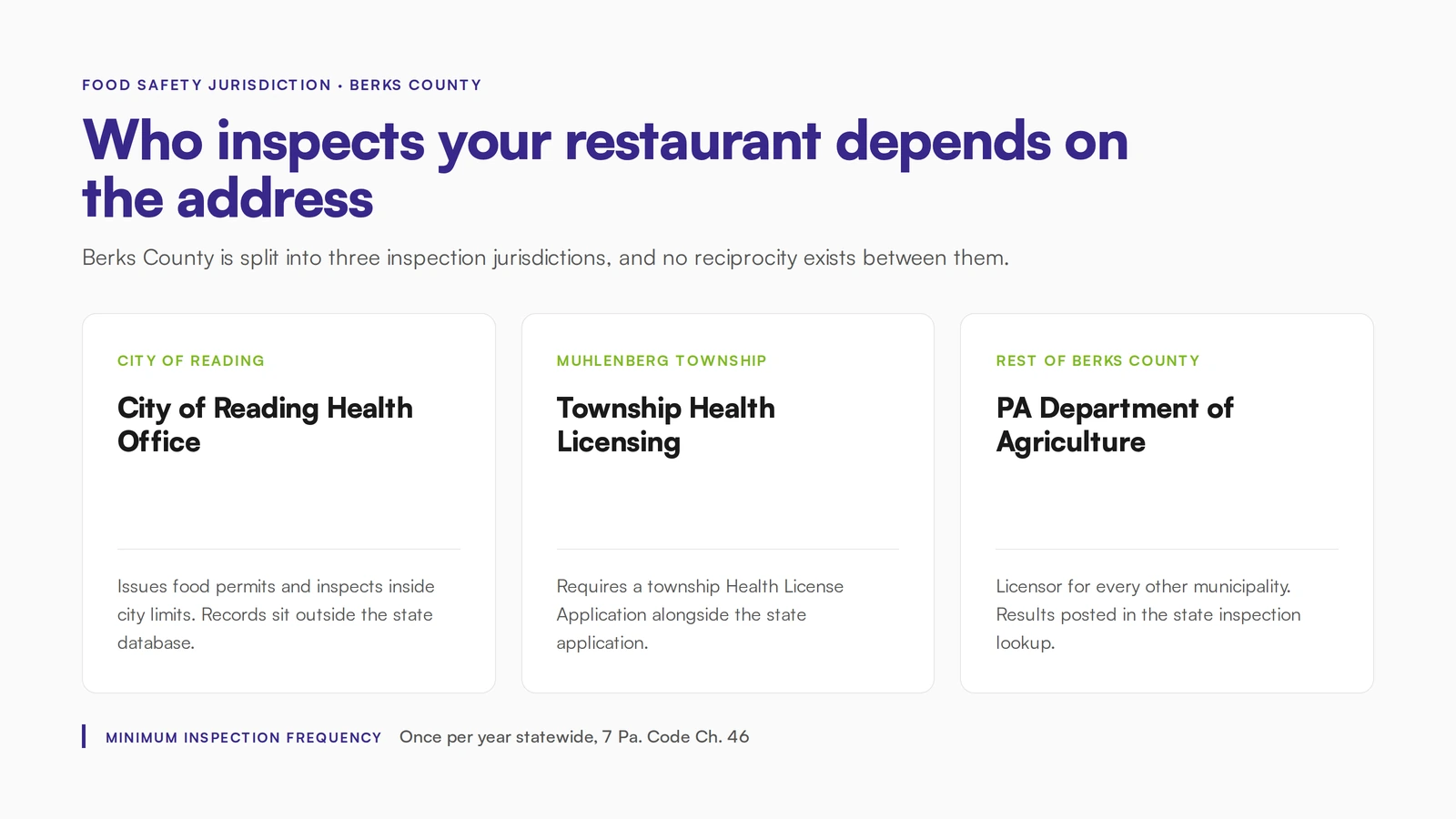
Berks County is split into three food safety jurisdictions. The City of Reading and Muhlenberg Township each employ their own food safety inspectors. Every other municipality in the county falls to the Pennsylvania Department of Agriculture.
That split has a statutory basis. Under Pennsylvania's Food Code at 7 Pa. Code Chapter 46, the licensor for a retail food facility is the health authority of the city, borough, incorporated town, or first class township where the facility sits. The Department of Agriculture is the licensor only where no such local authority exists.
In Reading, that authority is the Health Office inside Property and Codes Enforcement. It issues permits for restaurants, food vendors, laundromats, and vending machines, and conducts regular inspections for food producers and providers. Muhlenberg Township operates its own health licensing, requiring retail food establishments to file a township Health License Application alongside the state application.
There is one consequence worth planning around: no reciprocity exists between local health departments and the state. If you operate in a local jurisdiction, you contact that department directly for licensing, and a permit from one does not carry over to the other. That becomes expensive to discover late if you are opening a second location across a municipal line, on top of the occupancy and turnover work a new build already requires.
Knowing which desk your file sits on is the first step in any serious restaurant cleaning program, because the standard you are held to is set locally even though the code behind it is federal.
Why Your Inspection Record Might Not Be in the State Database
The state's public inspection lookup only shows facilities under Department of Agriculture jurisdiction, plus the county and local departments that have chosen to post their results there. If your restaurant sits inside Reading city limits and you cannot find yourself in the state database, that is expected rather than an error. Your record lives with the city.
This runs both directions. The weekly inspection roundups local news outlets publish, and the consumer-facing safety trackers built on top of them, pull from the state database. Reading city establishments are largely absent from those feeds, along with their violations. Operators inside the city sometimes assume this means less scrutiny. It does not. It means the record is held somewhere most people are not looking.
How Often Are Pennsylvania Restaurants Inspected?
Once per year is the floor. State law requires the department to inspect every eating and drinking establishment annually, and inspectors may return several more times in the same year if complaints are received or the initial inspection was not passed. A change of ownership or a compliance follow-up also triggers a visit.
That annual rhythm matters because most national guidance on this topic assumes a twice-yearly or quarterly cycle borrowed from large metropolitan health departments. Building a deep cleaning calendar around a six-month inspection cadence leaves a Pennsylvania operator exposed, because the real interval is longer and grease, residue, and drain buildup have more time to accumulate between visits.
What Health Inspectors Check in a Pennsylvania Restaurant
Pennsylvania adopts the FDA Food Code, so inspections here are organized around federal violation levels rather than a point score or a letter grade.
Priority, Priority Foundation, and Core Violations
Violation level | What it covers | What happens when cited |
|---|---|---|
Priority | Direct contributors to foodborne illness: handwashing, food handling, time and temperature control, contamination from pests or rodents | Must be corrected immediately, or the entire inspection goes out of compliance |
Priority Foundation | Supporting requirements that make priority controls possible, such as available handwashing supplies and working thermometers | Correction required, frequently on the spot during the visit |
Core | General sanitation, maintenance, equipment condition, and facility upkeep | Correction expected; repeated or severe cases can put a facility out of compliance |
Two things follow from this structure. First, Pennsylvania assigns no letter grades. A facility can carry several violations and still be recorded in compliance, or carry a single violation and be recorded out of compliance, depending entirely on severity. Second, a priority violation corrected while the inspector is still on site still appears on the report, even though the facility remains in compliance.
The distinction between the three levels is also where most cleaning-driven citations land. Priority Foundation and Core items are overwhelmingly matters of sanitation discipline rather than food handling technique, which is covered in more depth in our guide to food service sanitation standards.
The Cleaning Violations Berks County Restaurants Get Cited For
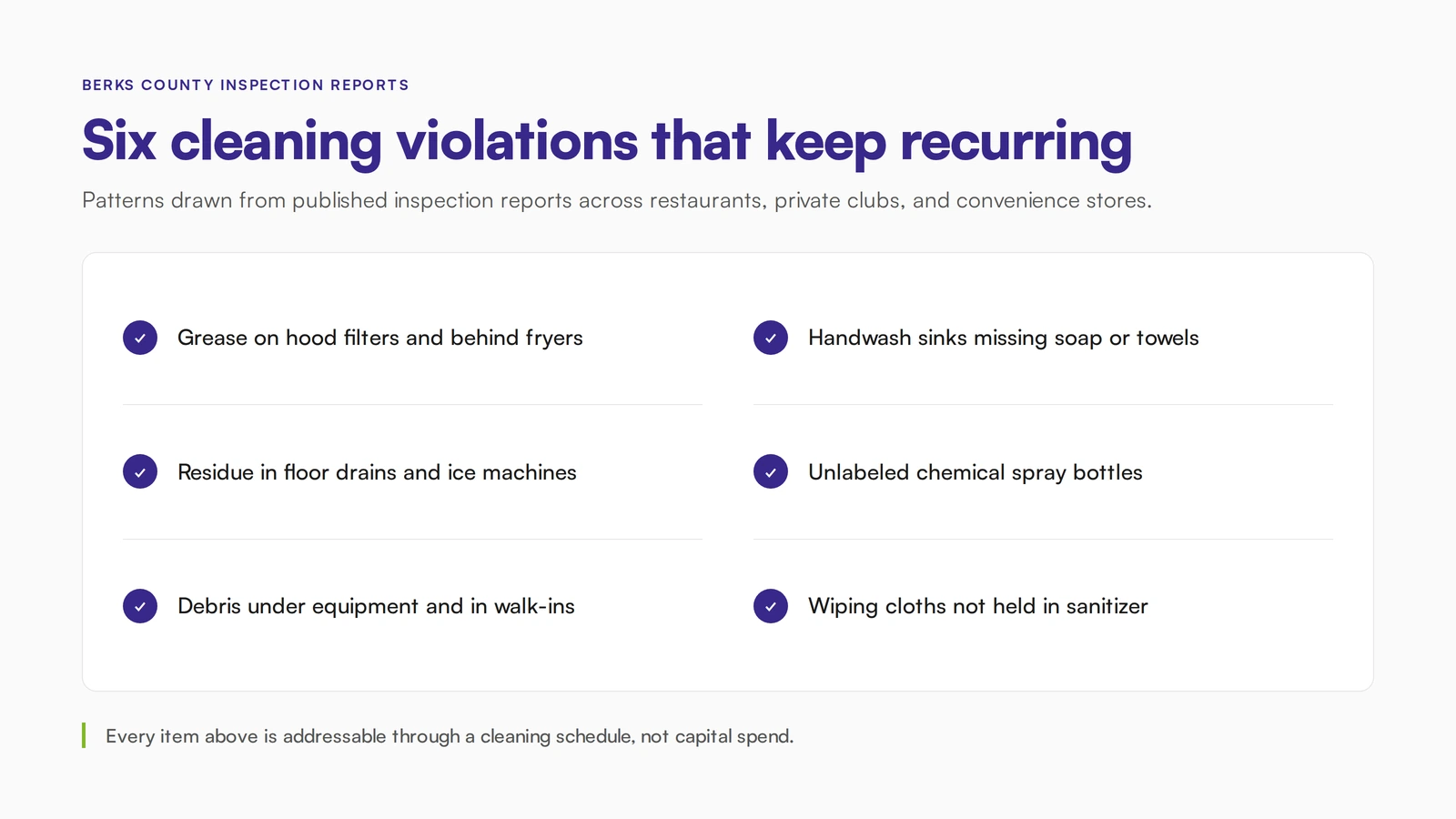
Published inspection reports across Berks County show the same cleaning-related citations recurring at independent restaurants, chains, private clubs, and convenience stores alike. The pattern is consistent enough to plan against:
Grease accumulation on hood filters, behind fryers, and on adjacent wall surfaces
Residue, organic matter, or debris built up in floor drains and on ice machine interiors
Dirt and food debris on floors beneath equipment and shelving, including walk-in freezer floors
Wet wiping cloths left on surfaces rather than held in sanitizer solution between uses
Handwash sinks missing soap or single-use towels, including bar-area sinks
Working spray bottles not marked with the common name of the chemical inside
Plumbing in disrepair at the three-compartment sink, including leaks and makeshift repairs
Water below the required temperature at the three-bay sink
Missing or inaccessible equipment thermometers in coolers, bain maries, and hot-hold units
Equipment surfaces that are scored, pitted, or broken and no longer easily cleanable
Evidence of rodent or insect activity
Nearly every item on that list is addressable through cleaning, scheduling, or supply discipline. Very few require capital expenditure. The ones that recur most stubbornly are the tasks nobody owns explicitly: the grease behind a fryer that never made it onto a nightly close list, the drain that gets rinsed but never scrubbed, the walk-in floor that only gets attention after a spill. A structured checklist closes most of that gap by assigning each task to a named person and a fixed frequency.
What Documentation Should Be Ready Before an Inspector Arrives?
Certified food employee certificate. Pennsylvania's Food Employee Certification Act requires at least one employee holding a valid certificate to be present or immediately accessible during all hours of operation, and that person must be the person in charge when on duty. The original certificate has to be posted in public view. An unposted certificate is a citation by itself, and it is a common one.
Retail food facility license. Issued by your licensor, which is the city in Reading, the township in Muhlenberg, and the Department of Agriculture everywhere else in Berks County.
Temperature and cleaning logs. Cooler, freezer, and hot-hold readings plus documented cleaning frequencies for equipment that is not cleaned every shift.
Hood system service certificates. Dated records of the last full exhaust cleaning.
One clarification on certification, because national guidance gets this wrong for Pennsylvania: the requirement is a manager-level food protection certification from a nationally recognized program. The state is explicit that this must be a management course rather than a food handler course, and there is no statewide food handler card for non-supervisory staff.
The hood records sit in a different lane worth understanding. Commercial kitchen exhaust systems are governed by NFPA 96, and enforcement belongs to the fire code authority rather than the health inspector. Health inspectors still cite grease-laden hood filters as a sanitation violation, and insurers routinely ask for dated certificates, so kitchen hood cleaning ends up serving two separate compliance obligations at once.
How to Build an Inspection-Ready Cleaning Routine
Because the annual inspection can land in any week of the year, readiness has to be a standing condition rather than a two-week sprint before a date you do not actually know.
What Your Staff Should Handle Daily
Wiping cloths moved into fresh sanitizer at the start of every shift and changed on a set schedule
Handwash stations checked for soap and single-use towels at open and at every shift change, bar sinks included
Every working spray bottle labeled with the common name of its contents
Cooler, freezer, and hot-hold thermometers verified, readable, and in place
Floors swept and mopped under and behind movable equipment, not only in the walkways
What Needs a Professional Deep Clean
Ziva Cleaning Services handles the work that a nightly close cannot physically reach, scheduled between close and the next prep so the line is ready for service.
Degreasing behind and beneath fixed cooking equipment, including wall and floor surfaces the line hides
Floor drain scrubbing and treatment, rather than rinsing
Tile and grout extraction across kitchen and dish areas, where grease-trapped grout holds odor and fails a visual check
Walk-in cooler and freezer interiors, including shelving, gaskets, and floor corners
Hood, plenum, duct, and rooftop fan cleaning to NFPA 96 with dated certificates
Our crews work in food-service environments across Reading and Berks County using EPA-registered sanitizers approved for food-contact surfaces, which keeps janitorial chemistry from becoming its own cross-contamination problem.
What Happens If Your Restaurant Fails an Inspection?
"Fail" is not the term Pennsylvania uses. Reports record a facility as in compliance or out of compliance. Out of compliance means one or more violations require a return visit from an inspector, and the facility is expected to correct the underlying problems before that follow-up.
The practical sequence is straightforward. Correct what can be corrected during the visit, because on-site correction is recorded and can keep the overall result in compliance. Document what cannot. Then fix the cause before the inspector comes back.
For cleaning-driven citations specifically, fixing the cause means changing who owns the task and how often it happens. A single emergency deep clean removes the evidence without removing the pattern, and the same violation tends to reappear at the next visit.
Inspection-Ready Restaurant Cleaning in Reading and Berks County
We have spent 14 years cleaning commercial kitchens and dining rooms across Berks County, and the citations that cost operators the most are rarely the dramatic ones. They are the recurring sanitation items that no one was specifically assigned.
Schedule a free on-site assessment and we will walk your kitchen, dish area, and front of house, identify the spots that typically draw citations in this county, and build a cleaning schedule around your service hours.


