

The Chester County Health Department, not the state, licenses and inspects West Chester restaurants, and kitchens serving potentially hazardous food must employ a Certified Food Manager holding a county certificate valid for five years. Prepare by fixing the sanitation items county reports cite and keeping your certificates, logs and hood records ready.
Ziva Cleaning Services provides restaurant cleaning services and commercial cleaning in West Chester, and this guide covers both halves of inspection prep: the county's own rules first, then the cleaning work that keeps a kitchen ready between visits.
Who Inspects Restaurants in West Chester, PA?
West Chester restaurants are inspected by the Chester County Health Department, whose Environmental Health Specialists license and inspect food facilities throughout the county. That is different from Reading, where the city runs its own health office, and from many Pennsylvania counties where the state Department of Agriculture does the work. A restaurant here needs a valid county license and must comply with Chester County Rules and Regulations Chapter 300, Food Safety at Retail Food Facilities.
Chapter 300 adopts the Pennsylvania Food Code, 7 Pa. Code Chapter 46, by reference. Violations are therefore classified the way they are across the state, and our guide to how Pennsylvania classifies restaurant violations explains the priority, priority foundation and core levels, and our overview of food service sanitation standards covers the routines behind them. This guide concentrates on what is specific to Chester County.
Do You Need Health Department Approval Before Remodeling?
Yes, in five situations. Chester County regulations require a food facility to submit plans and specifications for review and approval by the Health Department before any of the following begins, according to the county's Eating and Drinking Establishments page:
Construction of a food facility
Conversion of an existing structure into a food facility
Remodeling, or a change of facility type
A change in food operation
A change of ownership
Some plan reviews also require a Cooking Exhaust Ventilation Information Form. That makes your exhaust system part of the approval conversation, so keep your kitchen hood cleaning records current and documented.
What Is the Chester County Certified Food Manager Requirement?
Chester County adds a requirement that catches operators who assume a national food safety certificate is enough. The Health Department requires most retail food facilities to have at least one employee holding a county-issued Certified Food Manager certificate. A valid nationally accredited food manager course, from providers such as ServSafe, is accepted through reciprocity. You still apply to the county, with your course certificate, the county application and payment, through the Certified Food Manager Program.
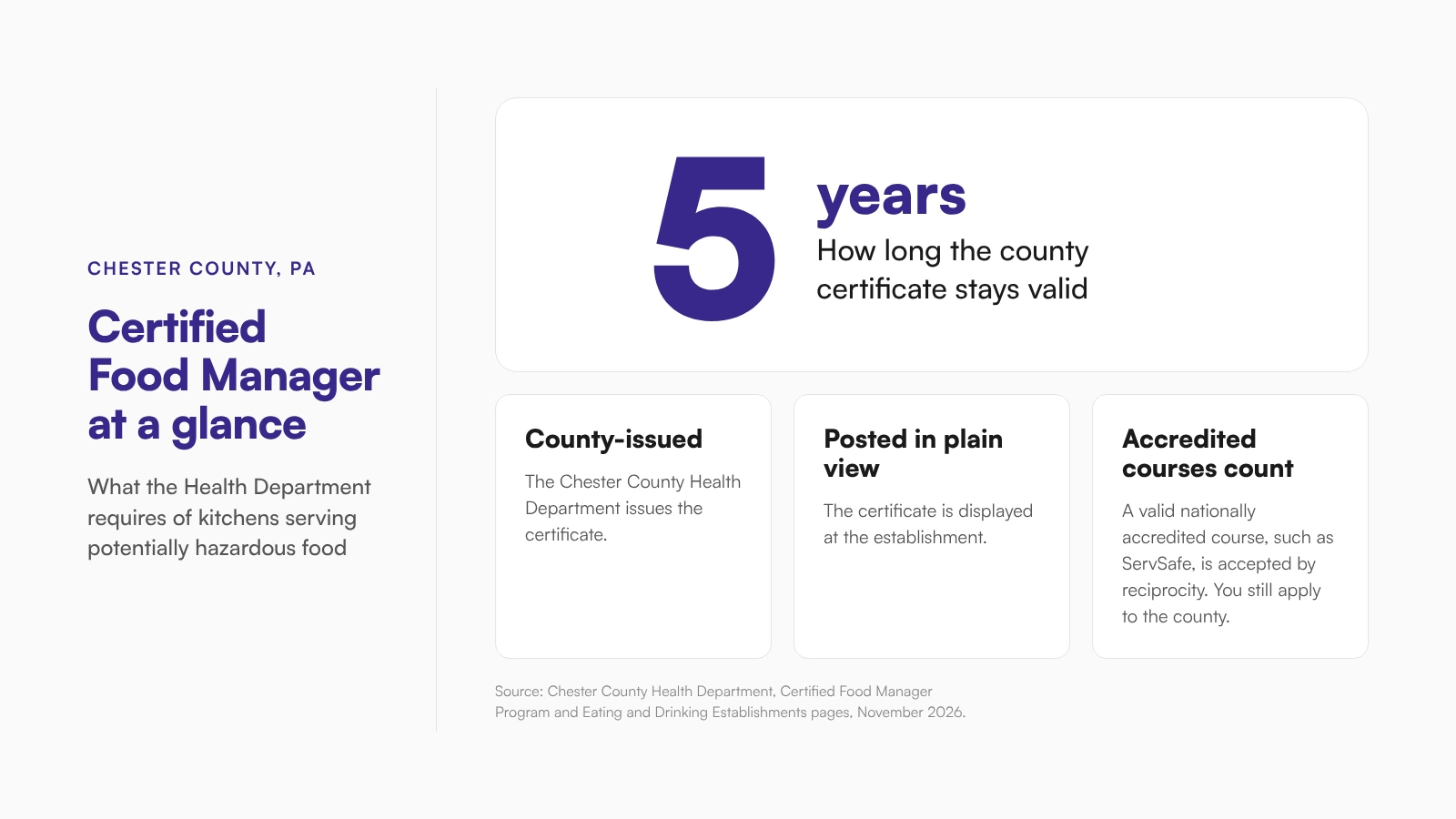
Requirement | What Chester County says |
|---|---|
Who issues the certificate | The Chester County Health Department |
How long it lasts | Five years |
Where it goes | Posted in plain view at the establishment |
Which courses count | Any course that results in a valid nationally accredited food manager certificate |
What you submit | Course certificate, county application and payment |
Who is exempt | Facilities selling only non-potentially hazardous items or commercially prepackaged potentially hazardous items (Chapter 300, section 303.3) |
Chapter 300 adds two details operators miss. The certificate is not transferable between individuals, and a Certified Food Manager may serve only one licensed food facility in the county at a time. Local news coverage of Chester County inspection reports in December 2025 shows the rule is enforced: food businesses and an institutional kitchen were cited for having no currently certified manager.
What If Your Certified Manager Leaves?
Under section 303.10 of Chapter 300, the operator has 90 days to employ a replacement Certified Food Manager and must notify the Health Department within five working days that the facility lacks one. These timelines come from the version of Chapter 300 posted on the county's site as of November 2026, so confirm them with the Health Department before relying on them. Keep the replacement's course certificate and county application ready so the 90 days are not spent finding a class.
Where Can You Find a West Chester Restaurant's Inspection Report?
Reports for Chester County facilities are available through the state's public inspection search. When you search, select "Chester County Health Department" as the Jurisdiction, as the county instructs. Look up your own restaurant first. An inspector arrives knowing your history, and local news outlets republish county reports by restaurant name.
The county is explicit about what a report means: an inspection "conducted on any given day may not be representative of the overall, long-term sanitation and food safety status of a food establishment." A clean report reflects daily habits on the day of the visit, which is why preparation has to be a standing routine rather than a last-minute scrub.
Which Cleaning Violations Do Chester County Inspectors Cite?
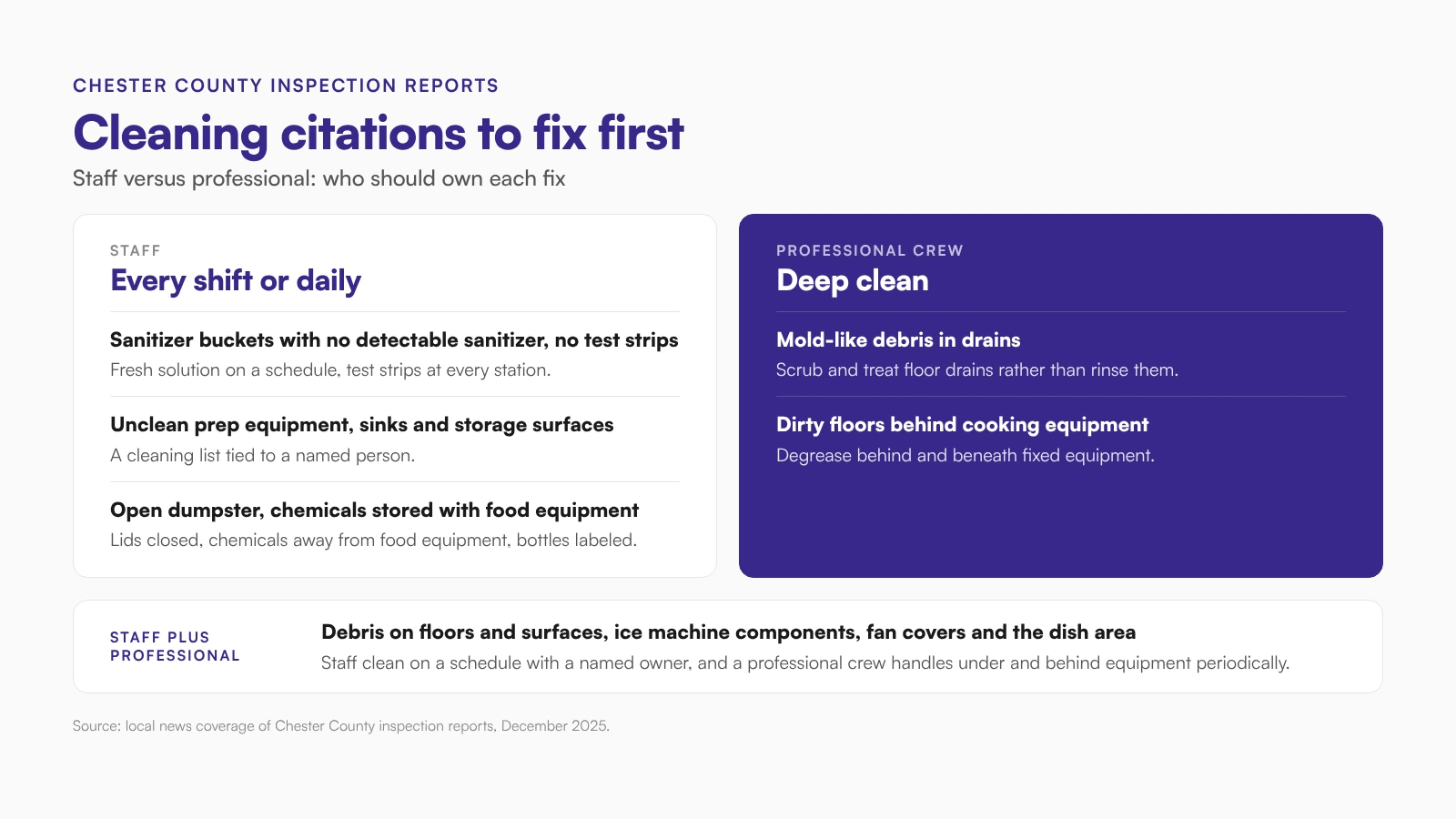
County inspection reports for restaurants, cafes and institutional kitchens, as covered by local news in December 2025, repeat the same sanitation items. We sorted the cleaning-related citations by who should own each fix.
What inspectors cited | The fix | Who owns it |
|---|---|---|
Sanitizer buckets with no detectable sanitizer, no test strips on hand | Fresh solution on a schedule, test strips at every station | Staff, each shift |
Debris on non-food-contact surfaces and at floor level | Clean under and behind equipment, not only the walkways | Staff nightly, professional periodically |
Mold-like debris in drains | Scrub and treat floor drains rather than rinse them | Professional deep clean |
Ice machine components, fan covers and dish area needing cleaning | A scheduled task with a named owner | Staff plus professional |
Unclean prep equipment, sinks and storage surfaces | A cleaning list tied to a named person | Staff, daily |
Open dumpster, chemical spray bottles stored with food equipment | Lids closed, chemicals stored away from food equipment, bottles labeled | Staff, daily |
Dirty floors behind cooking equipment | Degrease behind and beneath fixed equipment | Professional deep clean |
Not every citation is a cleaning problem. The same reports cite a dishwasher that failed to reach sanitizing temperature, a leaking water supply line, damaged cove base and burned-out lights. Those need a repair, and cleaning will not close them. For the daily layer, a restaurant cleaning checklist assigns each task to a named person at a fixed frequency, which is what closes most recurring citations.
What Should Be Ready Before the Inspector Walks In?
Keep these seven items together in one place near the kitchen office:
Your food facility license from the Chester County Health Department
The Certified Food Manager certificate, current and posted in plain view
The county's required inspection posting sign, available on its Eating and Drinking Establishments page
Temperature logs for coolers, freezers and hot-holding units, plus cleaning logs for equipment not cleaned every shift
Sanitizer test strips at each sanitizing station
Dated hood and exhaust cleaning certificates, since NFPA 96 governs commercial kitchen exhaust cleaning and grease on hood filters can also draw a sanitation citation
Plan-review approval for any recent remodel, change of food operation or change of ownership
Items 1, 2, 3 and 7 come from county requirements. Items 4 through 6 are practices that make a visit shorter and answer the questions inspectors and insurers ask most often.
How Do You Build an Inspection-Ready Cleaning Routine?
An inspection-ready kitchen gives every sanitation task a frequency and an owner. Daily tasks belong to staff, weekly tasks to a named lead, and the work a nightly close cannot reach to a professional crew.
Frequency | Tasks | Who |
|---|---|---|
Daily | Refresh and test sanitizer, stock handwash sinks, label spray bottles, close dumpster lids, sweep and mop under movable equipment, clean prep sinks and surfaces | Kitchen staff |
Weekly | Ice machine interior, fan guards and cooler fans, walk-in shelving, wall and floor corners | A named kitchen lead |
Professional deep clean | Degreasing behind and beneath fixed cooking equipment, floor drain scrubbing and treatment, tile and grout extraction in the kitchen and dish area, walk-in interiors including gaskets and floor corners, hood, plenum, duct and rooftop fan cleaning to NFPA 96 | A commercial cleaning crew |
We schedule deep cleaning between close and the next prep so the line is ready for service. A single emergency scrub removes evidence without removing the habit that created it, so the daily and weekly layers matter as much as the professional visit. If you are budgeting the exhaust work, our guide to what hood cleaning costs breaks down the factors that set the price.
What Happens After a Restaurant Inspection in Chester County?
As elsewhere in Pennsylvania, many violations are corrected before the inspector leaves, and a follow-up visit can follow when problems remain. Facilities are expected to correct cited issues promptly. Because reports are public, a repeat citation for the same item stays on the record next to the first one.
The practical response is to fix the cause, not the evidence. Change who owns the task and how often it happens, then put the fix on the cleaning log so the next report shows a pattern of control.
Inspection-Ready Restaurant Cleaning in West Chester
We serve West Chester and the rest of Chester County, and we build restaurant cleaning schedules around your service hours. Schedule a free on-site assessment and we will walk your kitchen, dish area and dining room, point out the spots county reports cite most often, and quote a program that fits your close.


