

Veterinary clinic cleaning services are specialized commercial cleaning programs built around infection control for animal care facilities. They differ from standard medical cleaning in two ways: clinics must contain zoonotic diseases that pass between animals and people, and they must use disinfectants safe for chemically sensitive patients. One infection-control breakdown reportedly cost a veterinary teaching hospital $4.12 million.
That figure comes from a peer-reviewed study of a nosocomial outbreak at a large-animal teaching hospital, and it illustrates why cleaning in an animal hospital is a clinical function rather than a cosmetic one. The practices that keep these facilities safe are codified in veterinary infection-control standards published by the American Animal Hospital Association (AAHA). This guide explains what veterinary clinic cleaning covers, why it is a distinct discipline, how each area of a clinic should be handled, and what to look for in a provider.
What Are Veterinary Clinic Cleaning Services?
Veterinary clinic cleaning services are professional cleaning and disinfection programs designed for facilities that treat animals, including general practices, animal hospitals, specialty surgical centers, and boarding operations. The work combines three requirements that rarely appear together: medical-grade disinfection, animal-safe product selection, and high-volume maintenance for a space that sees constant patient turnover, animal hair, dander, and waste.
These programs serve practice managers, hospital administrators, and clinic owners who are accountable for a safe environment but whose staff are trained animal caregivers, not professional cleaners. A structured cleaning program protects three groups at once: animal patients (many of them immunocompromised, very young, or elderly), the veterinary team, and the pet owners who share the waiting room.
How Veterinary Cleaning Differs From Human Medical Cleaning
In a human clinic, patients follow hygiene instructions and cross-contamination is controlled through standard precautions. Veterinary facilities have no such cooperation from their patients. Animals shed hair and dander, have accidents on the floor, arrive carrying pathogens from home or the outdoors, and cannot be asked to wash their hands. Two factors make this environment its own discipline.
Zoonotic Pathogens That Shape Cleaning Protocols
Zoonotic diseases transmit between animals and people, which makes thorough cleaning a matter of public health as well as animal care. Several pathogens common in clinical settings drive the protocols a cleaning program has to follow:
Canine parvovirus is the benchmark for difficulty. According to Cornell University College of Veterinary Medicine, the virus resists many common disinfectants and can survive in the environment for up to a year. Most routine cleaners will not kill it, which is why product selection and contact time matter so much.
Ringworm is a fungal infection that spreads through spores on surfaces and grooming tools and transmits readily to humans.
Leptospirosis spreads through contaminated urine and requires careful handling of floor and cage surfaces.
Salmonella and MRSA both persist on surfaces and move between patients, staff, and clients when disinfection is inconsistent.
The lesson from the pathogen list is that "clean" and "disinfected" are not the same standard. Understanding how disinfection differs from routine cleaning is the foundation of any veterinary program: visible soil is removed first, then an appropriate disinfectant is applied and left for its full dwell time.
Why Animal-Safe Disinfectant Selection Matters
Animals are far more sensitive to cleaning chemistry than people. They walk on treated floors and then groom their paws, they have acute senses of smell, and they spend hours in enclosed spaces where residues and fumes accumulate. Products containing bleach, ammonia, phthalates, or heavy fragrances can irritate skin, paws, and airways, and some are unsafe if ingested during grooming.
A veterinary program therefore selects disinfectants that balance efficacy against safety. Accelerated hydrogen peroxide, quaternary ammonium compounds, and chlorhexidine are common choices for broad-spectrum disinfection, matched to the pathogen risk of each area and always used at the correct dilution and dwell time per the product label. Where a stronger agent is required for a resistant pathogen like parvovirus, surfaces are rinsed and dried to a neutral state before animals return.
Cleaning Requirements by Area of the Clinic
No two zones in a veterinary facility carry the same risk, so an effective program treats each area on its own schedule. The table below summarizes the priority for each zone; the sections that follow explain the reasoning.
Clinic area | Primary risk | Cleaning priority |
|---|---|---|
Reception and waiting | Shared touchpoints, animal accidents, dander | Multiple times daily |
Exam rooms | Patient-to-patient transmission | Between every patient |
Surgical and treatment suites | Surgical site infection, biohazard waste | Between every procedure |
Kennels and boarding | Close-quarters disease spread | Daily cycle, plus between occupants |
Isolation wards | Contagious patients | Dedicated tools, separate protocol |
Reception and Waiting Areas
The waiting room is the first impression for pet owners and a gathering point for germs. Floors need attention several times a day because animal accidents are common, and shared frequently touched shared surfaces such as counters, door handles, card readers, pens, and seating should be disinfected on a frequent cycle. Dander and hair are captured with HEPA-filtered vacuums and microfiber before they migrate into vents and upholstery.
Exam Rooms
Exam rooms turn over constantly, and each patient may carry a different health status. Between every appointment, the exam table, scale, counters, and equipment surfaces are cleaned of visible soil and then disinfected, with floors addressed after messy visits. The two-step sequence, clean then disinfect, is what actually interrupts patient-to-patient transmission.
Surgical and Treatment Suites
Surgical and treatment areas are held to medical-grade standards because they involve invasive procedures and open tissue. Operating tables and surfaces are cleaned and disinfected between procedures, and treatment-area floors are cleaned daily. Procedures also generate regulated waste, so a program needs a clear process for handling regulated medical and sharps waste alongside the routine cleaning of the space.
Kennels and Boarding Areas
Kennels demand the most rigorous protocols in the building because animals are housed in close quarters, often stressed and shedding pathogens. A daily cycle removes solid waste, cleans and disinfects walls and floors, and launders bedding at high temperature; food and water bowls are washed and sanitized after each use. Drains and floors need scheduled mechanical agitation to prevent biofilm, and cleaning schedules should be documented and posted so nothing is missed.
Isolation Wards
Every clinic that houses contagious patients needs a dedicated isolation area with its own cleaning protocol. Isolation rooms use segregated tools and color-coded textiles that never leave the space, and they are cleaned last in the daily sequence with end-of-shift floor disinfection to prevent any pathogen from traveling to the rest of the facility. This is the zone most general cleaning services overlook, and it is often where an outbreak is contained or lost.
How Often Should a Veterinary Clinic Be Cleaned?
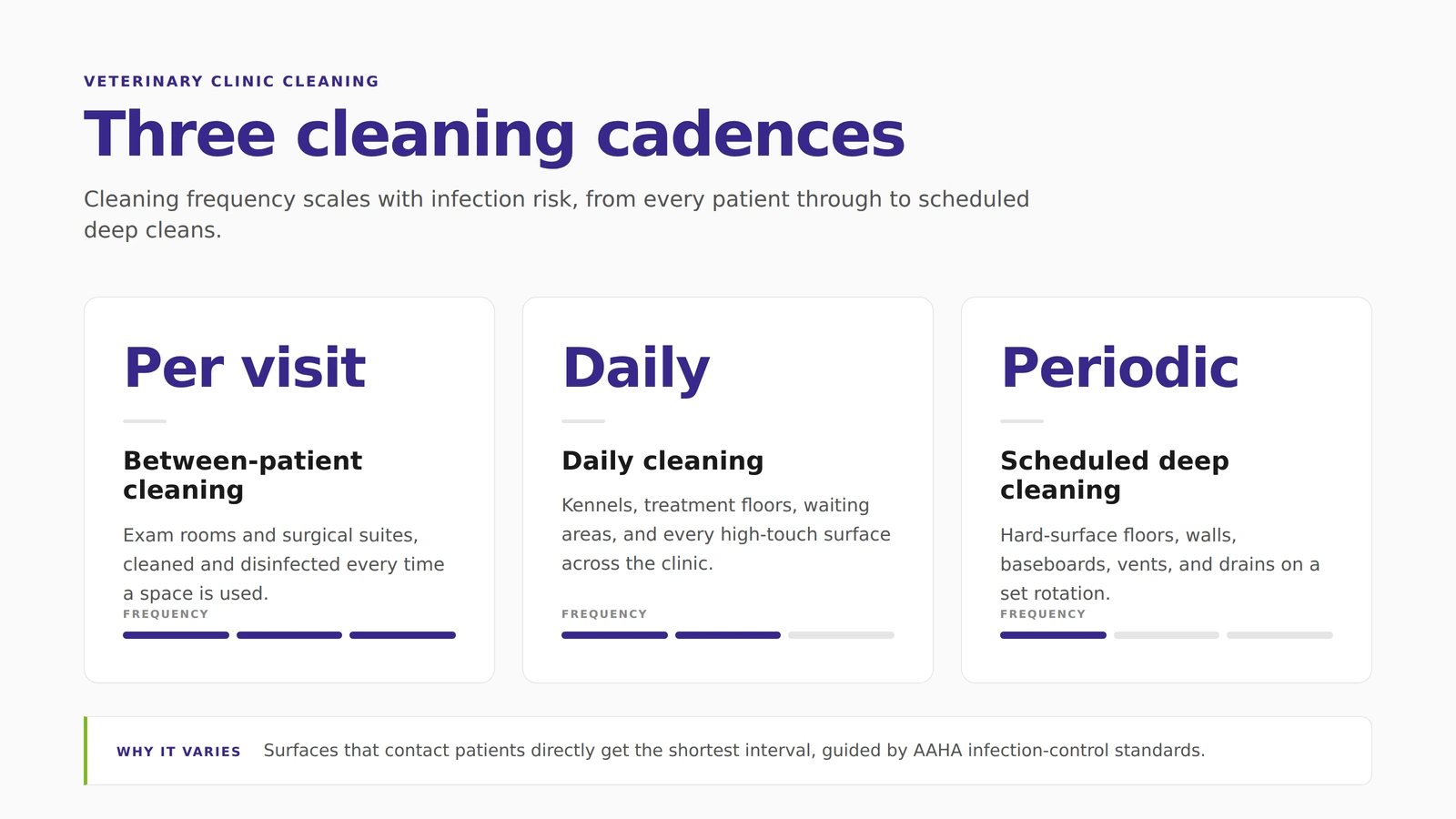
Cleaning frequency in a veterinary facility is driven by risk, not by a single schedule. Rather than a fixed weekly visit, an effective program layers three cadences:
Between-patient and between-procedure cleaning for exam rooms and surgical suites, performed every time a space is used.
Daily cleaning for kennels, treatment floors, waiting areas, and all high-touch surfaces.
Periodic deep cleaning for hard-surface floors, walls, baseboards, vents, and drains on a scheduled rotation.
AAHA's environmental-surface guidance frames frequency this way because the highest-risk surfaces, the ones that contact patients directly, need the shortest interval, while structural surfaces can be handled on a longer cycle without raising infection risk.
What to Look for in a Veterinary Cleaning Provider
Not every commercial cleaner is equipped for an animal hospital. When evaluating a veterinary cleaning provider, look for demonstrated infection-control knowledge, not just general janitorial experience. The right partner should be able to explain animal-safe product selection, show how they segregate tools between clinical and public zones, and document their protocols and cleaning schedules so the practice has an auditable record.
Ziva Cleaning Services approaches veterinary facilities as the medical environments they are. Our team works from specialized medical-facility cleaning protocols, uses EPA-registered disinfectants matched to the pathogen risk of each area, and builds a documented plan around your clinic's exam rooms, surgical suites, kennels, and isolation needs. As a cleaning company that is certified, bonded, insured, and staffed by background-checked technicians, we hold ourselves accountable to the same standards your patients depend on.
If you manage a veterinary practice in Berks County or the surrounding area, we can walk your facility and build a cleaning program around it. Schedule a free on-site assessment to get started.


