

Physical therapy clinic cleaning is the disinfection of shared therapy equipment, treatment surfaces and clinical floors in an outpatient setting where patients arrive continuously and no sterile procedures take place. OSHA lists synovial fluid as a potentially infectious material in 29 CFR 1910.1030, which brings a typical outpatient physical therapy clinic inside the Bloodborne Pathogens Standard.
What Makes Physical Therapy Clinic Cleaning Different?
An outpatient therapy clinic sits in an awkward gap between an office and a clinical facility, and most cleaning contracts are written for one or the other. There is no sterile field, no operating room turnover and no terminal clean. What there is instead is sustained, direct skin contact with surfaces that twenty or thirty patients will touch over a single day, often with exposed skin, fresh surgical scars or healing wounds.
That combination is why the regulatory picture surprises people. The OSHA Bloodborne Pathogens Standard applies wherever occupational exposure to blood or other potentially infectious materials is reasonably anticipated, and paragraph (b) of the standard names synovial fluid directly in its definition of those materials. Joint fluid is not an edge case in a therapy setting. Add post-surgical incisions that weep during manual therapy, abrasions under a gait belt, and the fact that housekeeping staff handle soiled linens and waste, and the exposure is foreseeable rather than hypothetical.
The federal benchmark for scope is the CDC's Guide to Infection Prevention for Outpatient Settings, which sets out minimum expectations for ambulatory care built on Standard Precautions and ships with a fillable checklist. Practice managers can use the environmental cleaning portion of that checklist as a direct comparison against what their cleaning contract actually covers. Where the contract is thinner than the checklist, that gap is the clinic's to answer for during an inspection, not the vendor's.
Ziva Cleaning Services builds therapy clinic scopes around that gap rather than around a generic janitorial template. Our medical cleaning services teams work across outpatient settings that face the same room-turnover pressure walk-in clinics face, where the cleaning has to happen inside a working day rather than after one.
What Gets Disinfected Between Patients in a Therapy Gym
The therapy gym is the part of the clinic most often under-specified in a cleaning contract. It functions much like a fitness floor, with the same high-contact grips and shared surfaces, but the people using it have compromised skin integrity and recent surgical histories. The protocols for shared fitness equipment are a useful starting point, though the clinical stakes raise the bar on frequency and documentation.
Item | Handling |
|---|---|
Parallel bars, handrails, grab rails | Clean and disinfect after each use |
Walkers, crutches, canes | Clean and disinfect before another patient uses them |
Exercise equipment grips, handles, seats, pads | Clean and disinfect between patients |
Transfer aids and slide boards | Clean and disinfect between patients |
Gait belts | Single patient. Launder before reuse or when soiled |
TheraBands, putty, exercise balls | Single patient, not shared between caseloads |
Bulk lotions, gels and massage creams | Dispense, never dip. No returning product to the container |
TENS units | Disposable electrodes. Disinfect the unit per manufacturer instructions |
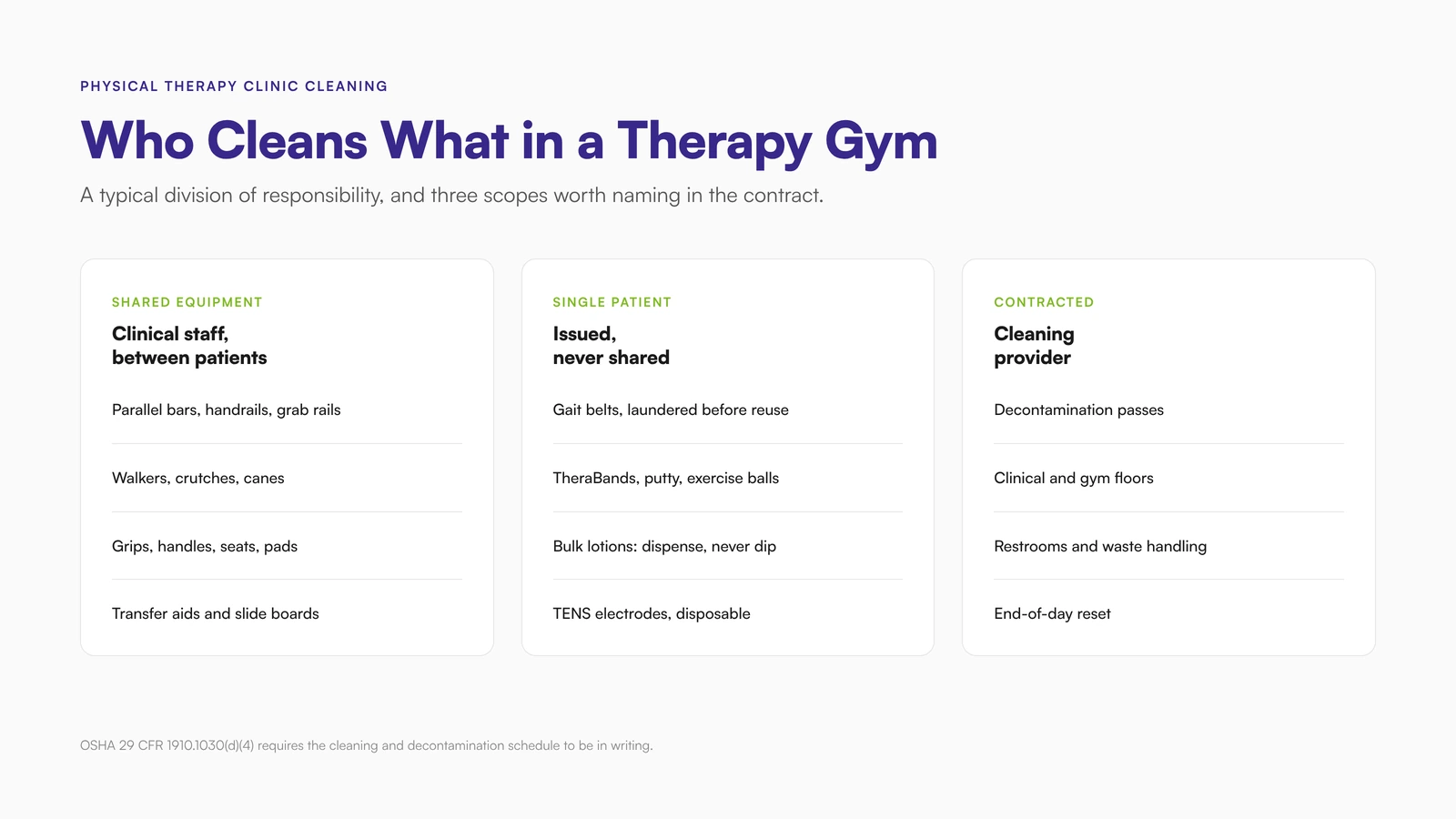
The second half of this question is the one practice managers actually ask: who does it? In most clinics the point-of-care wipe-down between patients belongs to clinical staff, because it has to happen in the ninety seconds between appointments and nobody else is standing there. The contracted cleaning scope covers the scheduled decontamination passes, floors, restrooms, waste handling and the end-of-day reset. Problems start when neither party has that split in writing and both assume the other owns the equipment. A good contract names the items by category and assigns each one. For the clinical side of that division, a room-by-room cleaning checklist gives staff something concrete to work from.
Treatment Tables, Bolsters, and Linens Between Patients
Treatment surfaces need a full wipe rather than a pass, and the disinfectant has to stay wet for its labelled contact time before it is dried or covered. A table wiped and immediately re-papered has been cleaned, not disinfected. This is the distinction between when a surface needs disinfecting rather than sanitizing, and in a treatment room it almost always needs the former.
Positioning equipment gets missed more than the tables do. Bolsters, wedges and pillows with sealed covers take the same treatment as the table surface. Fabric covers are laundry, not a wipeable surface, and they need to leave the room when they are soiled. Face cradles and the cushions around them collect respiratory contact and should be on the same between-patient cycle as the table.
Linen handling is where OSHA becomes specific. Under the housekeeping provisions at 29 CFR 1910.1030(d)(4), contaminated laundry must be handled as little as possible and with a minimum of agitation, bagged or containerized at the location where it was used, and not sorted or rinsed there. Shaking out a sheet in the treatment room to see whether it is reusable is the exact practice the standard rules out.
On products, the governing rule is to follow both the disinfectant label and the equipment manufacturer's instructions for use. Treatment surfaces vary in material, and the manufacturer's documentation is the authority on what is compatible with a given table. Our team checks that documentation before a product goes on a clinic's approved list, because replacing treatment furniture costs considerably more than selecting a different disinfectant.
Hydrotherapy Tanks: What CDC Guidance Requires
Many outpatient clinics have retired their whirlpools over the past decade, so this section applies only where hydrotherapy is still in use. Where it is, the standards are stricter and more specific than anything else in the building.
CDC guidance on water use in hydrotherapy tanks directs that equipment including Hubbard tanks, tubs, whirlpools and whirlpool spas be drained and cleaned after every patient, with surfaces and components disinfected using an EPA-registered product according to the manufacturer's instructions. Where no EPA-registered water treatment product is available, the guidance gives concrete chlorine residual targets: 15 ppm for small hydrotherapy tanks, Hubbard tanks and tubs, and 2 to 5 ppm for whirlpools and whirlpool spas.
Three details in that guidance get overlooked in practice. Tub liners do not remove the requirement to clean and disinfect the equipment underneath them. Chairs and trolleys that come into contact with the patient or with tank water need disinfection on the same cycle as the tank. And for larger therapy pools, the guidance calls for a patient risk assessment, with patients who have draining wounds or fecal incontinence deferred until the condition resolves.
Floor Care in Gait Training and High-Traffic Therapy Areas
Floor finish in a therapy clinic is a patient safety decision before it is an appearance decision. A gait training area is a room where people with impaired balance are deliberately walking at the edge of their ability, and a high-gloss finish that looks impressive in a lobby is the wrong specification for that floor. Slip resistance should drive the product choice, with appearance as a secondary consideration.
Wet floor windows have to be scheduled rather than improvised. Mopping a therapy gym while patients are moving through it introduces exactly the hazard the clinic spends its day working against, which means floor work belongs in a block when the room is empty and the floor has time to dry completely before the next session.
Soft flooring needs its own cycle. Mat areas and any carpeted zones hold contamination that surface disinfection does not reach, and they need a periodic extraction schedule written into the contract rather than handled on request. Wheelchair and walker traffic also wears visible tracks along the main routes between the waiting area and the treatment floor, and those lanes need attention at a different frequency than the rest of the room.
How to Build a Written Cleaning Schedule for a Clinic With No Overnight Window
OSHA does not leave the schedule to judgment. Paragraph (d)(4) of the Bloodborne Pathogens Standard requires the employer to determine and implement an appropriate written schedule for cleaning and method of decontamination, based on the location within the facility, the type of surface, the type of soil present and the tasks being performed. For most outpatient clinics, the cleaning contract is that written schedule, or the clinic does not have one.
The operational complication is that a clinic running from seven in the morning to seven at night has no overnight window. There is no equivalent of the post-close terminal clean that a surgical center relies on, which pushes clinics toward a two-tier model: point-of-care turnover handled by clinical staff throughout the day, and scheduled contractor passes that cover the areas staff cannot reach between appointments. Clinics with sustained throughput often add day porter coverage so that restrooms, waiting areas and spills are handled while the building is occupied rather than twelve hours later.
Cleaning around patients also raises privacy obligations that an after-hours contract never has to address. Technicians working during treatment hours will pass open charts, unlocked screens and conversations between clinicians and patients. Our teams are trained to avert eyes from patient information, and every technician is background-checked, bonded and insured before entering a clinical environment.
Physical Therapy Clinic Cleaning in Exeter Township
Exeter Township holds one of the denser outpatient clusters in Berks County, concentrated along the Perkiomen Avenue corridor and around Demoss Road, where outpatient centers, physical therapy practices, imaging and urgent care sit within a few minutes of each other. Clinics here serve patients from Reiffton, Lorane, Jacksonwald, Stonersville and the surrounding townships.
One practical note for anyone searching for a local provider: the township has no post office of its own, so Exeter Township addresses are written as Reading, PA 19606. A clinic on Perkiomen Avenue and a clinic in downtown Reading can share a city line on paper while sitting in different markets, which is worth keeping in mind when comparing quotes or checking whether a vendor actually covers the township.
Ziva Cleaning Services has worked across Berks County for more than fourteen years, serving healthcare facilities alongside other business types across the township. Our clinic scopes are built item by item rather than sold as a package, because a practice with hydrotherapy and three treatment rooms needs a different written schedule than a single-therapist studio. If you would like to see what that looks like for your clinic, we offer a free on-site assessment and a written scope you can compare directly against the CDC outpatient checklist.


