

Choosing a medical cleaning company comes down to verification, not marketing claims. Ask which EPA pathogen list matches your facility's risks, request OSHA 29 CFR 1910.1030 bloodborne pathogen training records, and confirm the written scope of work. The EPA maintains separate registered product lists for C. difficile, MRSA, TB, and bloodborne pathogens.
Most vendor evaluations fail because every provider gives the same answers. They all say they have healthcare experience, trained staff, and hospital-grade disinfectants. Those claims cost nothing to make and tell you nothing. The questions below have answers you can check against a document, a product label, or a federal list.
What Separates a Medical Cleaning Company From a General Janitorial Service
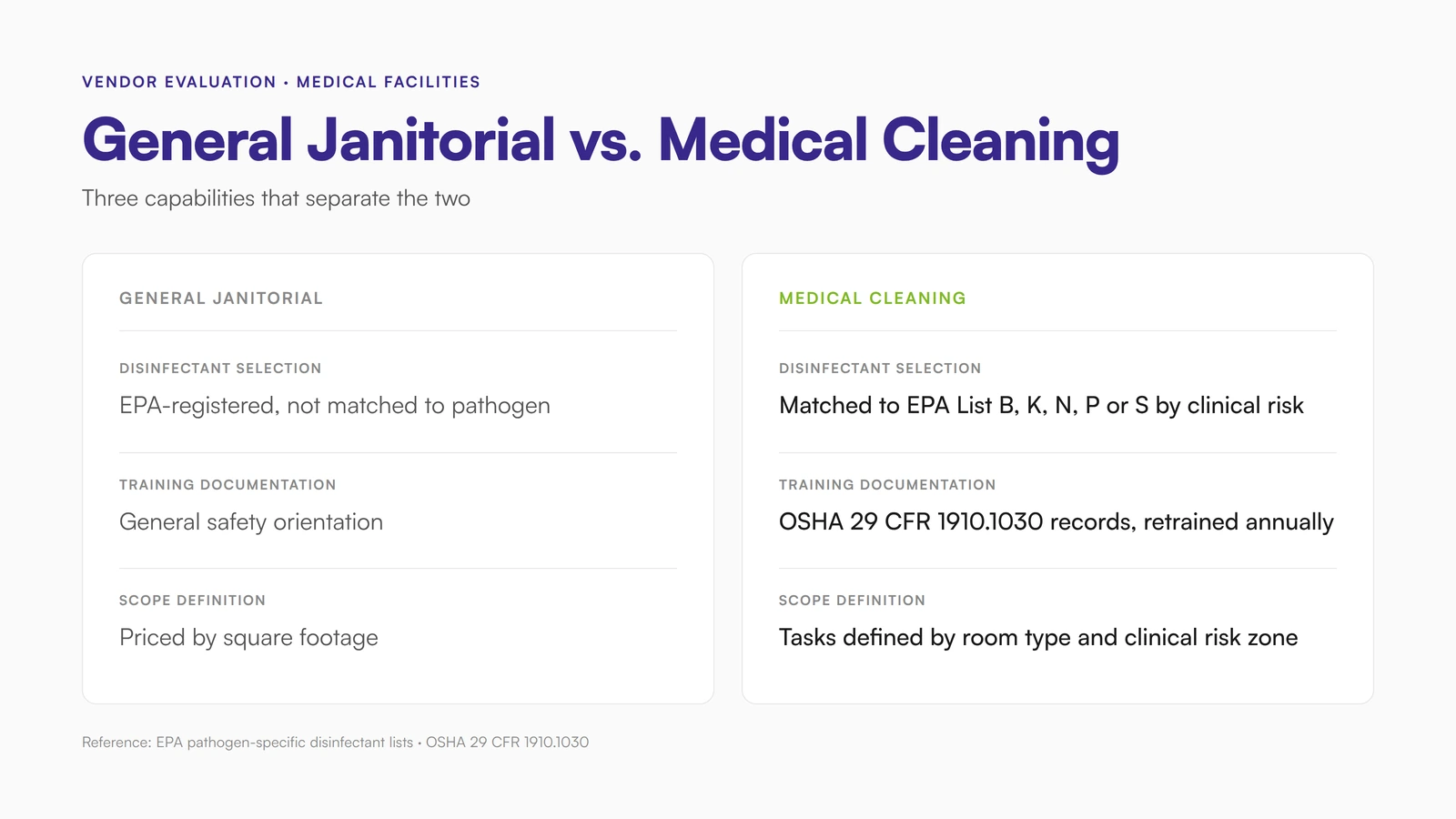
Three things separate a genuine healthcare cleaning provider from a commercial cleaner with a medical page on their website: pathogen-specific disinfectant selection, documented bloodborne pathogen training, and a written scope tied to clinical risk zones rather than square footage.
A general janitorial crew can leave a waiting room spotless. What they usually cannot do is explain why the disinfectant on their cart carries a tuberculocidal claim, produce annual OSHA training records for the technician assigned to your exam rooms, or describe how cleaning sequence prevents carryover between a treatment room and a break room. Those are the capabilities that matter when a state inspector or an accrediting body asks how your environmental services program works.
Ziva Cleaning Services has built specialized cleaning programs for healthcare environments across Berks County for more than 14 years. If you want the underlying protocols before evaluating vendors, our guide to how clinical cleaning protocols differ from routine janitorial work covers the technical foundation.
Verify Disinfectant Competency, Not Just "EPA-Registered"
Nearly every cleaning company advertises EPA-registered disinfectants. The phrase is close to meaningless on its own, because registration tells you the product went through EPA review, not what it actually kills.
Ask Which EPA List, Not Whether They Use EPA Products
The EPA publishes separate product lists organized by pathogen. A product effective against SARS-CoV-2 may carry no claim at all against C. difficile spores. These are the lists that apply to outpatient clinical settings:
EPA List | Pathogen coverage | Where it matters |
|---|---|---|
List B | Mycobacterium tuberculosis | Pulmonology, urgent care, general practice |
List G | Norovirus | Pediatrics, high-traffic waiting areas |
List H | MRSA and VRE | Wound care, dermatology, podiatry |
List K | Clostridioides difficile spores | Gastroenterology, infusion, long-term care |
List N | SARS-CoV-2 | All patient-facing areas |
List P | Candida auris | Infusion, oncology, immunocompromised populations |
List S | HIV, Hepatitis B, Hepatitis C | Phlebotomy, injections, any bloodborne exposure risk |
List S is the detail worth remembering. The EPA retired Lists C, D, E, and F and consolidated them into List S for bloodborne pathogens. A provider whose standard operating procedures still reference List D is working from a document that has not been updated in years, and that tells you something about the rest of their program.
The Contact Time Test You Can Run During a Walkthrough
Contact time is the interval a disinfectant must remain on a surface to work, and the EPA is specific about the standard: the surface must stay visibly wet for the entire duration, with reapplication if it dries early. A product with a four-minute claim that evaporates in ninety seconds did not disinfect anything.
Watch a technician wipe an exam table, then time it. This single observation reveals more about training quality than any certificate. Our breakdown of the difference between reducing microbes and killing them explains why the distinction changes which product belongs in which room.
Third-party credentials offer a second layer of verification here, since programs like ISSA CIMS and GBAC require a company to demonstrate documented process control rather than self-report it. Our overview of which industry credentials actually mean something covers what each program audits.
Get the HIPAA Question Right Before You Ask It
Most facility managers ask prospective vendors whether they are HIPAA compliant, and most vendors say yes. The question does not mean much, because HIPAA does not certify cleaning companies and the underlying legal analysis is narrower than the industry usually presents it.
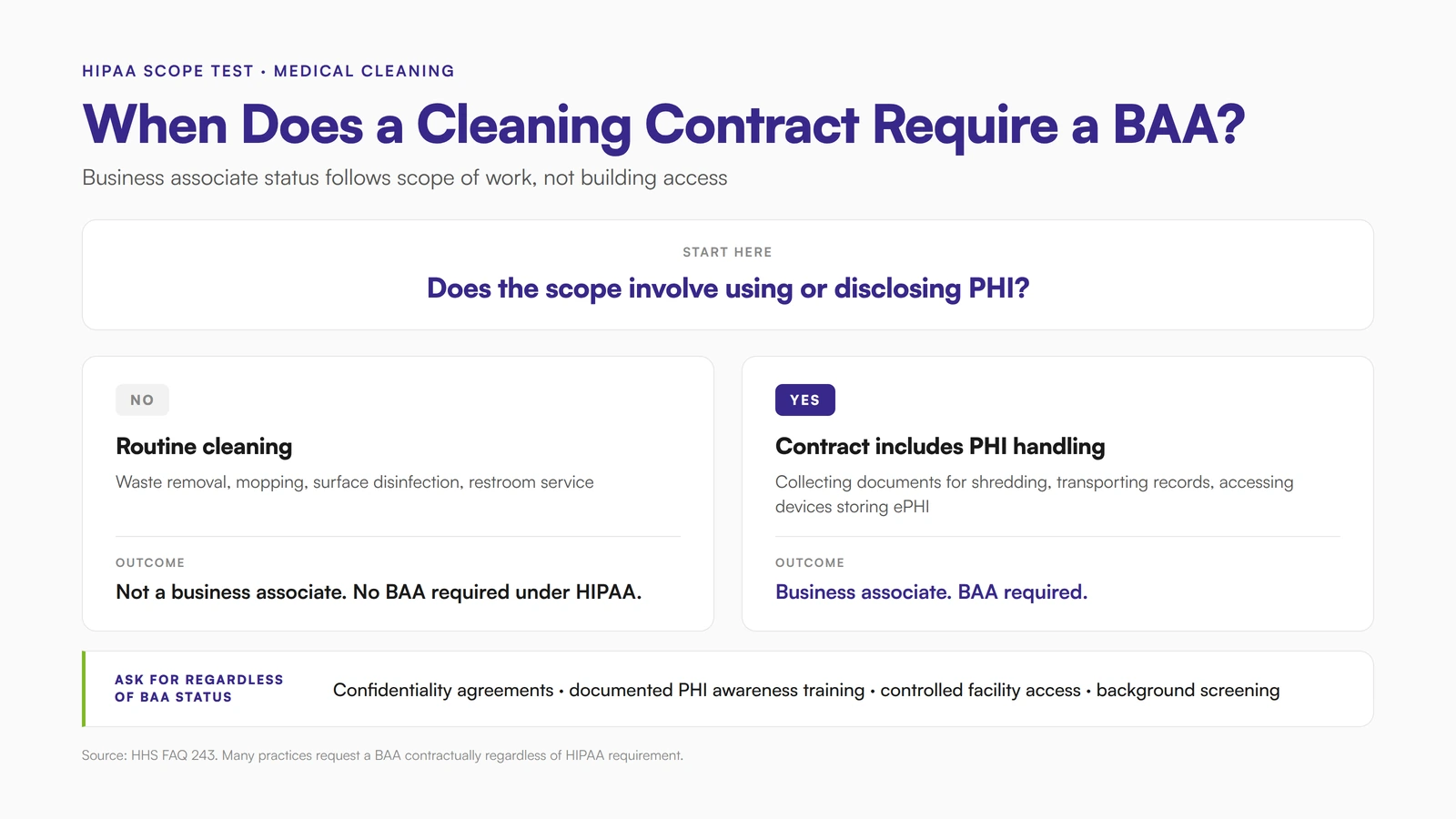
Under HHS guidance on business associate contracts, janitorial services that clean a covered entity's facilities are generally not business associates. Their work does not involve the use or disclosure of protected health information, and any exposure that happens while emptying a trash can is incidental and permitted under the Privacy Rule. A Business Associate Agreement is generally not required for routine cleaning scope.
That analysis changes when scope changes. If your contract includes collecting or transporting documents containing PHI, handling records, or accessing devices that store patient data, the provider does become a business associate and a BAA is required. Many practices also request a BAA regardless, simply to codify expectations and remedies in writing.
The productive questions are different. Ask what your technicians are trained to do when they find a chart left open on a desk. Ask whether every assigned staff member signs a confidentiality agreement and completes documented PHI awareness training before their first shift. Ask how facility access is controlled and logged. Those answers describe actual safeguards.
Ask for Documentation, Not Assurances
Request these five items before signing anything. A provider that serves clinical facilities regularly will have all five ready. One that hesitates is telling you they have not been asked before.
Certificate of insurance: naming general liability limits, workers' compensation coverage, and bonding. Confirm the certificate is current and that your practice can be added as a certificate holder.
OSHA 29 CFR 1910.1030 bloodborne pathogen training records: for the specific technicians assigned to your facility, dated within the last twelve months. The standard requires annual retraining.
Safety Data Sheets: for every product that will enter your building, which your practice needs on file for its own OSHA Hazard Communication obligations.
A written scope of work: listing tasks by room type and frequency, not a per-visit summary. This document is what you hold the vendor to when quality slips.
A background check policy: covering every employee with facility access, including how often checks are refreshed.
A provider that produces all five without friction has been through clinical vendor onboarding before. That fact alone is worth more than a testimonial.
Red Flags That Should End the Conversation
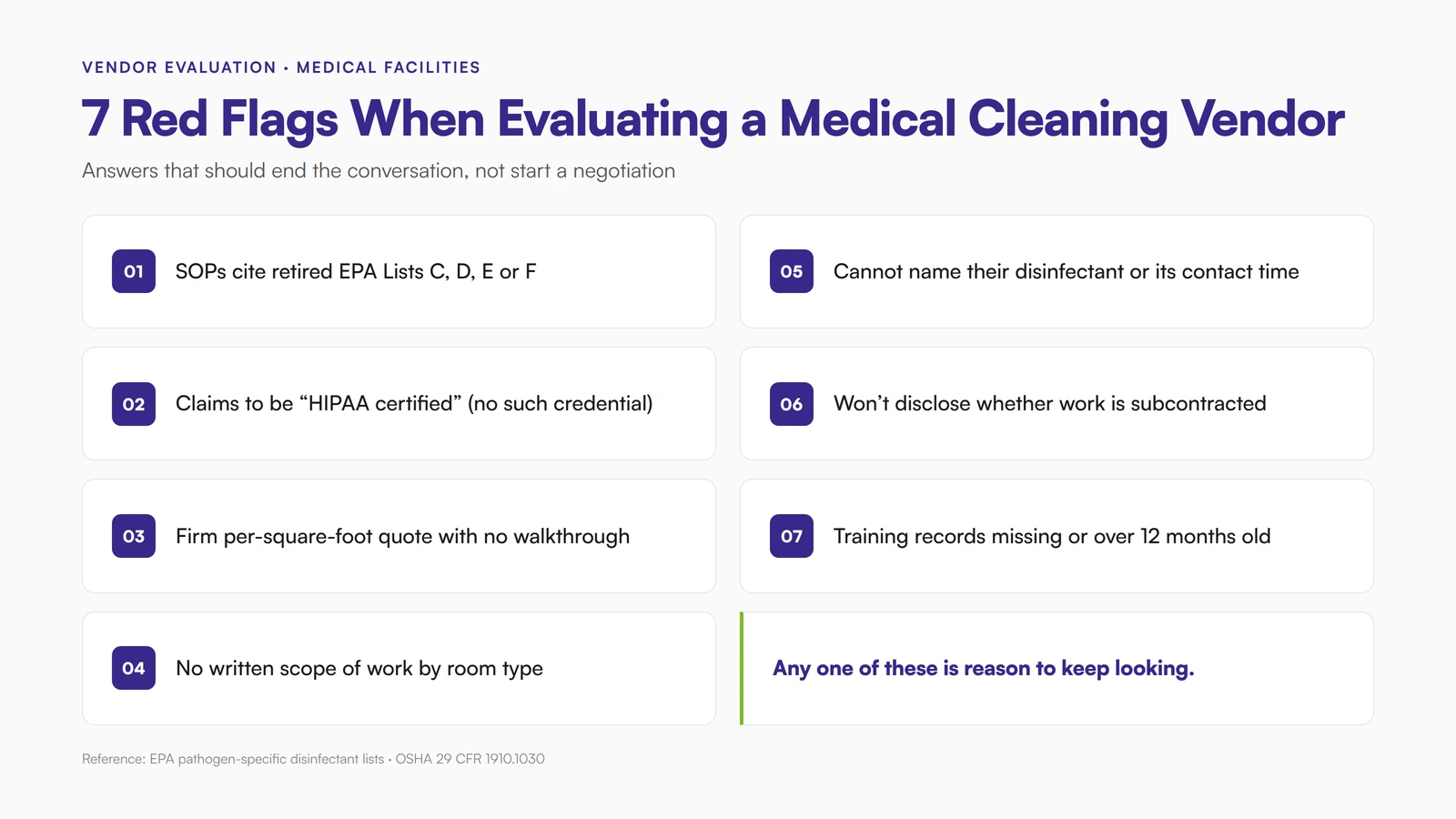
Some answers tell you to stop the process rather than negotiate:
Standard operating procedures citing retired EPA lists such as List C, D, E, or F.
A claim of being "HIPAA certified," which is not a credential that exists.
A firm per-square-foot quote issued without an on-site walkthrough of your clinical spaces.
No written scope of work, only a verbal description or a generic service brochure.
Inability to name the disinfectant they would use and its contact time.
Reluctance to disclose whether any work is subcontracted.
Training records that cannot be produced, or that are dated more than twelve months back.
How to Verify Quality After You Sign
Vetting does not end at the contract. Most cleaning relationships degrade in month four, after the attentive onboarding period ends and before anyone has established a review rhythm.
Build three mechanisms into the agreement itself. Set an inspection cadence with documented findings, so quality is measured rather than sensed. Name a single escalation contact with a defined response window, so an issue in a treatment room does not sit in a general inbox overnight. Schedule a formal review at 30, 60, and 90 days to confirm the scope on paper matches the work being performed.
Also read the exit terms before you need them. Notice periods, key return, and transition obligations are far easier to negotiate at signing. If you are leaving an existing provider, our guidance on planning a clean handover between vendors covers sequencing the changeover without a service gap.
Choosing a Medical Cleaning Partner in Berks County
Local matters here for a practical reason rather than a sentimental one. When a treatment room needs an unscheduled turnover, the question is whether you reach someone who can dispatch a trained technician that afternoon or whether you reach a regional call center that opens a ticket.
Our clients speak directly with the people accountable for the work. Our technicians are background-checked, bonded, and insured, and we build scope documents around each facility's room types and patient flow rather than applying a fixed package. Clinics along the State Hill Road and Spring Ridge medical corridor are a short drive from our headquarters on North Wyomissing Boulevard; our page on medical cleaning for Wyomissing practices sets out what recurring visits cover and what stays with your practice. Every engagement starts with a free on-site assessment, because a quote issued without walking your exam rooms is a guess.
For budgeting context before you request proposals, our guide to what drives the numbers in a healthcare cleaning proposal breaks down the variables that move a quote.
Schedule a free on-site assessment and we will walk your facility, document the scope your practice actually needs, and give you a proposal you can compare line by line against any other provider.


