

Switching commercial cleaning companies without disrupting operations is a three-phase process: pre-switch preparation, a transition window that overlaps both vendors, and a structured first 90 days with the new crew. Most commercial cleaning contracts require 30 to 90 days written notice, which sets the timeline and shapes every decision in the switch.
Phase 1: Before You Give Notice
The prep phase happens entirely behind the scenes. Everything below should be settled before your current vendor knows you are leaving.
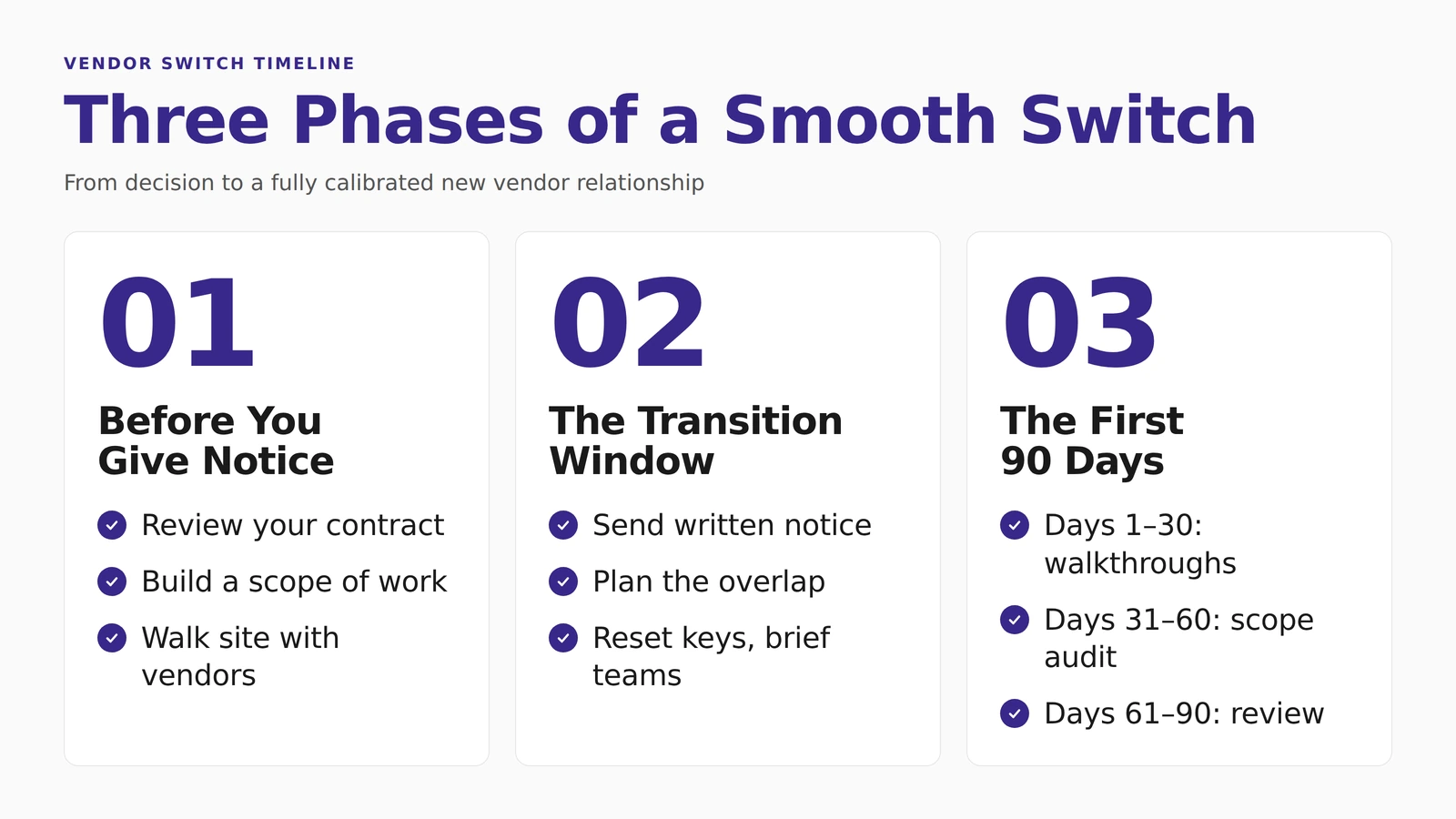
Review your current contract: Pull the contract and find the notice period, the termination clause, and the equipment ownership terms. Notice periods typically range from 30 to 90 days. Termination clauses often distinguish between cancellation for cause (immediate) and cancellation without cause (full notice required). Watch for an auto-renewal clause that locks you in if notice is missed by a single day.
Build a clear scope of work: A scope-of-work document is what every prospective vendor will quote against. Without it, bids are not comparable. Build a daily, weekly, and monthly task baseline covering every area, frequency, and specialty requirement in your facility.
Walk the facility with prospective vendors: Walk every floor with each shortlisted vendor. This is when the due-diligence questions to ask new vendors get answered in real time. Ziva Cleaning Services structures every prospective walkthrough around the same checklist.
Walkthrough and handoff inventory checklist:
Scope-of-work line items mapped vendor-to-vendor
Certificate of insurance verified for liability, workers' comp, and bonding
Equipment ownership confirmed for floor machines, dispensers, and supplies
Building access points documented, including after-hours protocols
Specialty areas flagged: medical zones, vaults, server rooms, kitchens
Compliance requirements named: HIPAA, OSHA, NFPA 96, EPA-registered products
Supply storage and chemical lockers inventoried
Key, fob, and badge count reconciled
Alarm codes and access credentials listed for reset
Emergency contacts and after-hours response expectations defined
Phase 2: The Transition Window
Most switches fail here, almost always because of poor communication between the outgoing vendor, the incoming vendor, and the facility manager. The window typically runs the length of your contract notice period.
Send formal written termination notice: Use certified mail or a traceable electronic format. Date the notice, keep a copy, and reference the contract's specific termination clause. A verbal notice or unconfirmed email is not enough. Outgoing vendors occasionally claim notice was never received, which extends your billing cycle by 30 or 60 days.
Plan the overlap so service never gaps: Schedule your incoming cleaning provider to stage equipment and supplies in the building 48 hours before their official start date. We coordinate this directly with the outgoing vendor's account manager to confirm storage handoff, key transfer logistics, and the final-night cutover plan.
Overlap-period billing matrix:
Notice scenario | Overlap structure | Billing approach |
|---|---|---|
30-day notice, urgent switch | New vendor starts Day 31; outgoing services through Day 30 | Outgoing billed in full; new vendor billed from Day 31 |
60-day notice, standard switch | New vendor stages Days 50 to 60; full service Day 61 | Pro-rate any reset deep-clean between vendors |
90-day notice, complex facility | New vendor shadow-cleans the final 2 weeks | Negotiate outgoing reduction for overlap nights |
Transfer keys, badges, and alarm codes on the final shift: Security exposure is the single largest risk in any vendor switch. On the outgoing vendor's last night, inventory every master key, fob, and badge against the original count. Deactivate every old access credential. Reset alarm codes the moment the new vendor takes possession. Never give the new vendor the codes the previous crew used.
Communicate the change to employees and tenants: Send a brief, neutral announcement two weeks before the switch. Name the new vendor, the effective date, and where to direct feedback.
Internal staff template: "We are transitioning our cleaning services to [new vendor] effective [date]. The new crew may take a few weeks to learn our building. Please direct feedback to [facility contact]."
Tenant template (property managers): "Effective [date], a new cleaning provider will service the building. Service times and standards remain the same. Contact [facility contact] with any questions."
Vendor handoff confirmation: "This confirms [outgoing vendor]'s final service date as [date] and [new vendor]'s start date as [date]. All access credentials will be reset on [date]."
Transition Risks by Industry
Compliance handoff is industry-specific. Generic transition advice fails when the facility has regulated obligations the new vendor must continue from Day 1.
Medical and healthcare: The HIPAA Business Associate Agreement must be re-executed with the new vendor before service starts. The HIPAA cleaning protocols a new vendor must adopt include OSHA Bloodborne Pathogens training documentation, which transfers under OSHA 29 CFR 1910.1030.
Financial and banking: Vault and after-hours access requires re-cleared staff and escort re-coordination. Alarm-code reset is non-negotiable, and chloride-free cleaning agents must continue in vault zones.
Industrial and manufacturing: OSHA forklift, PPE, and chemical-exposure training documentation must transfer with the incoming crew before they enter the production floor.
Post-construction (mid-project): Phase documentation (rough vs. final cleaning) must hand off cleanly so the new vendor picks up at the correct project stage.
Restaurant and food service: NFPA 96 kitchen hood cleaning schedules and FDA food-contact protocols must continue uninterrupted through the switch.
Your First 30, 60, and 90 Days With the New Vendor
Days 1 to 30, weekly walkthroughs: Walk the site weekly with the new account manager. Verify every line on the original walkthrough checklist is being delivered. Review the first supply invoice line-by-line. Most vendor disputes in month one trace back to ambiguous scope or supply line items that were never agreed in writing. Preparing your facility for the first night of service reduces almost all of these issues.
Days 31 to 60, scope adherence audit: Collect feedback from employees who see the facility daily. Surface any zones being missed, any frequency that has slipped, and any specialty area where the new crew needs additional training.
Days 61 to 90, formal performance review: Hold a structured performance review with the account manager. Response time on requests, inspection scores, supply spend, and missed-task incidents. This sets the baseline you will measure against for the remaining contract term.
Common Pitfalls That Derail a Vendor Switch
The outgoing vendor reduces effort in the final weeks
Notice period and new-vendor start date misalign, creating a service gap
Skipped walkthrough means the new vendor underquotes and under-delivers
Old access credentials stay active, creating security exposure
No employee announcement creates resistance to the new crew.
Looking for a transition-ready partner in Reading, Berks County, or the surrounding region? Our team has managed cleaning vendor handovers across 14 industries for more than a decade. Schedule a free on-site assessment and we will walk your facility, build a scope, and prepare a clean handover plan with no obligation.


