

Retail cleaning services are commercial cleaning programs built for stores, boutiques, malls, and shopping centers, with daily, multi-shift, or after-hours visits depending on store traffic. They cover the full customer-facing footprint, from entryways and sales floors to fitting rooms, restrooms, and checkout zones, and typically scale up around peak shopping periods.
Retail is the largest private-sector employer in the United States, supporting 55 million jobs and contributing $5.3 trillion to annual GDP, according to the National Retail Federation. Cleaning programs for that footprint are a distinct category of commercial work, with their own scope, schedule, and operating logic. This guide covers what retail cleaning includes, how it differs from general janitorial work, the delivery models used in the industry, and what to look for in a provider. Ziva Cleaning Services has worked with various retail clients since 2011 and the patterns covered here come directly from that work.
What's Included in Retail Cleaning Services
The baseline scope of a retail cleaning program falls into five recurring categories. Anything outside that scope is treated as a specialty add-on rather than part of the routine cleaning rotation.
Customer-facing zones come first because they shape the shopper's first impression. Entryways and sales floors need spot-mopping, dust control, and trash response throughout the day, with deeper floor work scheduled around closing or off-peak hours. Glass doors, storefront windows, and interior mirrors get streak-free cleaning at a frequency that matches foot traffic. Fitting rooms get the most overlooked attention in retail cleaning, including surface wipe-downs, floor maintenance, and mirror care between busy periods.
Restrooms are the second core zone, and they carry heavy reputational weight in retail. Fixtures, surfaces, and high-touch points get cleaned and disinfected on a schedule, with consumables restocked and waste removed throughout open hours.
Checkout and high-touch surfaces include counters, card readers, payment terminals, scanner glass, and any display fixtures shoppers handle directly. These see the highest contact frequency in the store, so they get treated as a separate cleaning rotation rather than folded into general dusting.
Back-of-house zones cover breakrooms, stockrooms, and staff restrooms. Shoppers never see them, but the standard a store sets here shows up in employee morale and daily operations.
Cross-cutting tasks include floor care, dusting, and trash management that run across all zones. For a full task breakdown by frequency, see our daily and weekly task breakdown for busy stores.
Retail Cleaning vs. General Janitorial vs. Office Cleaning
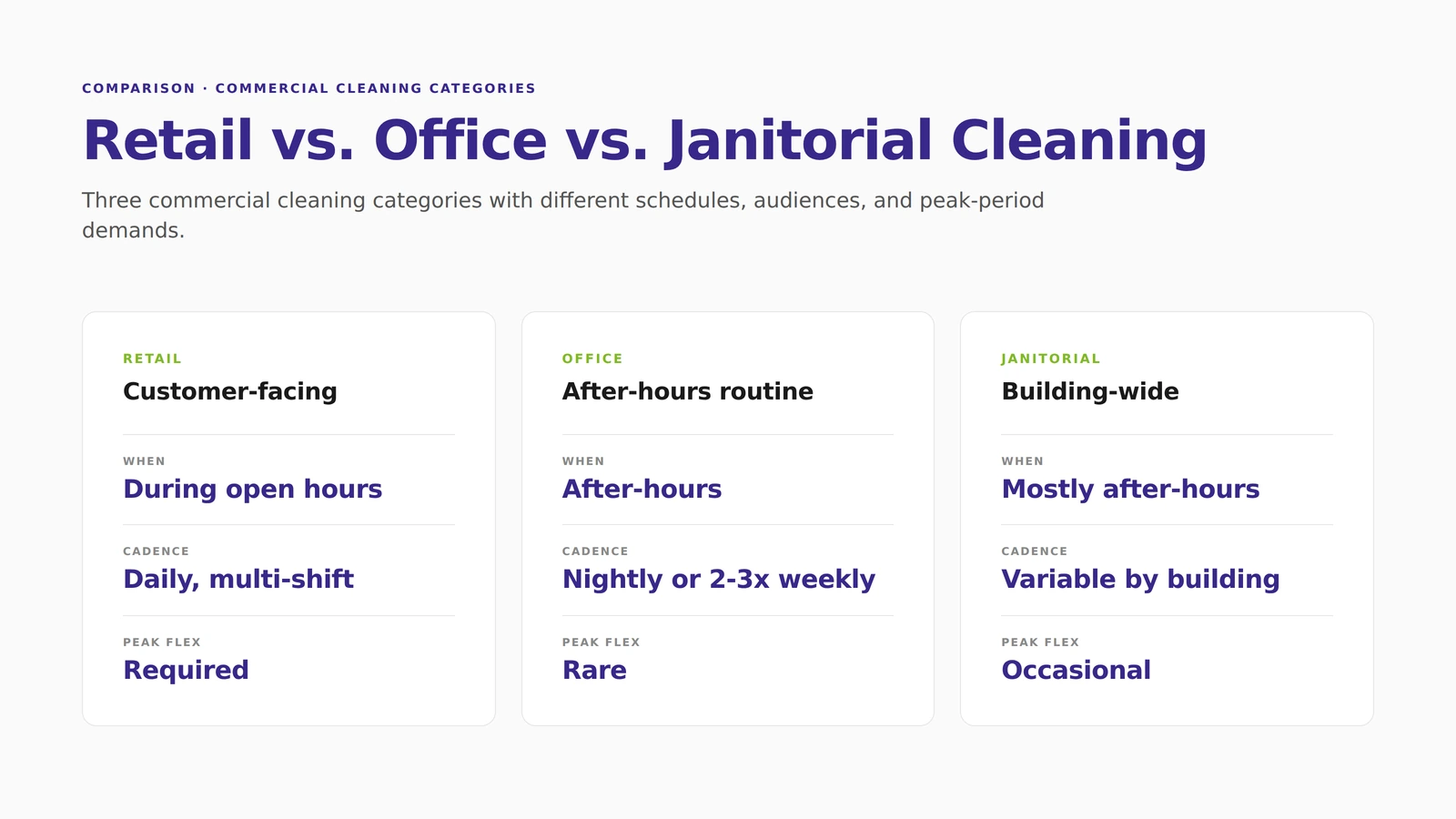
Retail cleaning shares a lot of the same task vocabulary as general janitorial and office cleaning, but the operating reality is different in three meaningful ways: the schedule, the customer-facing pressure, and the peak-period flexibility.
Factor | Retail Cleaning | Office Cleaning | General Janitorial |
|---|---|---|---|
Primary audience | Customers and staff | Employees only | Building occupants |
Visibility of cleaning | Often during open hours | Almost always after-hours | Mostly after-hours |
Schedule pattern | Daily, multi-shift, or extended hours | Nightly or 2 to 3 times per week | Weekly to nightly, varies by building |
Peak flexibility | Required for holidays, sales, events | Rare | Occasional |
Restroom standard | Customer-facing, frequent restocking | Employee standard | Variable |
Floor care intensity | High due to foot traffic, salt, water | Moderate | Variable |
The shorthand version: office cleaning operates on a routine that the people in the building rarely see. General janitorial covers a broad range of building types with no strong customer-facing component. Retail cleaning runs in front of paying customers, on schedules that flex with seasonal traffic, with fitting rooms and restrooms held to a consistently presentable standard because shoppers actively use them.
That's why a store hiring a general janitorial provider often ends up disappointed: the schedule and scope work for an office, but they don't account for a Saturday rush, a holiday week, or a fitting room that needs attention every two hours.
How Retail Cleaning Services Are Delivered
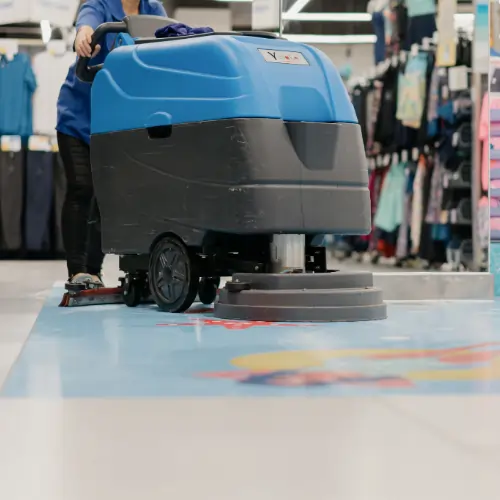
Retail cleaning programs are typically built around four delivery models, sometimes used in combination depending on store size, traffic, and operating hours.
Day porter service puts a dedicated cleaner on-site during open hours, handling spills, restroom restocking, fitting room turnover, and high-touch sanitization in real time. This model is common in malls, big-box stores, and any retail environment where messes need to be addressed before customers see them. For a closer look at the role itself, see what a day porter actually does on-site.
After-hours and overnight cleaning runs when the store is closed, allowing for deeper floor work, full restroom resets, dust control, and stocking without disrupting customers. Most independent stores and small chains rely on this model for their core scope.
Recurring contracts vs. one-off visits describe the cadence rather than the timing. Recurring programs run on a fixed schedule (daily, three times a week, or weekly) and are how most retail stores maintain consistent standards. One-off visits cover deep cleans, post-event cleanups, store openings, and remodel handovers.
Single-store vs. multi-site programs is the structural question. A single-store program is straightforward to build and manage. Multi-site programs (regional chains, mall tenants, franchise operators) need a provider who can deliver the same standard across locations, with consistent reporting, account management, and a clear escalation path. Not every retail cleaning company is set up to scale this way.
Who Needs Retail Cleaning Services
Retail cleaning programs are not one-size-fits-all. We work with three main buyer types, each with different operational realities and different reasons for outsourcing.
Independent boutique and small store owners
Typically run with a small staff and limited time for cleaning beyond surface tidying. They hire a retail cleaning provider to handle the work that doesn't fit into a sales associate's day, including deep restroom cleaning, floor care, and consistent fitting room turnover. Cost predictability and flexible scheduling tend to matter more to this group than enterprise-grade reporting.
Mall, shopping center, and multi-tenant property managers
They are responsible for common areas, food courts, restrooms, and exterior approaches across multiple tenants. Their cleaning program covers building-level scope rather than individual stores, which means a more complex schedule, larger crew, and tighter coordination with tenant operating hours. Day porter coverage is almost always part of the program at this scale.
Big-box district managers and franchise operators
They are managing standards across multiple locations. Consistency is the operating priority, so the program is structured around standardized scope, performance reporting, and a single point of contact for escalations across stores.
If you're weighing whether outsourcing makes operational sense for your store, the case for outsourcing your store's cleaning walks through the financial and operational considerations.
Specialty Services That Extend a Retail Cleaning Program
Beyond the baseline scope, retail cleaning programs often include specialty services that handle work outside the daily rotation. These typically run on their own schedule (monthly, quarterly, or as-needed) and require dedicated equipment and training.
Window cleaning covers exterior storefront glass, interior partitions, and high windows in atriums or skylit spaces. Storefront windows in high-traffic retail need attention more often than the typical commercial frequency, especially during weather seasons that bring rain and salt residue.
Pressure washing addresses sidewalks, building facades, parking areas, and exterior approaches. For street-facing retail and shopping centers, the entry approach is part of the customer experience and benefits from quarterly or semi-annual treatment.
Hard-floor care and polishing includes stripping, waxing, and burnishing for tile, vinyl, and polished concrete. Retail stores with high foot traffic see floor finishes wear faster than offices, which is why floor care is one of the most common specialty add-ons.
Carpet cleaning and extraction covers the carpeted zones a routine vacuum can't restore, particularly fitting room carpets, runner mats, and back-of-house offices.
Post-remodel cleanup is a one-off service that handles the dust, debris, and detail work between a remodel finishing and the store reopening. Retail remodels generate fine dust that settles on fixtures and merchandise long after the contractors leave.
We coordinate these as part of an integrated retail program rather than as separate vendors, which keeps scheduling simple and avoids gaps between scope.
What to Look for in a Retail Cleaning Provider
The vetting criteria for a retail cleaning provider differ from the questions a typical office or building manager would ask. Five things matter most.
Industry experience: A provider that has cleaned office buildings doesn't automatically know how to handle a sales floor during a Saturday rush. Ask for retail-specific references and case examples, not general commercial work.
Insurance, bonding, and background-checked staff: Retail environments have public-facing exposure, expensive merchandise, and after-hours access. Verify general liability coverage, workers' compensation, bonding for theft protection, and that all on-site personnel are background-checked.
Scheduling flexibility for peak periods: Holidays, sales events, mall-wide promotions, and seasonal traffic create cleaning loads that can double or triple normal volume. A provider that runs on a rigid schedule will not keep up. Ask how they handle peak weeks before signing.
Quality assurance and reporting: For multi-site or larger single-store accounts, a structured QA system matters. That includes documented inspections, issue logs, and a way for the store contact to flag problems without playing phone tag.
Communication and account management: A clear point of contact, a standing communication cadence, and a defined escalation path. The cleaning provider should know your store's quirks and your team should know who to call.
Pricing varies considerably by store size, frequency, and scope, and is best handled in a customized assessment. For a sense of the variables involved, our breakdown of retail cleaning rates and what drives them covers the main factors.
If you're shopping for a retail cleaning provider, the next step is a free on-site assessment. Our team will walk the store, scope the work against your operating hours and traffic patterns, and put together a proposal that covers the full footprint without surprises. Schedule a free assessment and we'll take it from there.


