

Flu season cleaning protocols are a tiered plan that raises how often a workplace cleans and disinfects shared surfaces as flu activity rises. The CDC reports that U.S. flu activity most often peaks between December and February, so Pennsylvania offices and facilities should have the plan written and running before the winter holidays.
Ziva Cleaning Services has worked in commercial cleaning for 15+ years, and this guide sets out the protocol we recommend as part of our commercial cleaning programs. It covers which surfaces matter, how often to treat them, which disinfectants carry a flu claim and which safety rules apply. It follows current CDC and EPA guidance.
What Are Flu Season Cleaning Protocols?
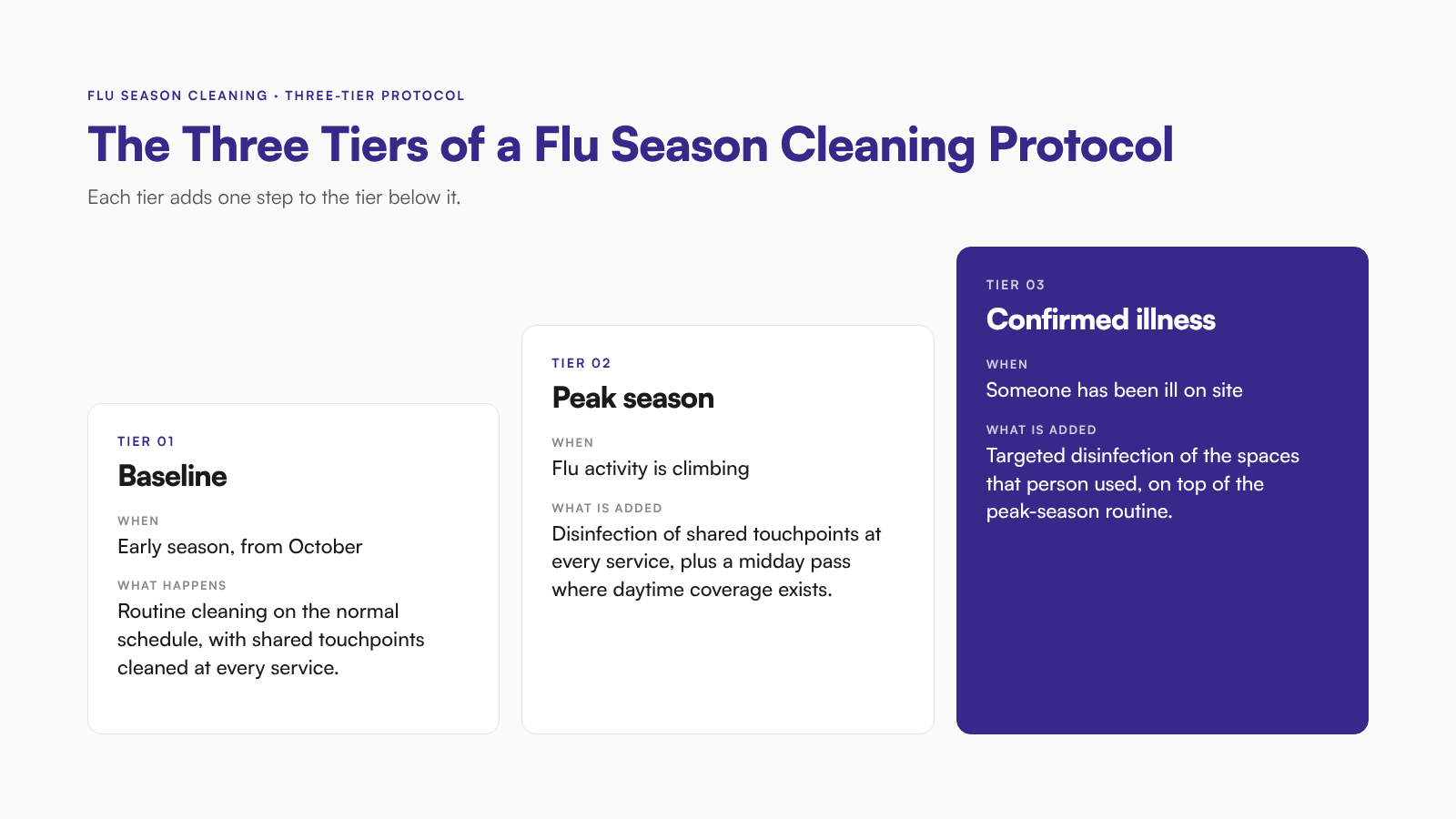
Flu season cleaning protocols are written instructions that tell a cleaning crew what changes when respiratory illness is circulating. They name the surfaces that get extra attention, the frequency, the product, and the person who decides when to step up or step down. A workable protocol has three tiers:
Baseline (early season): routine cleaning on the normal schedule, with shared touchpoints cleaned at every service.
Peak season: disinfection of shared touchpoints added at every service, plus a midday pass where the building has daytime porter coverage.
Confirmed illness: targeted disinfection of the areas a sick person used, on top of the peak-season routine.
The CDC's guidance on cleaning and disinfecting a facility says that "in most situations, cleaning regularly is enough to prevent the spread of germs," and it reserves disinfection for areas "where people have obviously been ill." That guidance covers buildings in community settings such as offices, gyms and businesses. It is not intended for healthcare settings, which follow their own infection-control rules.
When Is Flu Season in Pennsylvania?
Flu season in Pennsylvania runs through the fall and winter, and the peak moves from year to year. The Pennsylvania Department of Health counts its respiratory virus season from the first week of October, and the CDC's record of peak months from the 1982-83 season through 2023-24 shows February as the most frequent peak, in 17 seasons, with March the peak in six.
Because a calendar is only a rough guide, a better trigger is the state's Respiratory Virus Dashboard, which tracks influenza A, influenza B and RSV along with emergency department visits and hospitalizations for respiratory illness. We suggest a facility manager check it weekly from October, move to the peak-season tier when activity is climbing, and hold that tier until activity has clearly fallen.
Does Disinfecting Surfaces Actually Stop the Flu From Spreading?
Surface disinfection reduces one route of flu transmission, and it is not the main route. The CDC states that flu viruses spread mainly by droplets made when people with flu cough, sneeze or talk, and that a person gets flu "less often" by touching a contaminated surface and then their mouth, nose or eyes.
That is the honest case against heavy seasonal disinfection. In its guidance on managing flu in schools, the EPA says that it and the CDC do not believe disinfection beyond the recommended routine cleaning is required.
Our view is that shared surfaces still earn targeted attention. The same EPA page says influenza virus can survive on surfaces and infect a person for up to 2 to 8 hours, long enough to span a working day on a shared door handle. Shared touchpoints are also the one route a cleaning crew controls, and a short list of them is a far smaller job than a whole building.
Cleaning is one layer among several, because ventilation, staying home when sick and hand hygiene address the droplet route that surface cleaning cannot reach. See how ventilation and cleaning shape office air for the air side of the problem, which matters most in the months when windows stay shut.
Which Surfaces Need Attention During Flu Season?
The surfaces that matter during flu season are the ones many different hands touch within a few hours. The CDC's list of high-touch surfaces for community buildings includes pens, counters, door handles, stair rails, elevator buttons, touchpads, restroom fixtures and desks. In a workplace, those sort into five zones:
Entrances and lobbies: door handles, push plates, sign-in tablets and reception counters.
Shared work areas: hot desks, conference tables, shared phones and printer panels.
Breakrooms: refrigerator and microwave handles, coffee machines, faucets and tabletops.
Restrooms: faucet and flush handles, stall latches, dispensers and door hardware.
Circulation: elevator buttons, stair rails, light switches and time clocks.
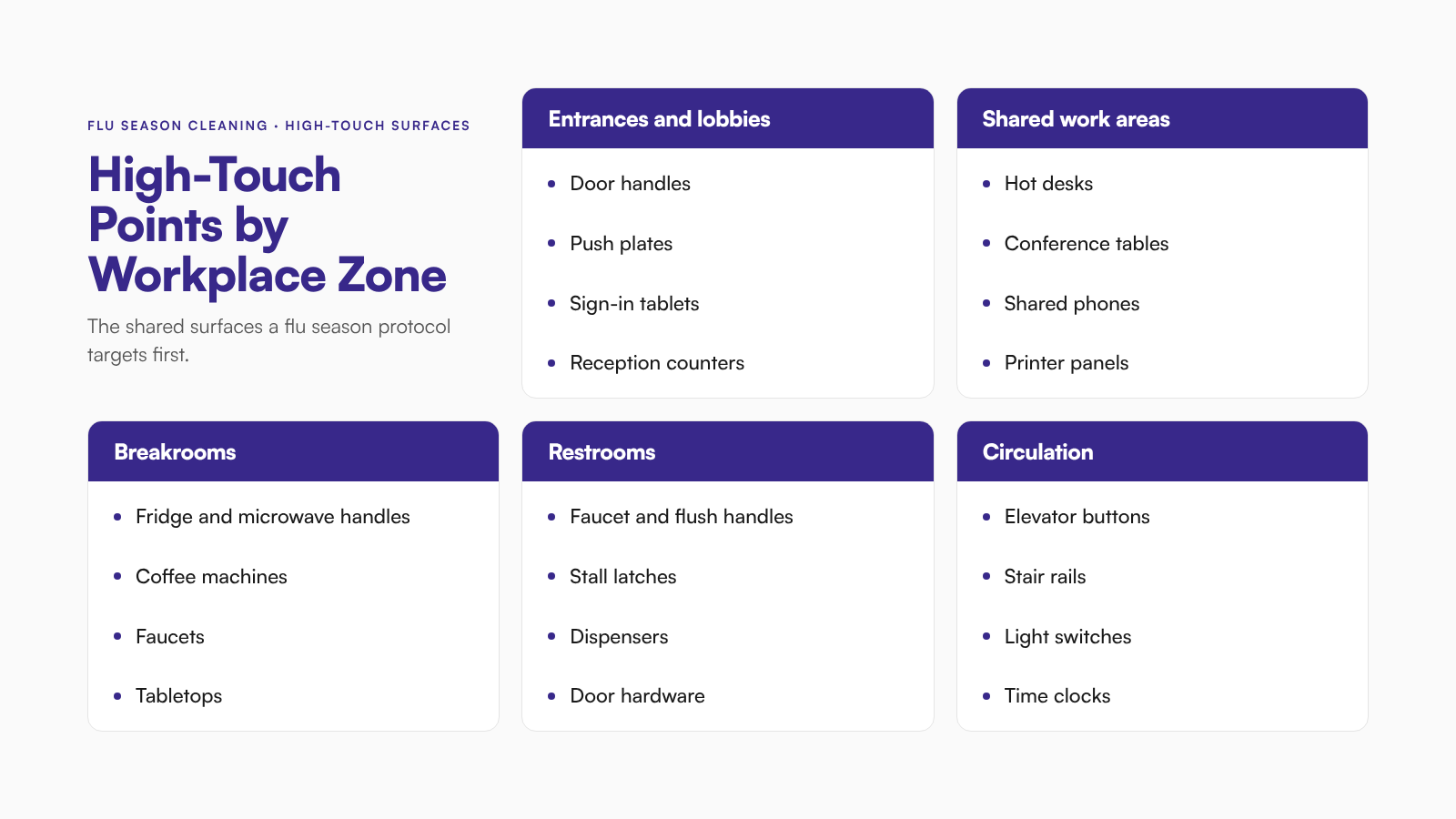
This is a narrower list than a full schedule of routine cleaning tasks by design. Floors, walls and windows stay on their normal frequency because hands rarely touch them, and assigned desks stay on the normal schedule unless their user has been ill.
How Often Should a Workplace Be Disinfected During Flu Season?
The CDC sets no number for how often a workplace should be disinfected during flu season. Its facility guidance says to clean high-touch surfaces regularly and gives no frequency, so the schedule below is the practice we recommend, set by how many hands share each surface.
Zone | Baseline (early season) | Peak season | After a confirmed illness |
|---|---|---|---|
Entrance and lobby touchpoints | Clean at every service | Disinfect at every service, plus a midday pass where daytime coverage exists | Same as peak season |
Shared desks, conference rooms and equipment | Clean at every service | Disinfect at every service, with wipes available between users | Disinfect the spaces the person used before the next occupant |
Breakroom handles and tables | Clean at every service | Disinfect at every service, plus a midday pass | Same as peak season |
Restroom fixtures and door hardware | Disinfect at every service | Same, plus a midday pass in busy buildings | Same as peak season |
Elevator buttons, stair rails and switches | Clean at every service | Disinfect at every service, plus a midday pass | Same as peak season |
Assigned desks | Normal schedule | Normal schedule | Disinfect that person's desk, phone and keyboard |
Baseline is the routine scope done reliably, which matches the CDC's position that regular cleaning is enough in most situations. Peak season adds a disinfection step to shared touchpoints at every visit, because more of the people in the building are likely to be carrying the virus. The confirmed-illness tier follows the CDC's advice to disinfect areas where people have obviously been ill, and it applies only to the spaces that person used.
The midday pass exists because of timing. A surface disinfected at 7 p.m. is touched again from 8 a.m., so a nightly service leaves a full working day between treatments, and daytime coverage closes that gap for entrances, restrooms and breakrooms.
Which Disinfectants Work Against the Flu Virus?
A disinfectant works against the flu virus only if its label says so. The EPA publishes lists of registered disinfectants for specific pathogens, and as of November 2026 none of those lists covers seasonal human influenza. List M covers avian influenza and List N covers SARS-CoV-2, so neither is the right reference.
The EPA says each registered product lists the microorganisms it is effective against, so look for three things on the label:
An influenza claim: Influenza virus is named among the organisms the product kills.
The EPA registration number: The EPA calls it the only way to accurately identify a product.
The contact time: The surface should stay visibly wet for the entire contact time.
Contact time is the step a quick spray-and-wipe misses, because a product whose label calls for four minutes has not done its job on a surface that dries in one. Disinfectant also belongs on a clean surface, and the CDC says to clean with soap and water first.
Electrostatic sprayers and foggers are offered across the cleaning industry as a faster way to cover a room. The CDC's facility guidance says fogging, fumigation and wide-area or electrostatic spraying are not recommended as primary methods of surface disinfection unless the product label says the method can be used. For a typical office, wiping the touchpoints with a labeled product at full contact time is the method the guidance supports.
What Safety Rules Apply to Flu Season Disinfection?
The rules that apply to flu season disinfection are chemical-safety rules, because more disinfecting means more chemical handling. OSHA's seasonal flu page names no flu-specific cleaning standard. Three requirements apply to whoever employs the people using the products:
Hazard communication: OSHA's Hazard Communication standard, 29 CFR 1910.1200, requires employers to keep safety data sheets readily accessible to employees during each work shift, to label containers of hazardous chemicals, and to train employees on the hazardous chemicals in their work area.
Label directions: The EPA states that pesticide labels are legally enforceable, and disinfectants are registered with the EPA as pesticides. Using a product on a surface the label does not list, or at a shorter contact time, is using it off-label.
Protective equipment and ventilation: The CDC's facility guidance says to wear the protective equipment recommended for the product, such as gloves or goggles, and to increase air circulation in the area while disinfecting.
When a contractor does the work, these duties belong to the contractor as the employer of its crew. A facility manager should still ask for the safety data sheet for every product brought on site, and flag occupants with asthma or chemical sensitivities before the peak-season tier starts. For the wider picture, see what OSHA and EPA expect from a cleaning contractor.
How Do Flu Season Protocols Differ by Facility Type?
The three tiers stay the same across facility types, and what changes is where the shared touchpoints are.
Facility type | Where the protocol concentrates |
|---|---|
Offices | Shared desks, conference rooms, breakrooms and reception |
Schools and daycares | Desks, cafeteria tables, shared supplies and toys |
Gyms and fitness centers | Equipment grips, benches, lockers and wipe stations |
Industrial and warehouse sites | Time clocks, shared tools, forklift controls and locker rooms, timed around shift changes |
Medical and dental offices are the exception. The CDC guidance behind these tiers is not intended for healthcare settings, so a practice's own infection-control plan governs there. In those buildings the tiers are at most a supplement for reception, waiting rooms and staff areas.
What Should a Business Do After a Flu Outbreak or at the End of the Season?
After a cluster of flu cases, the job is targeted disinfection of the spaces those employees used, followed by a return to the peak-season routine. We recommend this sequence:
List the spaces each person used on their last day or two at work: desks, meeting rooms, vehicles and shared equipment.
Clean those spaces, then disinfect the hard touchpoints with a flu-labeled product at full contact time.
Clean soft seating in those spaces with a product labeled for that material.
Restock tissues, soap, hand sanitizer and wipes.
Hold the building at the peak-season tier until absences return to normal.
At the end of the season, step down in the same order the protocol stepped up, returning shared touchpoints to the baseline tier once the state dashboard shows flu activity has clearly fallen. Use the spring reset to deep clean soft seating, replace worn microfiber, and write down what to change before next October.
Where Do We Provide Flu Season Cleaning?
We provide commercial cleaning across Berks County, including Reading, Wyomissing, West Reading, Sinking Spring and Exeter. We also serve the Lehigh Valley, Lancaster, the Chester County corridor around Exton and West Chester, and King of Prussia in Montgomery County. Our professional disinfecting service is available as an add-on to a regular cleaning program during cold and flu season.
A free on-site assessment is the place to start. We walk the building with you, list the shared touchpoints by zone, and set out the three tiers in writing. Our staff are bonded, insured and background-checked, and you deal directly with the owners of a family-owned company. Schedule your free on-site assessment and we will build the flu season schedule around how your building is used.


