

Dental clinic cleaning services are medical-grade cleaning and disinfection programs adapted to the specific contamination risks of dental practice: aerosol-generating procedures, operatory turnover between patients, and dental unit waterline maintenance. A 2025 meta-analysis in the American Journal of Infection Control found integrated dental aerosol prevention strategies cut microbial burden in dental aerosols by 46.64%.
This guide covers what a dental clinic cleaning service actually includes, how it differs from generic medical cleaning, what compliance applies, and what to look for in a partner. Ziva Cleaning Services has delivered medical and dental facility cleaning for more than 14 years across Berks County and surrounding markets. The protocols below reflect what works operationally, not just what the standards say on paper.
What Dental Clinic Cleaning Services Include
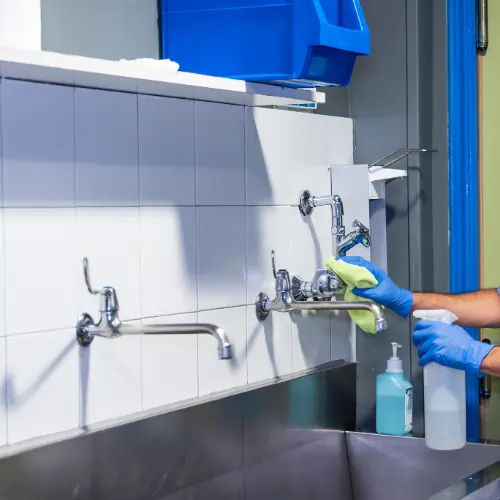
A dental clinic cleaning program covers every functional zone of the practice, with cleaning intensity scaled to the contamination profile of each area. The work falls into three layers stacked on top of each other.
The first layer is routine janitorial work that applies anywhere people congregate: vacuuming and mopping floors, emptying trash, restocking restrooms, cleaning break rooms, and dusting reception and administrative spaces. The second is medical-grade disinfection for any area with patient contact, using EPA-registered hospital-grade disinfectants applied with documented dwell times. The third is dental-specific protocols that address aerosol contamination, operatory turnover, and surfaces unique to dentistry, such as dental chairs, light handles, X-ray sensors, and suction equipment.
By zone, that typically breaks down as:
Operatories and treatment rooms: surface disinfection, dental chair and light handle decontamination, X-ray sensor and dental unit cleaning
Sterilization area: environmental cleaning around clean and dirty workflow zones without crossing the clinical reprocessing workflow itself
Reception, waiting, and consult rooms: high-touch surface disinfection, floor and upholstery care
Restrooms and break rooms: clinical-grade sanitation
Administrative spaces: routine janitorial
How Dental Clinic Cleaning Differs from Standard Medical Office Cleaning
Every dental cleaning provider will tell you their work falls "under medical cleaning." That is true and incomplete. Dental cleaning is medical cleaning plus three specific add-ons that change the protocol substantially, and a provider trained only in the general medical cleaning approach is not automatically equipped for dental.
The first add-on is aerosol-specific procedures: Dental work using drills, ultrasonic scalers, and air-polishing devices generates fine sprays of saliva, blood, and oral debris that travel well beyond the patient's chair and settle on surfaces throughout the operatory. Generic medical cleaning does not account for this contamination radius.
The second is operatory turnover: Between every patient, every clinical surface needs cleaning and disinfection before the next patient sits down. This turnover happens at a frequency and intensity that general exam-room cleaning does not match.
The third is dental unit waterlines (DUWLs): Water flowing through handpieces, ultrasonic scalers, and air-water syringes runs through narrow tubing that can harbor biofilm. CDC environmental infection control guidance addresses DUWL maintenance directly, and the equipment is unique to dentistry.
The rest of this guide expands on each of those add-ons and what they mean for how your practice should be cleaned.
Why Dental Aerosols Change the Cleaning Protocol
Aerosols are the single biggest reason dental cleaning is its own discipline. Understanding why requires understanding three things: what creates them, where they go, and what cleaning does about them.
Aerosol-Generating Procedures (AGPs) in Dental Practice
The CDC classifies several routine dental tools as aerosol-generating: high-speed handpieces, ultrasonic and sonic scalers, air-water syringes, air-polishing units, and air abrasion devices. Each one releases a fine spray composed of water, saliva, blood, plaque, and microbial debris. Periodontal procedures are particularly aerosol-heavy because they combine bleeding tissue with the ultrasonic scaler, which generates the largest aerosol load of any common dental instrument.
How Aerosols Contaminate the Operatory and Beyond
Dental aerosols do not stay near the patient's mouth. Particles travel through the room and settle on dental chairs, lights, counters, computer keyboards, and adjacent surfaces. Smaller airborne droplets can remain suspended long after the patient leaves. Peer-reviewed dental aerosol research published in the American Journal of Infection Control shows that high-volume evacuators (HVE), when applied consistently alongside other mitigation steps, substantially reduce aerosol propagation and infection risk. Without that mitigation, contamination spreads further and lasts longer than most cleaning teams expect.
How Professional Cleaning Addresses Aerosol Contamination
The cleaning service's job is to handle what the clinical team's aerosol mitigation does not capture. That means surface disinfection across the entire operatory radius, not just the patient chair. HEPA-filtered vacuums capture fine particulates rather than recirculating them. EPA-registered disinfectants applied with proper dwell times kill remaining pathogens, and respecting the practical difference between cleaning, sanitizing, and disinfecting is the most-skipped step in healthcare environmental cleaning. For surgical dental work involving blood or extractions, the protocol overlaps with the structured approach to biohazard handling in medical settings.
How Often Should a Dental Clinic Be Cleaned?
Dental cleaning runs on several cadences at once. The professional cleaning service typically handles end-of-day deep cleaning and longer-cycle work, while clinical staff handle between-patient turnover during operating hours.
A typical schedule looks like this:
Between every patient (clinical staff, supported by service protocols): operatory surface disinfection, dental chair and light handle wipe-down, X-ray sensor and tray cleaning, suction equipment check
Daily, after hours (professional service): full operatory disinfection, restroom sanitation, reception cleaning, sterilization area environmental cleaning, trash and biohazard waste handoff, floor care
Weekly: detailed restroom deep clean, break room scrub, sterilization area deep clean
Monthly: high-dusting (vents, light fixtures, ceiling corners), waiting room upholstery, baseboards, terminal disinfection pass on operatories
Quarterly: floor stripping or carpet extraction, comprehensive deep clean
Frequency scales with patient volume, the procedure mix (more surgical work means more biohazard load), and facility size. Most general dental practices benefit from daily professional service. High-volume orthodontics or oral surgery practices typically need same-evening service every operating day.
Dental Clinic Cleaning Compliance Standards
Regulatory bodies set the cleaning floor for a US dental practice, as well as the dental-specific authority every qualified cleaning company should know. Citing them by their official designations matters because each one governs a specific aspect of the work.
OSHA's Bloodborne Pathogens Standard applies to every dental practice with employees who could reasonably be expected to encounter blood or other potentially infectious materials. For cleaning, it requires a written exposure control plan, annual training for any staff (including contracted cleaning staff) involved in cleaning blood or biohazard waste, specific PPE, and prescribed sharps container management.
The CDC's environmental infection prevention guidance for dental settings is the named authority that defines best practice for cleaning operatory surfaces, handling clinical contact surfaces with barriers or disinfection, managing dental unit waterlines, and disposing of regulated medical waste. It is the most cited document in US dental infection control and the one a competent cleaning provider should reference by name.
Cleaning Needs by Dental Sub-Specialty
Dental practice is not monolithic. The cleaning profile differs measurably across sub-specialties because the procedures, patient demographics, and biohazard volumes differ. A cleaning plan built for general dentistry will not fit an oral surgery practice without adjustments.
Sub-specialty | Distinct cleaning considerations | Biohazard volume | Aerosol risk profile |
|---|---|---|---|
General dentistry | Standard operatory turnover; routine restorative and hygiene procedures | Low to moderate | Moderate (handpieces, scalers) |
Orthodontics | More chair time per patient; lower aerosol; higher surface contact and appliance handling | Low | Low |
Oral surgery | Surgical site cleaning; higher blood and bone debris; high biohazard waste volume | High | High (surgical drills, suction) |
Pediatric dentistry | Higher cross-contamination from kids touching surfaces; toy and waiting room hygiene | Low to moderate | Moderate |
Endodontics | Procedure-heavy with rotary instruments and irrigation; significant aerosol load | Moderate | High |
For multi-specialty practices, the cleaning plan should be built around the highest-intensity sub-specialty operating in the building rather than averaging across them. An oral surgery operatory needs the most demanding protocol every visit, even if it sits next to general dentistry chairs.
Who Handles What: Dental Staff vs Professional Cleaning Service
The most common operational gap in dental cleaning sits in the seams between roles. Clinical staff assume the cleaning crew handles disposal. The cleaning crew assumes the hauler handles everything once it is bagged. Exposure incidents happen in the middle of those assumptions. Clarifying ownership is the simplest way to close the gap.
Role | Owns |
|---|---|
Dental clinical team (assistants, hygienists, dentist) | Operatory turnover between patients; point-of-use sharps disposal; dental unit waterline maintenance and treatment; first response to spills and exposure incidents |
Sterilization technician | Instrument reprocessing workflow, separate from environmental cleaning |
Professional cleaning service | End-of-day environmental cleaning across all zones; deep disinfection on the cadences above; restroom and waiting area maintenance; coordination with the biohazard hauler on containment; documented cleaning logs |
Licensed medical waste hauler | Off-site transport, treatment, and final disposal of regulated medical waste |
Most practices already have the clinical and hauler sides covered. The gap usually sits with the cleaning service, particularly when the practice has been using a generic janitorial provider without dental-specific protocols. The cost of that gap shows up in failed inspections, exposure incidents, and patient perception issues that surface months later in online reviews.
What to Look for in a Dental Clinic Cleaning Partner
Not every cleaning company that says "we clean medical facilities" is equipped for dental. The gap shows up in the documentation, the training, and the protocols. Before signing a contract, the practice manager or dentist owner should verify the following:
Dental-specific training: documented protocols for aerosol mitigation, operatory turnover, and DUWL-adjacent environmental cleaning
OSHA 29 CFR 1910.1030 Bloodborne Pathogens training: current records for every staff member entering your practice
EPA-registered hospital-grade disinfectants with tuberculocidal claims: the CDC benchmark for dental disinfection, with Safety Data Sheets available
HEPA-filtered equipment and electrostatic spraying capability: specifically for aerosol particulate capture
Fully insured, bonded, and background-checked staff
Transparent line-item pricing: scope, frequency, and add-on terms documented in the contract
References in dental: ideally practices similar in size and sub-specialty to yours
Dental practice cleaning services cost depends on multiple factors like facility size, procedure mix, and frequency. Our complete cost breakdown for medical and dental facility cleaning walks through the variables in detail.
Ziva Cleaning Services has delivered specialized healthcare cleaning for more than 14 years. We are certified, bonded, insured, and staffed by background-checked technicians trained for medical and dental environments. Our approach mirrors the structured protocols behind our healthcare cleaning programs, adapted to each practice's layout and workflow.
Every dental practice has a different operatory count, procedure mix, scheduling need, and compliance obligation. We build cleaning programs around those realities, not a template. Contact us for a free on-site assessment and a transparent quote tailored to your practice.


