

Gym locker room cleaning means working from the dry zone to the wet zone with EPA-registered disinfectants held at full label dwell time, daily at minimum and more often at volume. Reading, PA facilities carry one variable most guides skip: under 28 Pa. Code Chapter 18, a gym with a pool has state-regulated shower and dressing facilities.
Why Locker Rooms Carry the Highest Risk in a Gym
The workout floor gets the attention. The locker room carries the risk. It is the only zone combining sustained warmth, standing moisture, shared surfaces, and direct contact with bare skin. Free weights get sweaty hands. Shower floors, benches, and locker interiors get bare feet, wet towels, and open skin. That is a different category of exposure.
The CDC's guidance for athletic facilities is built around that distinction. It directs cleaning attention to surfaces that contact bare skin daily, and makes a second point almost no facility acts on: equipment and furniture with damaged surfaces that cannot be adequately cleaned should be repaired or replaced (CDC, Athletic Facilities: MRSA Prevention and Control).
That reframes a cracked bench laminate or a dented locker door. Neither is a cosmetic problem waiting on a capital budget. A surface that cannot be cleaned to a verifiable standard is a sanitation defect, and no cleaning frequency fixes it.
Ziva Cleaning Services scopes gym and fitness facility programs around that ranking, so locker rooms and wet areas get their own line item instead of a slot on a general janitorial route. For the wider view, see how a fitness facility program gets scoped.
How to Clean a Gym Locker Room, Dry Zone to Wet Zone
Sequence is what most routines get backwards, and it costs more than product choice.
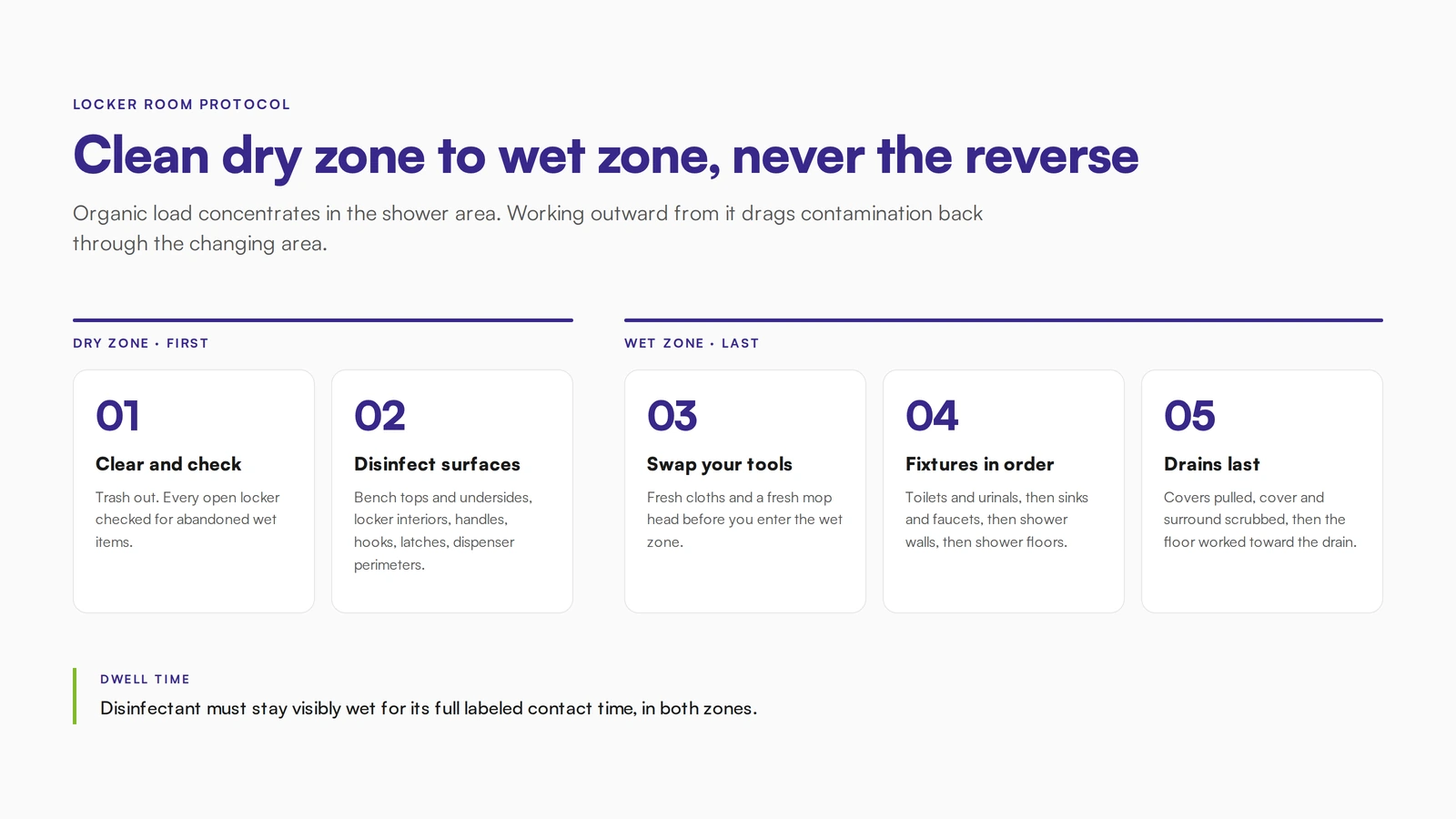
Organic load is not evenly distributed. Soap scum, skin cells, hair, and body fluids concentrate in the shower area. A crew that starts there and works outward carries a saturated mop head and contaminated cloths back through the changing area, the benches, and the lockers. The room looks clean. It has been cross-contaminated.
Work dry to wet. This page covers the locker room; the facility-wide task list covers the rest of the building.
Dry zone first: lockers, benches, and high-touch surfaces
Clear all trash and check inside any locker left open. Abandoned wet items are the most common source of a recurring odor complaint. A damp towel sealed in a locker in warm conditions begins growing mold within a day and a half, and by the time a member reports the smell the growth is established inside the locker.
Apply disinfectant to bench tops and undersides, the interior shelf and floor of open lockers, door handles, hooks, latches, and the perimeter of hand dryers and dispensers. Bench undersides get skipped constantly and collect what you would expect.
Wet zone last: showers, drains, and floors
Move in with fresh cloths and a fresh mop head, then work fixture order: toilets and urinals, sinks and faucets, shower walls, shower floors. Pull the drain covers rather than wiping around them, scrub the cover and the surround, then replace. A drain that only ever gets mopped over becomes a biofilm reservoir, and biofilm is what produces the sour smell that survives every cleaning.
Finish by working the floor toward the drain, not away from it.
Across both zones, dwell time decides the result. A disinfectant sprayed and immediately wiped has cleaned the surface, not disinfected it. Every EPA-registered product carries a labeled contact time, and most quaternary ammonium products need several minutes of visible wet surface to make their kill claim. If route time does not budget for that, the label claim is decorative. The CDC points facilities to EPA List H, noting that products effective against Staphylococcus aureus are sufficient against MRSA. For a locker room, look for a label that also covers dermatophytes, the fungal group behind athlete's foot.
It is the same distinction that separates cleaning, sanitizing, and disinfecting. A member wiping a bench for eight seconds is doing the first one.
How Often Should Gym Locker Rooms and Showers Be Cleaned?
There is no single correct frequency. A boutique studio with two showers is a different problem from a twenty-four hour facility. What stays constant is the structure:
Daily, without exception. Full protocol on the sequence above: every surface, every fixture, drains pulled.
Intra-day touch-ups, scaled to volume. High-traffic facilities need a mid-day reset covering floors, high-touch surfaces, and restocking, plus a second pass after the evening peak. Low-traffic studios can often hold on one daily clean with staff spot-checks. The trigger is member density, not clock time.
Weekly. Locker interiors top to bottom, grout lines inspected and scrubbed, shower curtains or door tracks addressed.
Monthly. Caulk lines inspected at the shower pan and wall joints, shower heads descaled, ventilation checked.
For most Reading facilities the practical question is whether this happens before opening, overnight, or in zones during operating hours. Gyms that never fully close need zoned scheduling, which changes crew sizing more than it changes scope. Weigh the daytime and overnight tradeoffs before setting a schedule you will have to renegotiate. Cleanliness is one of the few things a member evaluates on every visit, and the locker room is where that judgment gets made, which is why facility condition tracks with retention.
How to Prevent Mold in Gym Showers
Mold does not start on the tile face. It starts in the grout and the caulk.
Glazed tile is non-porous and sheds water. Grout is porous, holds moisture, and sits where water pools. Silicone caulk at the pan joint and wall corners is softer still, and once mold establishes in a caulk line, surface cleaning will not reach it. That line has to be cut out and replaced.
Use a product rated for porous surfaces on grout, not just a general-purpose bathroom cleaner. Scrub with a stiff-bristle brush rather than a cloth.
Inspect corner caulk and the pan joint monthly. Discoloration that returns within days of cleaning means the growth is below the surface.
Treat ventilation as part of the program. No frequency outruns a failed exhaust fan. If the room stays humid for hours after peak use, the fan is undersized, blocked, or not running long enough, and that is the actual fix.
Check behind benches and in floor corners, where airflow is lowest.
Wet-area grout follows the same logic as commercial tile floor care, with a much shorter tolerance for neglect.
What Causes Locker Room Odor, and How to Stop It
Locker room odor is a diagnostic signal. Fragrance masking is the standard response and the wrong one: the smell returns on a cycle while the source keeps growing. There are three real sources.
Floor drains. Biofilm builds inside the drain body and around the trap, out of sight and never mopped, producing a persistent sour note that intensifies in warm weather. Pulling and scrubbing drain covers on a set schedule is the fix.
Trapped moisture. Under benches, inside lockers, in floor corners, behind partitions. Anywhere air does not move and the floor does not fully dry.
Abandoned textiles. Wet towels, gym clothes, and swimwear left in lockers overnight.
If a locker room smells and the surfaces look clean, check a drain or a locker interior before buying anything.
Why Shower Heads Need Descaling and Flushing
Two problems build inside a shower head, and neither shows up on a walkthrough. The first is scale. Water carrying dissolved calcium and magnesium leaves deposits on fixtures, glass, and tile, and that is not only cosmetic. The rough surface scale creates gives soap scum something to grip, so a scaled shower wall gets dirty faster and stays dirty longer. Inside the head itself, the same deposits restrict flow and produce the uneven spray members complain about. Descale monthly with a product matched to the finish.
The second is stagnation. CDC guidance on building water systems lists showers among the devices that aerosolize water, and notes that Legionella grows best in large, complex systems that are not adequately maintained, with biofilm and temperature fluctuation among the contributing factors. The formal control is a water management program aligned to ASHRAE Standard 188.
Be precise about scope here, because this is where cleaning companies overclaim. A janitorial contractor does not run a water management program. That is a building water systems responsibility covering temperature control, disinfectant residual, and plumbing design. What a contractor owns is narrower and still useful: descaling on schedule, flushing seldom-used showers so water is not sitting in low-flow lines, and reporting temperature or flow anomalies to whoever owns the program.
What Actually Regulates a Gym Locker Room in Pennsylvania
Most articles on this topic wave at OSHA, and most get it wrong.
What OSHA covers, and what it does not
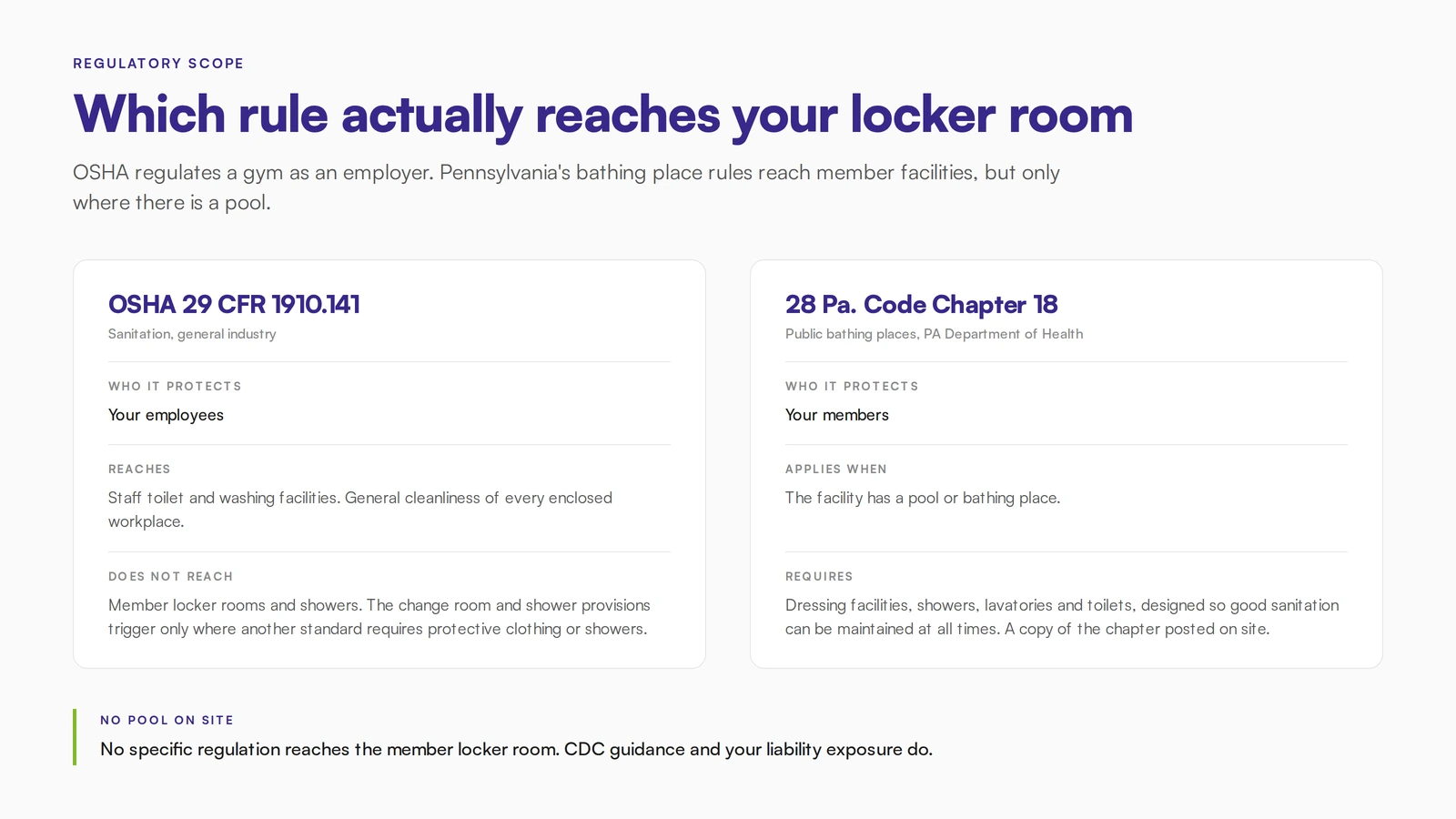
OSHA's sanitation standard, 29 CFR 1910.141, applies to your gym as an employer toward its employees. It is not a member-facing hygiene rule. Its change room provision is triggered only where another standard requires protective clothing against contamination with toxic materials, and its shower provision applies only where showers are required by some other standard. Neither condition is met by a commercial gym's member locker room.
What does apply is the general obligation: every enclosed workplace must be kept clean, orderly, and sanitary, and employers must provide adequate toilet and washing facilities for staff. Your staff restroom is inside that. Your member showers are not.
So when a vendor calls its locker room protocol "OSHA compliant," the phrase is doing no work. Member-facing hygiene runs on state regulation, CDC guidance, and liability exposure. Our OSHA and EPA compliance guide covers where the standards genuinely bind a cleaning program.
The rule that changes if your gym has a pool
Pennsylvania regulates public bathing places under 28 Pa. Code Chapter 18, enforced by the Department of Health under the Public Bathing Law, and the chapter does not stop at the water. Sections 18.61 through 18.63 cover bather preparation facilities, requiring separate dressing facilities, showers, lavatories, and toilets designed and constructed so good sanitation can be maintained throughout the building at all times. A copy of the chapter must be posted at the facility (PA Department of Health, Public Bathing Place Laws and Regulations).
If your Reading or Berks County facility has a pool, the locker room sits inside a state regulation, not just your own standards. That covers the YMCAs, multi-sport complexes, hotel and club fitness wings, and any gym that added a pool along the way.
Who is actually checking
Pennsylvania has eleven local health departments: seven county and four municipal. Neither Berks County nor the City of Reading operates one. Under Act 315, the environmental health services those departments deliver include public bathing place sanitation, so where a county has its own health department, that work sits locally. In Berks, it sits with the state.
So nobody local is scheduled to walk your locker room. Scrutiny comes from a member complaint, an insurance claim, or a pool permit inspection, and all three arrive after the problem exists. A program that is scheduled, specified, and logged answers all three.
Schedule a Free Locker Room Assessment
Four questions separate a program from a route sheet:
Which disinfectant do you use, and what does its EPA label claim cover? Look for Staphylococcus aureus and dermatophytes.
Is dwell time built into the scheduled route time, or does the crew spray and wipe?
Who owns drain covers, grout, and caulk inspection, and on what cadence? Daily wipe-down is not the same scope.
Does the same crew return each visit? That is how a team learns which drain backs up and which locker bank holds moisture.
Our gym cleaning cost guide covers what drives a fitness facility quote. We clean gyms, fitness centers, and studios across Reading, Berks County, and the surrounding Pennsylvania region, and we scope locker rooms and wet areas separately. Get a free on-site assessment and we will walk your facility with you.

