

A 24-hour gym cleaning schedule operates in three layers: continuous touch-ups of high-touch surfaces during member hours, a scheduled deep clean in the lowest-traffic window, and weekly and monthly resets. Because the CDC advises cleaning high-touch surfaces regularly, and more often in high-traffic areas, a facility that never closes cannot rely on a single nightly pass.
Why Can’t a 24-Hour Gym Clean on a Closing-Time Schedule?
A gym that closes overnight can clean after the last member leaves, which gives the crew an empty building and an uninterrupted block of time. A 24-hour gym has no such window, so every cleaning task has to be sequenced around members who are using the same equipment, the same restrooms, and the same locker rooms. The CDC’s guidance for athletic facilities directs cleaning attention to shared equipment and surfaces that contact bare skin, and a single overnight pass cannot address what accumulates on those surfaces during the hours that follow it.
Ziva Cleaning Services designs 24-hour gym programs around that gap, assigning each layer of work to a defined owner with a verifiable record. This guide explains the three layers, shows a sample schedule, and describes how to confirm the work is happening when no one is on site. For a broader view of scope, see what professional gym cleaning covers and our gym cleaning services.
What Does a 24-Hour Gym Cleaning Schedule Look Like?
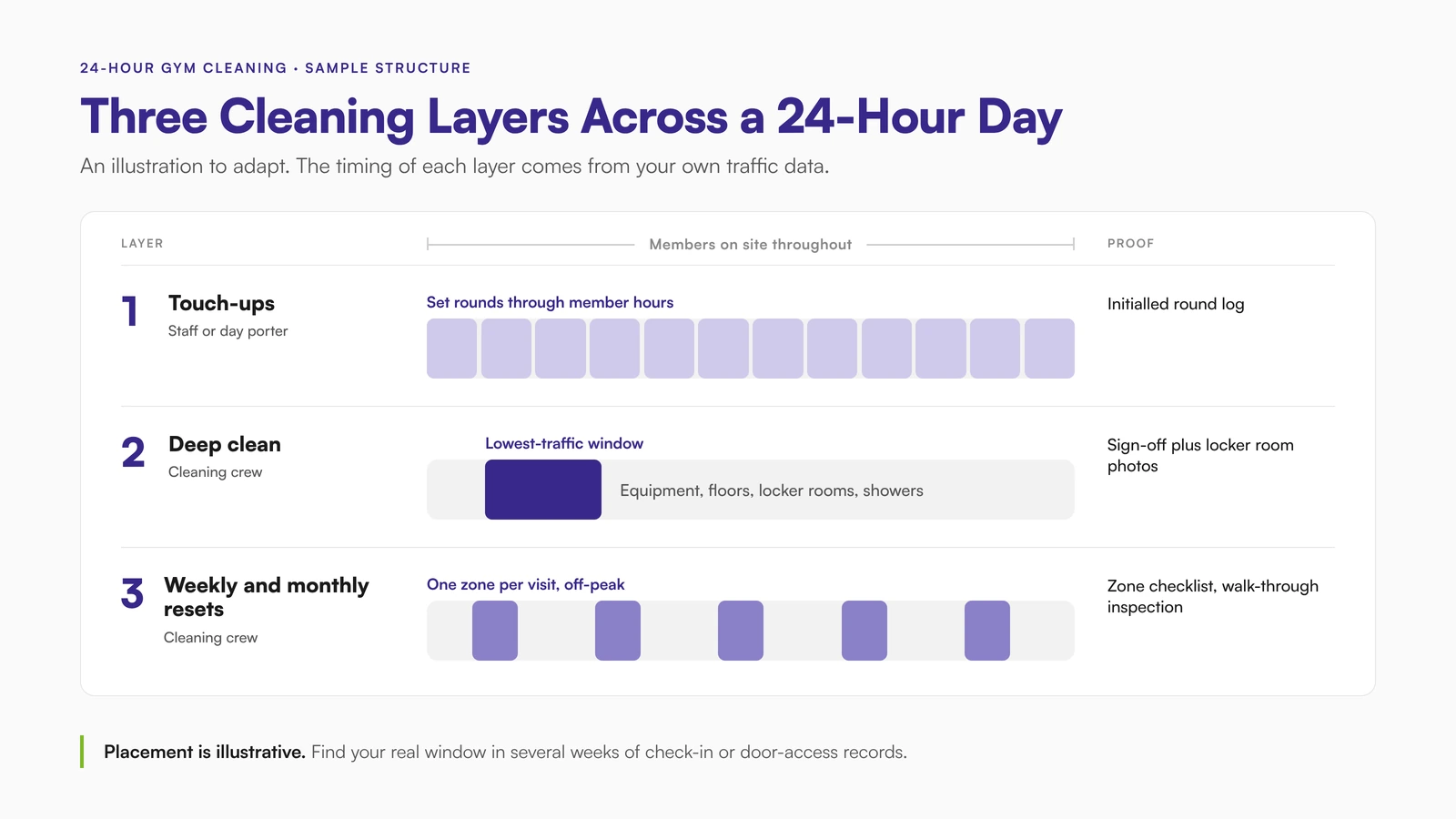
The sample below places all three layers in one table, showing who performs each task, when it happens, and what record proves it was done. It is an illustration to adapt rather than a fixed timetable, because the clock times for each layer should come from your own traffic data. Task-by-task lists for each zone sit in our gym cleaning checklist, which this guide deliberately does not repeat.
Layer | When | Who | Tasks | Proof |
|---|---|---|---|---|
Touch-ups | Through member hours, on a set round | Staff or day porter | High-touch surfaces, cardio consoles, spills, restroom check, trash | Initialled round log |
Deep clean | Lowest-traffic window from your access data | Cleaning crew | Full equipment disinfection to label contact time, floors, locker rooms, showers, restrooms | Sign-off plus locker room photos |
Weekly reset | Off-peak, one zone per visit | Cleaning crew | Floor scrub, mats and turf, glass and mirrors, drains | Zone checklist |
Monthly reset | Scheduled low-traffic block | Cleaning crew | Detail work on the areas the weekly pass skips | Walk-through inspection |
Each row serves a different purpose. Layer 1 keeps the floor presentable and safe between deep cleans, Layer 2 performs the disinfection and floor work that cannot happen with members in the way, and Layer 3 prevents slow accumulation, such as soil along mat edges and in drains, from becoming a sanitation problem. The proof column matters most during unstaffed hours, because a signed log and a dated photograph are the only reliable way to distinguish a completed visit from a skipped one.
Layer 1: Touch-Ups During Member Hours
Touch-ups take place while members are on the floor, so the method matters as much as the task list. The crew or porter works one zone at a time, places wet-floor signage, and uses electronics-safe, low-odor products on cardio consoles and touchscreens, while a spill kit at the front desk allows a leaking bottle or a sweat puddle to be cleared as soon as it is reported.
In a staffed building this is the work of a day porter. Where a gym is unstaffed for part of the day, a front-desk employee, a rotating trainer, or a scheduled porter visit can cover the round, provided that someone owns each pass and signs for it. The day and night cleaning trade-offs explain how daytime coverage and an off-peak crew divide the work.
Layer 2: The Deep Clean in Your Lowest-Traffic Window
The deep clean belongs in your lowest-traffic window, and the reliable way to find it is to pull several weeks of check-in or door-access records and rank the hours by entries. Many 24-hour gyms find their quietest period overnight, but your own data may show a different trough, such as mid-afternoon, and the schedule should follow the data rather than an assumption.
During that window the crew disinfects equipment, cleans floors, and works through the locker rooms and showers using the sequence described in our locker room and shower protocol. Disinfection depends on dwell time, meaning the surface must remain wet for the full contact time printed on the product label, so a rushed wipe-down cleans without disinfecting. Select products from the EPA’s list of registered disinfectants and apply each one exactly as its label directs.
Layer 3: Weekly and Monthly Resets
Weekly and monthly resets address the areas that daily cleaning skips, including floor scrubbing, mats and turf, glass and mirrors, drains, and detail work inside locker rooms. Rotating one zone per visit allows this work to fit inside a low-traffic block without closing the facility, and the rotation itself should be written into the schedule so that no zone drifts past its interval unnoticed.
Who Cleans What: Staff, Members or a Contractor?
Every task in a 24-hour gym needs a named owner, because shared responsibility is the most common way for a task to be skipped. The split below suits most facilities, although the exact division depends on how much on-site staff coverage a gym has.
Task | Staff or porter | Members | Cleaning contractor |
|---|---|---|---|
Spills and quick wipes | Primary | Support, with wipe-down stations | Backup |
Equipment disinfection to label contact time | Not assigned | Courtesy wipes only | Primary |
Locker rooms and showers | Spot checks | Not assigned | Primary |
Floors, mats and turf | Spot checks | Not assigned | Primary |
Log, photos and sign-off | Owner reviews | Not assigned | Completes |
Some operators rely on member wipe-down stations, and the case for that approach is reasonable: it costs little, it happens immediately, and members find it reassuring to see. Its weakness is that no one verifies it, since a spray bottle on a rack shows that the gym supplied cleaner but not that the bench was cleaned. We treat wipe-down stations as a courtesy layer that supports scheduled disinfection and never replaces it.
The same division applies across the whole schedule. Daytime coverage handles what happens between visits, and the off-peak crew handles the work that daytime coverage cannot reach.
How Do You Prove the Schedule Is Happening When No One Is On Site?
Overnight work is easy to assume and difficult to observe, so verification should be built into the schedule itself rather than added after a complaint. Four records cover most gyms:
A signed or initialled log for every Layer 1 round and every Layer 2 visit, with the time.
A photograph of each locker room and shower area after the deep clean.
A monthly walk-through by the owner or manager, using the same zone list as the log.
Keycard or door-access records, to confirm when the crew was in the building.
Measurement should then separate results from activity. The table below shows what to track and what to disregard.
Track | Ignore |
|---|---|
Log completion by layer | Hours the crew spent on site |
Inspection results by zone | Number of wipes or amount of product used |
Member complaints by zone | Total tasks listed on the schedule |
Time to clear a reported spill |
Hours on site and product counts measure effort rather than outcome, and a crew can spend a long time in the building while leaving the shower drains untouched, which is why inspection results and member complaints by zone are the more dependable signals.
What Changes for Gyms in Berks County?
Winter changes the entrance first, because slush and road salt arrive on members’ shoes and the entry mats and the flooring just inside the door need additional passes from late autumn through winter. Summer shifts the weight toward the locker rooms and showers, where humidity makes moisture, mold, and odor harder to control, so drains and shower areas move up the weekly list.
Berks County’s 24-hour clubs range from franchise gyms in towns like West Lawn and Hamburg to private training studios in Reading, and the same layered structure fits each of them. If a gym has a pool, Pennsylvania’s public bathing place regulations, 28 Pa. Code Chapter 18, also apply to the dressing and shower facilities, which places the locker rooms inside a state requirement as well as the owner’s own standards.
We provide commercial cleaning, including for gyms and fitness centers, across Berks County, with location pages for Reading, Exeter Township, and Hamburg and crews who also cover Wyomissing and West Reading.
What Should a 24-Hour Gym Put in Its Cleaning Scope?
Whoever performs the work, the schedule should exist in writing, and a workable scope of work for a 24-hour gym names the following:
The zones, the cleaning window for each, and the layer that covers them.
Who supervises the work and how often the manager sees it.
The log and photo requirements from the section above.
How quickly the crew responds to a spill or complaint reported between visits.
What is billed extra, such as turf restoration or sauna and steam room disinfection.
Insurance, staff background checks, and how keys and alarm codes are handled.
The notice period and exit terms, including the return of keys and codes.
For how these items affect pricing, see what gym cleaning costs.
Get a Free Cleaning Assessment for Your Berks County Gym
If you run a 24-hour gym in Berks County and want a schedule built around your own traffic data, we offer a free on-site assessment. We walk the floor, locker rooms, and entrance, then talk through your quiet hours and the areas you need covered. Schedule your free on-site assessment.

