

Why Cleaning Compliance Matters for Car Dealerships
A dealership is two regulated environments under one roof. The showroom operates as a customer-facing retail space where disinfectants, floor finishes, and glass cleaners are used throughout business hours. The service bay operates as an active industrial workspace where degreasers, solvents, and heavy-duty cleaners contact petroleum products, brake dust, and runoff water. Each environment triggers different regulatory scrutiny, and a single cleaning program has to satisfy both.
The stakes are measurable. OSHA serious violations carry penalties up to $16,550 per violation as of 2025, with willful or repeat violations reaching $165,514. These figures are adjusted annually by the Department of Labor. EPA penalties for Clean Water Act violations can run significantly higher for facilities that release regulated pollutants into storm drains or municipal sewers without proper controls. Beyond fines, compliance failures create personal-injury liability, environmental remediation costs, and insurance premium increases.
For dealership general managers and facilities coordinators, the challenge isn't just knowing the rules. It's knowing which rules apply where, who's responsible for enforcement, and how a cleaning program either creates risk or mitigates it. Understanding the scope of dealership cleaning work is the starting point. Compliance is the layer that sits on top.
OSHA Standards That Apply to Dealership Cleaning
OSHA regulates cleaning operations at dealerships under the General Industry standards in 29 CFR 1910. Four standards do most of the work when it comes to cleaning-related compliance.
Hazard Communication Standard (29 CFR 1910.1200)
The Hazard Communication Standard, often called HazCom or the "right to know" rule, is the most frequently cited OSHA standard in automotive settings. It requires every facility using hazardous chemicals to maintain a written HazCom program, keep Safety Data Sheets (SDS) accessible for every product, ensure all containers are properly labeled with Globally Harmonized System (GHS) pictograms, and train employees on chemical hazards before they handle any product.
For dealership cleaning, this applies to nearly every product in use: glass cleaners, disinfectants, floor strippers, degreasers, solvents, and even some general-purpose cleaners. The violation is usually not the presence of hazardous chemicals. It's missing documentation, out-of-date SDS, or staff who can't locate the SDS binder during an inspection.
Personal Protective Equipment (29 CFR 1910.132–138)
OSHA requires employers to conduct a documented hazard assessment, select appropriate PPE for each task, and train workers on its proper use. For cleaning staff at dealerships, the PPE requirements scale with chemical exposure. Glass cleaners and general disinfectants typically require chemical-resistant gloves and safety glasses. Service bay degreasers, floor strippers, and concentrated disinfectants often require additional protection such as goggles, aprons, and in ventilation-limited areas, respirators.
The documentation side matters as much as the equipment itself. A PPE program without written hazard assessments and training records is treated as non-compliant even when the right gear is in the closet.
Ventilation Requirements (29 CFR 1910.94)
The ventilation standard applies anywhere spray operations, concentrated solvent use, or chemical vapors can accumulate. In dealership service bays, this affects how aerosol degreasers are used, how floor stripping chemicals are applied, and how parts-washing areas are cleaned. OSHA requires engineering controls such as mechanical ventilation, spray booths, or local exhaust to keep airborne chemical concentrations below permissible exposure limits.
The walking-working surfaces rule (29 CFR 1910.22) also intersects with cleaning operations here. Wet floors from cleaning or service bay runoff must be signaled, contained, and managed to prevent slip-and-fall injuries. This connects directly to showroom floor maintenance practices that keep high-gloss finishes safe under foot traffic.
Record-keeping and Training Documentation
OSHA compliance is documented or it doesn't exist. Dealerships must maintain written HazCom programs, hazard assessments, training records, SDS libraries, and for facilities with more than ten employees, written Emergency Action Plans and Fire Prevention Plans. When cleaning is outsourced, the dealership cleaning company's documentation becomes part of the dealership's compliance posture. Auditors expect to see both.
EPA Regulations for Dealership Cleaning Chemicals
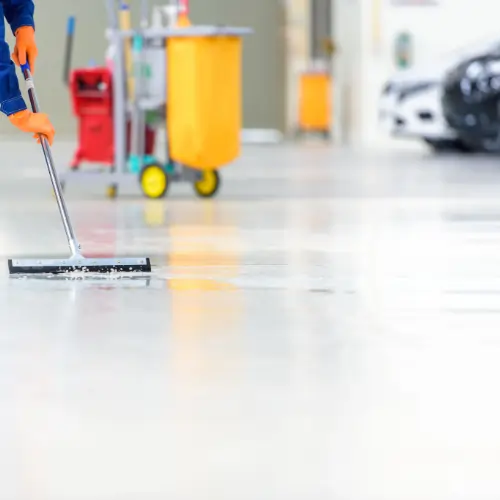
Where OSHA protects workers, the Environmental Protection Agency protects the environment. For dealerships, EPA oversight focuses on what happens to cleaning chemicals after they're used, especially in service bay operations where petroleum products, heavy metals, and cleaning residues can enter water supplies.
Clean Water Act and Service Bay Runoff
Under the EPA's National Pollutant Discharge Elimination System, service bay floor drains cannot legally discharge into storm drains or surface waters without a permit. This is one of the most commonly misunderstood rules at the dealership level. The floor drain in a service bay must connect to an oil-water separator and then either a municipal sanitary sewer (with local utility approval) or a licensed hazardous waste disposal system. Cleaning water containing degreaser residue, petroleum traces, or brake dust qualifies as regulated wastewater.
Dealerships near navigable waters with aggregate oil storage above 1,320 gallons also fall under the EPA's Spill Prevention, Control, and Countermeasure (SPCC) rule, which requires a written spill prevention plan, trained staff, and documented containment measures for above-ground storage tanks.
Resource Conservation and Recovery Act (RCRA)
RCRA governs how hazardous waste is classified, stored, and disposed of. For dealerships, this applies to spent solvents, used degreasers, contaminated shop towels, and any cleaning product that meets the hazardous waste criteria after use. Most dealerships qualify as Small Quantity Generators or Very Small Quantity Generators depending on monthly hazardous waste volume. Each category has its own storage time limits, manifest requirements, and disposal obligations.
The recent EPA proposals to add PFAS ("forever chemicals") to the RCRA hazardous substance list have direct implications for auto dealerships and repair shops, since PFAS are present in some cleaning products, fire suppression foams, and vehicle components.
EPA-Registered Disinfectants
Disinfectants used in commercial facilities must be registered with the EPA under the Federal Insecticide, Fungicide, and Rodenticide Act (FIFRA). The EPA registration number appears on the product label, and the product must be used according to that label, including contact time, dilution ratio, and surface type. Using a disinfectant outside its labeled parameters is a compliance violation, not just a performance issue.
For dealership customer areas such as restrooms, waiting lounges, and children's play spaces, EPA-registered disinfectants from the EPA's List N (or the successor list for current pathogens) are the baseline standard.
Chemical Safety Essentials for Showrooms and Service Bays

Regulations define what compliance looks like. Chemical safety practices are how compliance gets executed day-to-day. Three areas create most of the risk and most of the preventable citations.
Safety Data Sheet (SDS) Management
Every hazardous cleaning chemical on site must have a current SDS accessible to employees during every shift. An SDS contains 16 standardized sections covering hazards, composition, first aid, firefighting measures, handling, storage, exposure controls, and disposal. OSHA requires employees to be trained on how to read and interpret them.
Three practices separate compliant SDS management from the paperwork-only version most dealerships default to:
Maintain both a physical binder and a digital library accessible by phone or tablet
Verify SDS version numbers against manufacturer records at least annually, since roughly 15% of SDS documents are revised in any given year
Ensure every product in active use has a matching SDS before it's put into service
Storage and Segregation of Cleaning Chemicals
OSHA and NFPA standards require incompatible chemicals to be stored separately. Flammable liquids such as many floor strippers and solvents must be kept away from oxidizers and heat sources. Corrosives like acid-based restroom cleaners must be separated from bases like alkaline degreasers. Flammable storage requires appropriate electrical classifications under 29 CFR 1910.106. Bunded containment, meaning secondary spill containment that holds at least 110% of the largest container's volume, is best practice for concentrated products.
In a dealership setting, this often means service bay chemicals cannot share a storage area with showroom cleaning products. The separation protects both workers and the facility insurance position.
Disposal of Degreasers and Solvents
Spent solvents, used degreasers, and heavily soiled cleaning agents typically cannot be poured down drains or disposed of with general trash. Depending on the product and generator status, disposal routes include licensed hazardous waste haulers, solvent recycling programs, or drum collection services. Every disposal event generates a manifest or disposal record that must be retained for at least three years under federal RCRA rules, and longer under many state programs.
Cleaning contractors who bring their own products are responsible for managing disposal for those products. The dealership remains co-responsible under RCRA as the generator of the waste at its site. This shared liability is why worker safety protocols for industrial-adjacent cleaning operations extend to waste management, not just daily tasks.
Dealership Cleaning Compliance Checklist
Use this checklist to audit a dealership cleaning program against core OSHA and EPA requirements. Gaps on any item below typically indicate compliance exposure.
Area | Requirement | Documentation needed |
|---|---|---|
HazCom | Written HazCom program covering all cleaning chemicals | Program document, review date |
SDS | Current SDS for every hazardous product in use | Physical binder + digital library |
Labeling | All secondary containers labeled with GHS pictograms and hazard information | Visual audit, labeling protocol |
PPE | Documented hazard assessment for each cleaning task; appropriate PPE supplied | Written assessment, PPE logs |
Training | All cleaning staff trained on HazCom, PPE, and emergency procedures | Training records with dates |
Storage | Chemicals segregated by compatibility; flammables in approved cabinets | Storage layout diagram |
Spill response | Spill kit accessible in service bay and chemical storage areas | Kit inventory, response plan |
Service bay drains | Oil-water separator installed; no storm drain discharge | Plumbing schematic, permit |
Waste disposal | Hazardous waste manifests retained for minimum three years | Manifest file, hauler records |
EPA-registered products | All disinfectants carry valid EPA registration numbers | Product label verification |
Emergency plan | Written Emergency Action Plan (if 10+ employees) | EAP document, drill records |
SPCC plan | Written spill prevention plan (if applicable oil storage thresholds met) | Certified SPCC plan |
A single gap doesn't guarantee a citation. Multiple gaps, especially in HazCom, SDS, and training, are the pattern OSHA inspectors identify as systemic non-compliance.
How Professional Cleaning Services Reduce Compliance Risk
Managing dealership cleaning compliance internally is feasible but resource-intensive. A practical alternative is partnering with a cleaning contractor that brings its own compliance infrastructure. Ziva Cleaning Services trains staff on HazCom, PPE, and emergency response, maintains SDS documentation for every product we use, verifies EPA registration on all disinfectants, and follows proper disposal protocols for spent cleaning chemicals. Our team builds cleaning plans that meet the distinct standards of both showrooms and service bays simultaneously, reducing the worker-injury and environmental-violation exposure that cleaning operations can create when handled casually. A professional dealership cleaning partner doesn't eliminate your compliance obligations as the facility operator, but it does dramatically reduce the operational load of meeting them.
Ready for a cleaning partner that takes compliance off your plate? Schedule a free on-site assessment and we'll walk through your showroom and service bays to identify compliance gaps and build a cleaning plan that meets OSHA and EPA standards from day one.


