

The summer window for a school deep clean closes when teachers return for in-service, not when students arrive. Pennsylvania's 180-day instructional requirement fixes both ends of that calendar, and floor stripping is the task that cannot be compressed, so a workable Berks County timeline is built backward from the staff return date.
How Long Is the Summer Cleaning Window for Berks County Schools?
Pennsylvania school entities must provide a minimum of 180 days of instruction, or 900 hours at the elementary level and 990 hours at secondary, under the instructional time requirement set by the Pennsylvania Department of Education. Act 56 of 2023 made the hours option automatic rather than something a district had to request.
That requirement determines the two dates a facilities director actually schedules against, because districts construct their published calendars around it, and each board-approved calendar supplies four dates worth recording: the last student day, the last teacher day, the first teacher in-service day, and the first student day.
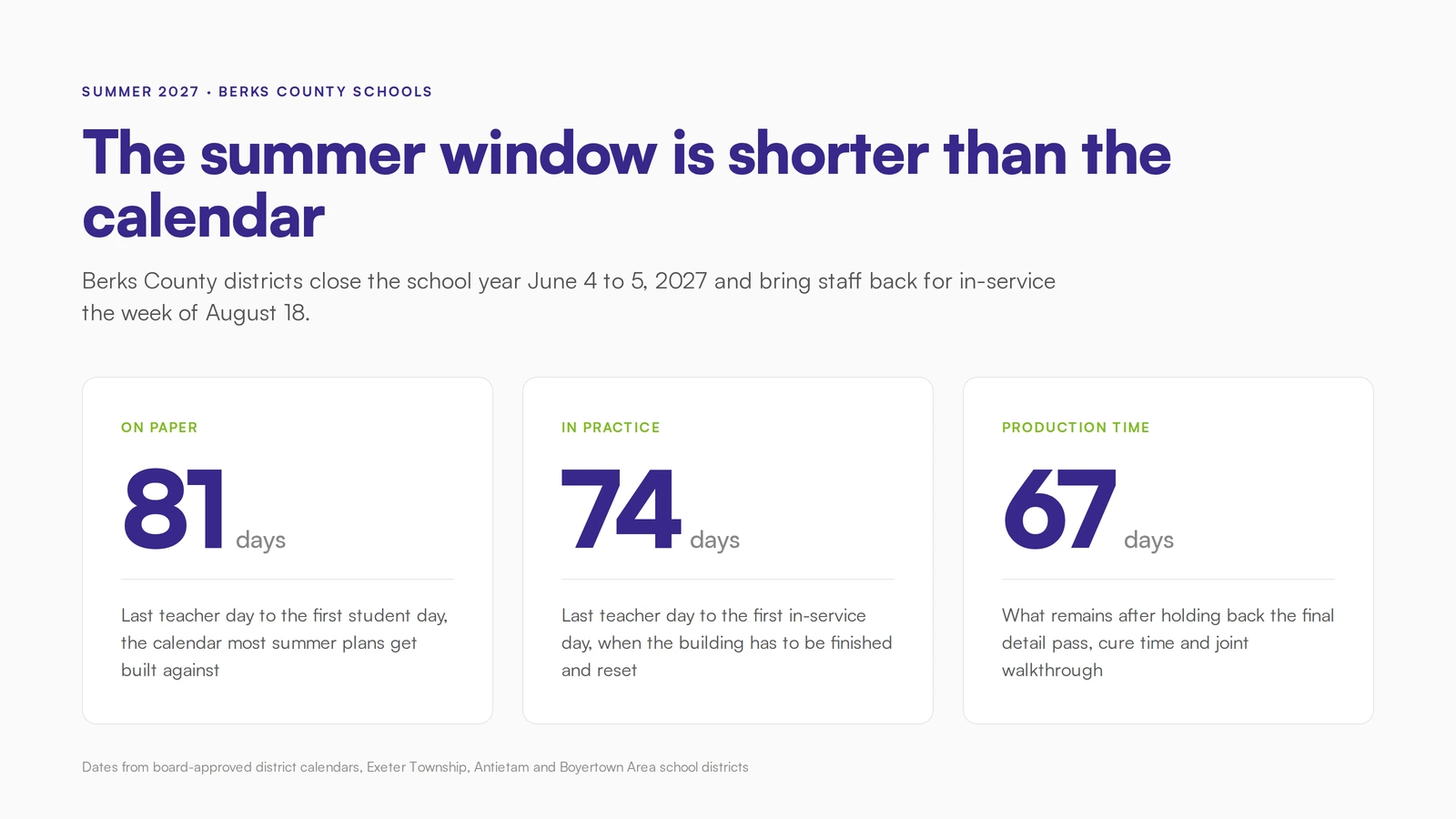
Only two of those matter for cleaning. The window runs from the last teacher day to the first in-service day, and Berks County calendars for the summer of 2027 show how narrow that actually is.
Exeter Township School District and Antietam School District both close the 2026-27 year with a last teacher day of June 4, 2027. Boyertown Area School District closes June 5 and brings staff back for in-service beginning August 18.
Run the arithmetic on Boyertown, which has both ends published, and the window is 74 calendar days, a little over ten and a half weeks. Now run it the way most plans get built, against a first student day rather than a staff return date. Exeter's students return August 24, which makes the same summer look like 81 days, close to twelve weeks.
That six-day difference is not a rounding error. It is the entire buffer most summer schedules assume they have.
Why the Usable Window Is Shorter Than the Calendar Window
Three things eat the back end. Teachers return before students to set up classrooms, which means furniture has to be back in place and floors fully cured before that date, not on it. Buildings often stay in use into early June for graduation, board meetings, and athletics. And the final coat of floor finish needs cure time that no amount of crew size will shorten.
Boyertown's in-service block runs August 18 to 20. The building has to be finished, cured, reset, and walked before the morning of the 18th. Take the 74-day window, hold back the final five business days for the detail pass and walkthrough, and roughly nine and a half weeks of production time remain. That is the number worth planning against.
If you want the distinction between this annual reset and what nightly service covers, we cover how routine custodial work and a full building reset differ separately. Ziva Cleaning Services builds both into the cleaning programs we run for educational facilities.
A Week-by-Week Summer Deep Cleaning Timeline
The buildings that come back ready in August are the ones where summer was sequenced by dependency rather than run as one long project. Counting backward from the staff return date rather than forward from the last bell is the difference between a plan and a hope.
Phase | When | Work | Why it sits here |
|---|---|---|---|
1. Access inventory | First week of break | Walk every building, flag rooms held by summer programs, camps, athletics, and capital work | Nothing downstream can be sequenced until restricted rooms are known |
2. Floor stripping and refinishing | 8 to 4 weeks before staff return | Strip, refinish, and cure, wing by wing | Longest lead item, cannot be compressed, sets every other date |
3. High dusting, vents, carpet extraction | 7 to 3 weeks before staff return, parallel wings | Overhead surfaces, light fixtures, return vents, then carpet | Overhead work has to precede the final floor pass in the same room |
4. Cafeteria, gym, locker rooms | 4 to 2 weeks before staff return | Court refinishing, locker room degreasing, serving line detail | These spaces carry the heaviest summer program traffic, so they go late |
5. Detail pass and walkthrough | Final 5 business days | Glass, restroom detail, furniture reset, joint walkthrough with facilities staff | Leaves correction time before anyone walks back in |
The dependency column is the part most plans get wrong. High dusting after a floor has been refinished puts overhead soil onto a fresh finish, and the room has to be done twice. Overhead first, floors last, room by room.
Sequencing Around Summer Programs and Capital Projects
Almost every district runs something in the building over the summer. Extended school year services, credit recovery, camps, and athletic conditioning all hold rooms and corridors that cannot be closed. So do capital projects, and in Berks County the summer is when roofing, HVAC replacement, and renovation work gets done.
Both get mapped in phase one, not discovered in phase three. Rooms held all summer come last or get worked around on a room-by-room basis. Rooms downstream of active construction get scheduled after that trade finishes, because a refinished floor under an open ceiling is a floor that gets done twice.
Scaling the Timeline to Your Building Count
The eighteen public school districts in the Berks County Intermediate Unit range widely in footprint. Antietam runs roughly 1,156 students across 3 schools. Boyertown Area runs roughly 6,375 across 9. Parochial and charter schools in the county often operate a single campus.
That range changes the plan, not just the price. A three-building district can move a single crew from building to building and still finish comfortably, whereas a nine-building district cannot, because sequential crews would require more weeks than the calendar actually contains. Parallel crews across separate wings or separate buildings become a structural requirement rather than an upgrade, and the phase-two start date has to move earlier to match.
Floor Stripping and Refinishing Sets the Whole Schedule
Floor work anchors the summer because it is the one task genuinely impossible during the school year. You cannot close a main corridor for a full day in October. Vinyl composition tile and terrazzo accumulate finish buildup, embedded soil, and scuffing across nine months that nightly mopping and weekly burnishing are not designed to remove.
A full strip takes the floor back to the base material, corrects embedded discoloration, and rebuilds the finish in coats meant to carry a year of traffic. High-traffic corridors and cafeterias generally need this annually. Lower-traffic offices and specialty rooms can often run on a longer cycle. Deferring a year does not save work, it makes the next strip slower. For what these surfaces need between resets, see our guide to what VCT and terrazzo need between annual resets.
Cure Time, Humidity, and Ventilation
Cure time is determined by the finish manufacturer's technical data sheet rather than by a rule of thumb, and it remains the single variable most likely to push a timeline past the staff return date, since recoat windows and full cure times vary considerably by product chemistry, film thickness, and ambient conditions in the room.
Two Berks County conditions matter here. August humidity extends cure time, so buffer days belong in the schedule before anyone needs them. And many districts reduce air handling over the summer to hold down utility costs, which works against finish that needs circulation to cure and off-gas properly. Normal ventilation should be restored several days before the final detail pass, not on the morning staff return.
Why Pre-1980 Floor Tile Slows a Strip-and-Refinish Schedule
This is the constraint most summer plans ignore, and in older Berks County buildings it changes the math.
Per OSHA's guidance on maintaining asbestos-containing flooring, any resilient floor tile installed before 1980 should be presumed to contain asbestos-containing material unless laboratory analysis has confirmed otherwise, and where that presumption applies, the work practices prescribed under the Occupational Safety and Health Administration asbestos standard at 29 CFR 1910.1001(k)(7) are explicit:
Sanding the flooring material is prohibited.
Stripping must use low-abrasion pads.
Machines must run below 300 rpm.
Wet methods are required.
Burnishing or dry buffing is permitted only where enough finish remains that the pad cannot reach the tile beneath.
Read that as a throughput constraint rather than a documentation exercise, because a machine restricted to 300 rpm with a low-abrasion pad covers substantially less square footage per hour than the high-speed equipment a crew would otherwise deploy, and the required wet methods add dwell and pickup time to every pass. The same corridor consequently takes longer, which means the phase-two start date has to move earlier to absorb the difference.
The practical consequence is a sequencing requirement rather than an administrative one, because the building's asbestos records, maintained under the district's Asbestos Hazard Emergency Response Act management plan, need verification before floor work is scheduled, not after a crew has already arrived with unsuitable equipment.
When Berks County Schools Need to Book Summer Work
The booking deadline is not June. Pennsylvania districts must adopt a proposed final budget by May 31 and a final general fund budget by June 30, so contracted summer work is scoped and funded during spring budget development. By the time the last bell rings, the money is already committed.
Districts that wait until the final week of June encounter a compressed version of the same problem annually, because no lead time remains to sequence around summer programming, order specialty materials, or staff the project at the size the calendar genuinely requires. The work then gets compressed into the final weeks, which is precisely when cure time and humidity are least forgiving.
Starting the conversation in January or February is not about urgency. It is about arriving at the last day of school with a sequenced plan, confirmed crew sizes, and a walkthrough already on the calendar, rather than trying to build all three inside a window that closes on August 18.
How Private, Parochial, and Charter Schools Differ
Non-public schools in Berks County run a different clock. Most operate a single campus, which removes the parallel-crew problem entirely. Most have no facilities committee or budget cycle standing between a decision and a start date, so the booking conversation can happen far later without hurting the schedule.
The trade is that there is usually no in-house custodial department to absorb overflow. If a contracted phase slips at a public district, head custodians can often close the gap. At a single-campus school with two or three staff, a slipped phase stays slipped.
The Two Things That Actually Slip a Summer Timeline
Staffing is the first. A summer deep clean is a different labor problem from nightly service, and running it with school-year crew sizes is the most common reason a plan misses its date. Floor stripping in particular needs trained technicians brought in for that phase rather than absorbed by the regular team on top of routine work. When evaluating any vendor, ask directly how summer crews are sized against the school-year contract. The answer tells you whether the timeline is real.
Capital project collision is the second. Roofing and mechanical work generate dust that lands on finished surfaces, and a room cleaned before the trade above it finishes is a room that gets cleaned twice. Summer work and capital work need one shared calendar, owned by one person, not two schedules that meet for the first time in week four.
For the room-by-room task breakdown inside each of those spaces, see our task-level breakdown for gyms, cafeterias, and restrooms.
Build the Schedule Before the Last Bell
A summer reset holds its date when the sequence is set before the building empties, not after. We walk Berks County school buildings, map the rooms that stay in use, check the constraints that change how floor work has to run, and build the phase dates backward from your staff return.
Schedule a free on-site assessment and we will build the sequence around your calendar.


