

Road salt and ice melt tracked in from outside dull floor finish, leave a white film and create slip hazards. Stop salt at the door with layered entrance matting, match your response to each floor type, and follow a storm-day routine. OSHA 29 CFR 1910.22 requires employers to keep walking-working surfaces free of hazards such as snow and ice.
How Does Road Salt Damage Commercial Floors?
Road salt damages commercial floors in three ways: it abrades the surface as gritty crystals are walked across it, it leaves a chalky residue that dulls finish, and it adds to the meltwater that makes entrances slick. Every step through a doorway carries more of it across the lobby. A floor that looks fine in December can show worn lanes and hazy patches by February.
Hard finishes such as floor wax or sealer take the abrasion and the residue first, which is why entrance lanes lose gloss before the rest of the floor does. Carpet holds salt in the fibers, where it can re-soil the pile and call for hot water extraction. Grout and unsealed concrete are porous, so salty meltwater can soak in, which is where tile and grout restoration comes in. The floor-by-floor table later in this guide sets out the right response for each surface.
Rock Salt, Calcium Chloride and Magnesium Chloride: What Is Actually on Your Lot?
Rock salt is sodium chloride. Calcium chloride and magnesium chloride are different compounds, and they are often sold as ice melt for colder weather. Your building rarely controls which one reaches the entrance, because the road crew, the snow contractor for your lot and the neighboring property may each use something different.
Ask your snow contractor what they spread on the lot and sidewalks, and write it down. It tells your cleaning crew what residue to expect and which cleaning products to match to it. The same salt reaches service doors and docks too, which is covered in our post on what winter does to a dock apron in Berks County. Check your flooring manufacturer's care guide for any limits on ice-melt products, since those limits decide how quickly residue has to come off.
What Do Winters Mean for Commercial Buildings in Berks County?
Berks County buildings spend a large share of the winter near freezing, so salt arrives on shoes for months, not days. NOAA's 1991 to 2020 climate normals for Reading Spaatz Field show an average of 107 days a year with a low at or below 32°F, and about 72 of those fall in December through February, out of roughly 90 days. PennDOT's winter facts page lists an average of 26 inches of snow for Berks County, along with 11,862 tons of salt and 72,805 gallons of brine used on the roads its crews treat. The sidewalks and lots at your building are treated separately, by whoever your lease or snow contract names.
Ziva Cleaning Services cleans commercial buildings in Reading, Wyomissing, West Reading and Exeter Township, and in every one of those buildings the entrance is where the salt comes in. Offices, medical practices, retail plazas and dealership showrooms each carry salt differently, because foot traffic, floor type and who maintains the entrance all vary. A shared plaza adds a further question, which is who owns the vestibule and the walk. Our commercial floor care program covers the floor work that follows, and the plan below applies to any building. For the full year, see our four-season cleaning calendar for multi-tenant properties.
How Do You Build an Entryway System That Stops Salt at the Door?
Build the entryway as three mats in sequence, each with one job, and check them on a schedule tied to the weather. During business hours, a day porter can handle those checks. A single mat inside the door has to do every job at once, so it can saturate and start spreading wet salt instead of stopping it. Splitting the work across zones lets the outside mat take the grit, the vestibule mat take the water, and the interior mat catch what is left.
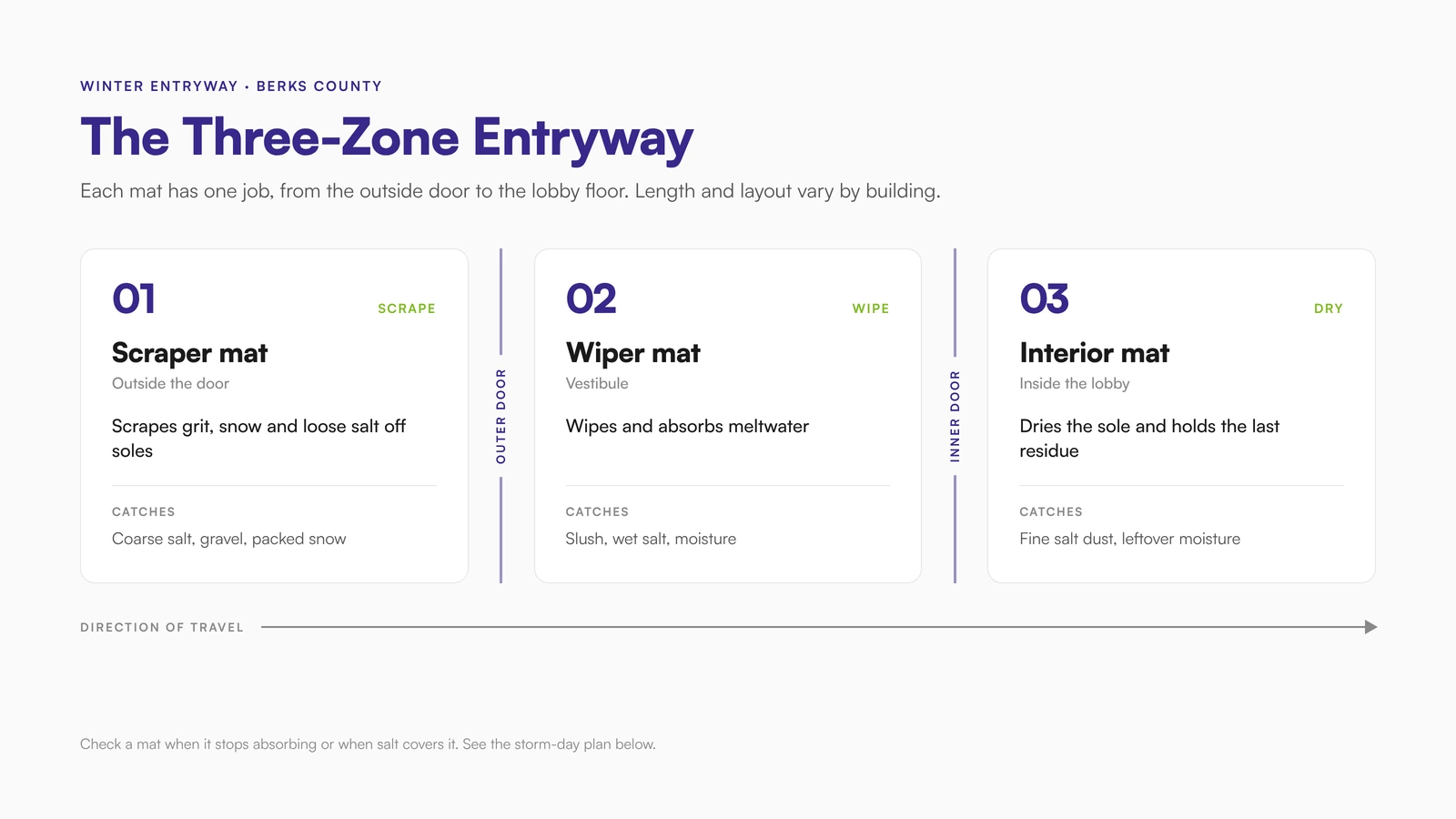
Zone | Job | What it catches | Check or swap when |
|---|---|---|---|
1. Outside the door | Scrape grit, snow and loose salt off soles | Coarse salt, gravel, packed snow | Snow packs into the surface, or salt covers it |
2. Vestibule | Wipe and absorb meltwater | Slush, wet salt, moisture | Standing water on top, or it feels wet underfoot |
3. Inside the lobby | Dry the sole and hold the last residue | Fine salt dust, leftover moisture | Visibly gray or damp, or salt shows beyond its edge |
How long should the system be? Long enough that each foot lands on it several times before reaching the floor, so measure the path people actually walk from the door to the first turn instead of relying on a stock mat size. Narrow mats get stepped around, which leaves a bare lane of floor taking the salt. Set the length and layout with your flooring manufacturer and your cleaning contractor.
Keep the mats flat and the edges safe: The 2010 ADA Standards limit a vertical change in level to 1/4 inch, require changes between 1/4 inch and 1/2 inch to be beveled, and require anything higher to be ramped. On an accessible route, measure the edge height of any mat you add, and replace curled or rippled mats rather than taping them down.
Lift before you mop: Pull the mats clear before wet-cleaning the floor under them. Mopping around a mat pushes water and salt beneath it, where the residue sits against the floor and the surface turns slick.
Which Floors Does Salt Hurt Most, and What Does Each Need?
Salt hurts finished and porous surfaces most, so vinyl composition tile with floor finish, grout, unsealed concrete and carpet need the closest attention. Sealed hard surfaces cope better but still lose their protective layer first in the entrance lanes. Use the table to match each floor to a before-winter task and an after-storm response, and treat your flooring manufacturer's care guide as the final word on products.

Floor type | What salt does | Before winter | After a storm |
|---|---|---|---|
Vinyl composition tile (VCT) and other resilient flooring with finish | Wears the finish and leaves a white film in traffic lanes | Check the finish in the entrance lanes and recoat any worn areas | Clean with a neutral-pH product, rinse and dry, so the residue does not build |
Ceramic and porcelain tile with grout | Grout is porous, so salty water soaks in and leaves deposits | Confirm the grout is sealed as the installer specifies | Flush the grout lines and pick up the water. See tile and grout restoration |
Sealed or polished concrete | Wears the sealer first, and exposed concrete takes the salt directly | Inspect the sealer or densifier and renew it on the manufacturer's schedule | Remove residue quickly and look for dull or rough patches |
Terrazzo and natural stone | Can dull or etch, depending on the stone and its sealer | Confirm the sealer is intact and ask the installer which products are safe | Use stone-safe, pH-neutral products only |
Carpet and carpet tile | Salt stays in the fibers, draws moisture and re-soils the pile | Vacuum the entrance lanes on a set schedule | Vacuum, then extract where salt shows. See hot water extraction for carpet |
Hardwood and engineered wood | Grit scratches and standing water can reach the seams | Add a wiper mat and walk-off zone before the first storm | Wipe water up quickly and avoid wet mopping |
The removal steps for hard floors follow the same pattern in every row: neutral-pH product, rinse, dry. How retail stores handle salt during the holiday rush walks through it step by step, including who handles the entrance in a shared plaza.
Should You Strip and Refinish Floors in Winter?
Floor-care professionals split on this. One view says to avoid stripping and refinishing between December and March, because new finish goes down just as the entrance starts taking salt again and may not cure fully before it is walked on. The other view says to refinish in the fall, so the finish has cured before the first storm, and then maintain it through the season.
For full-floor work, we side with the second view. The exception is an entrance lane that has worn through to bare tile, which takes salt directly and is worth a spot recoat during closed hours. Whichever approach you choose, get the cure time from the finish manufacturer and keep the area closed for that long.
What Should a Storm-Day Plan Cover?
A storm-day plan sets the triggers, the owners and a log before the weather arrives, so entrance checks do not depend on someone remembering. Write it in four stages and name one person for each.
Before the storm: When snow or ice is forecast, confirm the snow contractor has treated the lot and walks, lay the mats flat, and stage spare mats and wet-floor signs at the entrance. Confirm who is on site and who is on call.
During the storm: Check the entrance at set points, such as opening, midday and close, and again whenever slush is reaching the lobby. Swap saturated mats, dry-mop the vestibule and sign any wet floor. Day porter coverage can own these checks during business hours.
After the storm: Lift the mats, clean and dry the floor beneath them, remove salt residue, and vacuum the interior mat and carpet lanes. Look for curled or shifted mats that now create a trip hazard.
The next morning: Walk the entrance before the building opens, then record what was done and flag any dull, rough or hazy areas for the floor-care schedule.
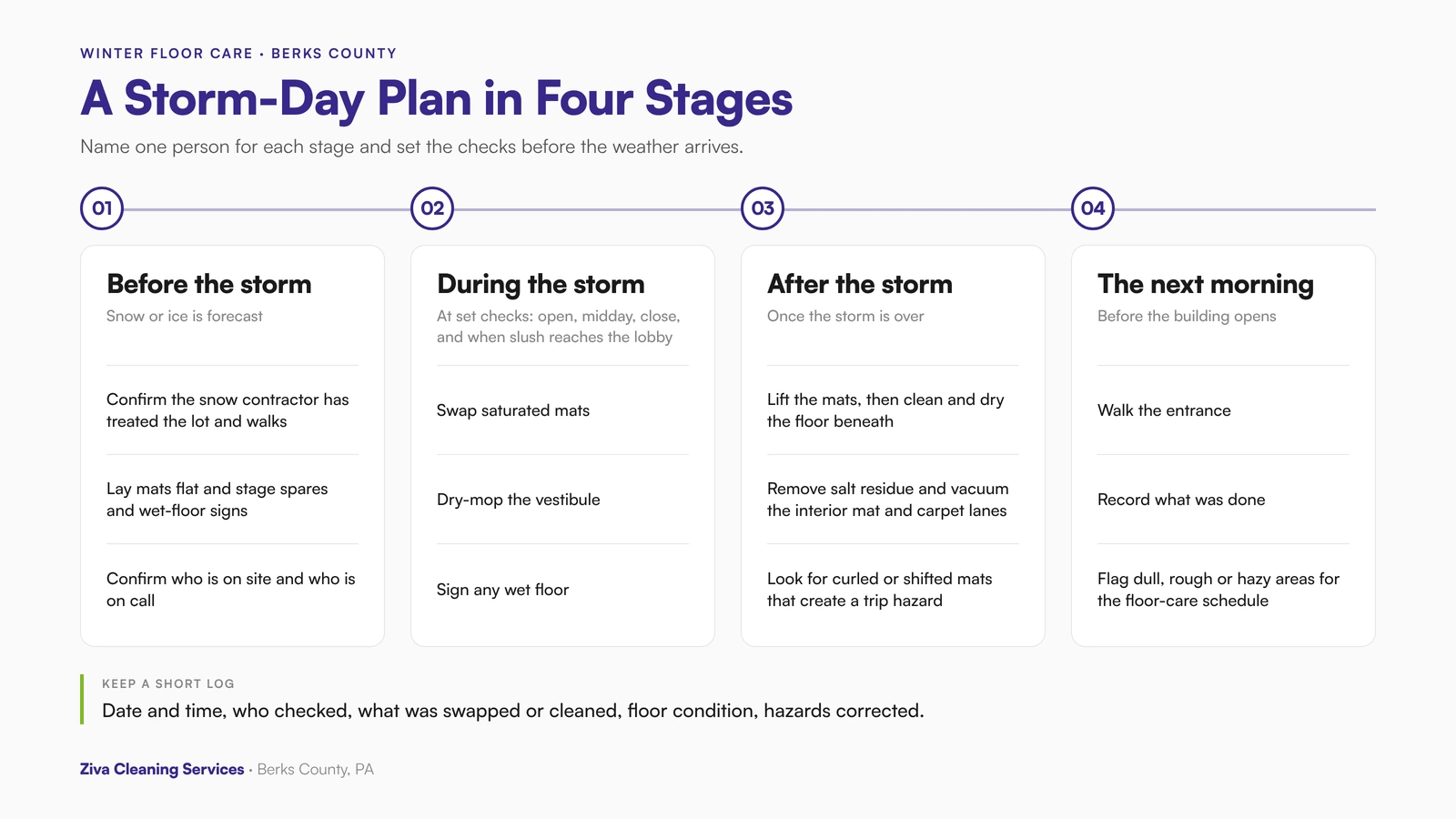
Keep a short log with the date and time, who checked, what was swapped or cleaned, the floor condition and any hazard corrected. A dated record shows that inspections happened, which supports the slip-and-fall prevention practices a building already follows.
What Does OSHA 29 CFR 1910.22 Require?
OSHA 29 CFR 1910.22(a)(3) requires employers to keep walking-working surfaces free of hazards such as snow and ice. As of November 2026, section 1910.22(d)(1) requires those surfaces to be inspected "regularly and as necessary," and section 1910.22(d)(2) requires hazardous conditions to be corrected before an employee uses the surface again.
When a correction cannot be made immediately, the hazard must be guarded so employees cannot use the surface until it is fixed. The standard sets no inspection interval, so your plan has to set one that fits your traffic and the weather. It protects employees, and it does not decide who is liable if a visitor falls, which depends on your lease and your insurance.
Who Is Responsible for Salt Control in a Leased Building?
Your lease decides, and it may split the entrance between the landlord and the tenant. A shared vestibule serving several suites is the usual gap, because each party can assume the other one covers it. Read the common-area maintenance clause before the first storm, and settle any gap in writing with the property manager. This is a planning checklist, not legal advice.
Area | Question to settle | What to write down |
|---|---|---|
Lot and sidewalks | Who clears snow and spreads de-icer, and with which product? | Contractor, product, trigger for treatment, response time |
Outside scraper mat | Who supplies it, lays it and cleans it? | Owner, placement, who checks it in a storm |
Vestibule | Common area or tenant space? | Who cleans it, how often, who calls the cleaner after a storm |
Interior lobby and floors | Who cleans and refinishes them? | Storm-day visits and how extra visits are billed |
Mat swaps and replacement | Who buys, swaps and replaces mats? | Spare stock and who pays |
A tenant whose cleaning crew only covers the suite can end up with a clean suite and a salt-covered lobby. Make sure your cleaning scope covers everything on your side of the door, so nothing falls between landlord, tenant and contractor.
When Should a Building Bring In a Cleaning Contractor for Winter?
Bring one in when your staff cannot cover the entrance checks every storm day, or when floor care such as refinishing and carpet extraction is beyond what the building can do itself. A small building with one entrance, sealed floors, a mat system already in place and a staff member who owns the checks may manage without one. A contractor cannot fix an entrance that has no mats and no written responsibilities, so sort those out first.
If you do hire, ask these questions before the first storm:
Which storm-day visits are included, and which are billed extra?
What triggers a visit, and who decides?
What does the crew record after each visit?
Are they insured and bonded, and who do you call after hours?
Which products will they use on each of your floor types?
What to track: the condition of the entrance at opening, the state of the mats at each check, repeat complaints and the log itself. What to ignore: visit counts and hours on site that say nothing about the floor. A crew can log many visits and still leave a salt film at the door.
We are insured and bonded, and we offer floor stripping, waxing and polishing, carpet extraction and day porter service for Berks County buildings. We start with a free on-site assessment of the entrance and floors, so the plan fits your building instead of a template.
How Can Berks County Buildings Get a Winter Floor Plan?
We start with a walk through your entrance and floors, noting the floor types, the mat gaps and who handles each area, then build a customized cleaning plan around what we find. Schedule your free on-site assessment, and we will give you a clear quote for winter coverage.


