

Service bay degreasing is the process of removing built-up oil, grease, and fluid residue from a dealership's service bay floor using commercial-grade degreasers and extraction equipment, not mops or hoses. Pennsylvania's Clean Streams Law prohibits washing these fluids into storm drains, making proper extraction the only compliant method for Reading, PA dealerships.
Grease and oil residue builds up on service bay floors faster than most facility managers expect, and the way it gets cleaned matters as much as how often. This guide covers what service bay degreasing actually involves, why common methods make the problem worse instead of better, and what a professional degreasing program looks like for a Reading dealership.
What Is Service Bay Degreasing?
Service bay degreasing targets the specific residue that accumulates where vehicles are serviced: motor oil, transmission and brake fluid, antifreeze, grease from undercarriage work, and tracked-in road grime. It's one piece of a dealership's overall cleaning scope, but a distinct process from general shop cleaning because this residue bonds to concrete differently than dust or dirt. Left untreated, it creates a slip hazard, breaks down floor coatings over time, and becomes nearly impossible to remove once it has soaked into porous concrete.
A proper degreasing program uses an alkaline or solvent-based degreasing agent matched to the floor's surface (sealed, epoxy-coated, or bare concrete), mechanical agitation to lift bonded residue, and wet vacuum extraction to pull the dissolved grease and dirty water off the floor. This is different from a daily sweep or a quick mop-down, which moves surface debris but doesn't address what's bonded to the concrete.
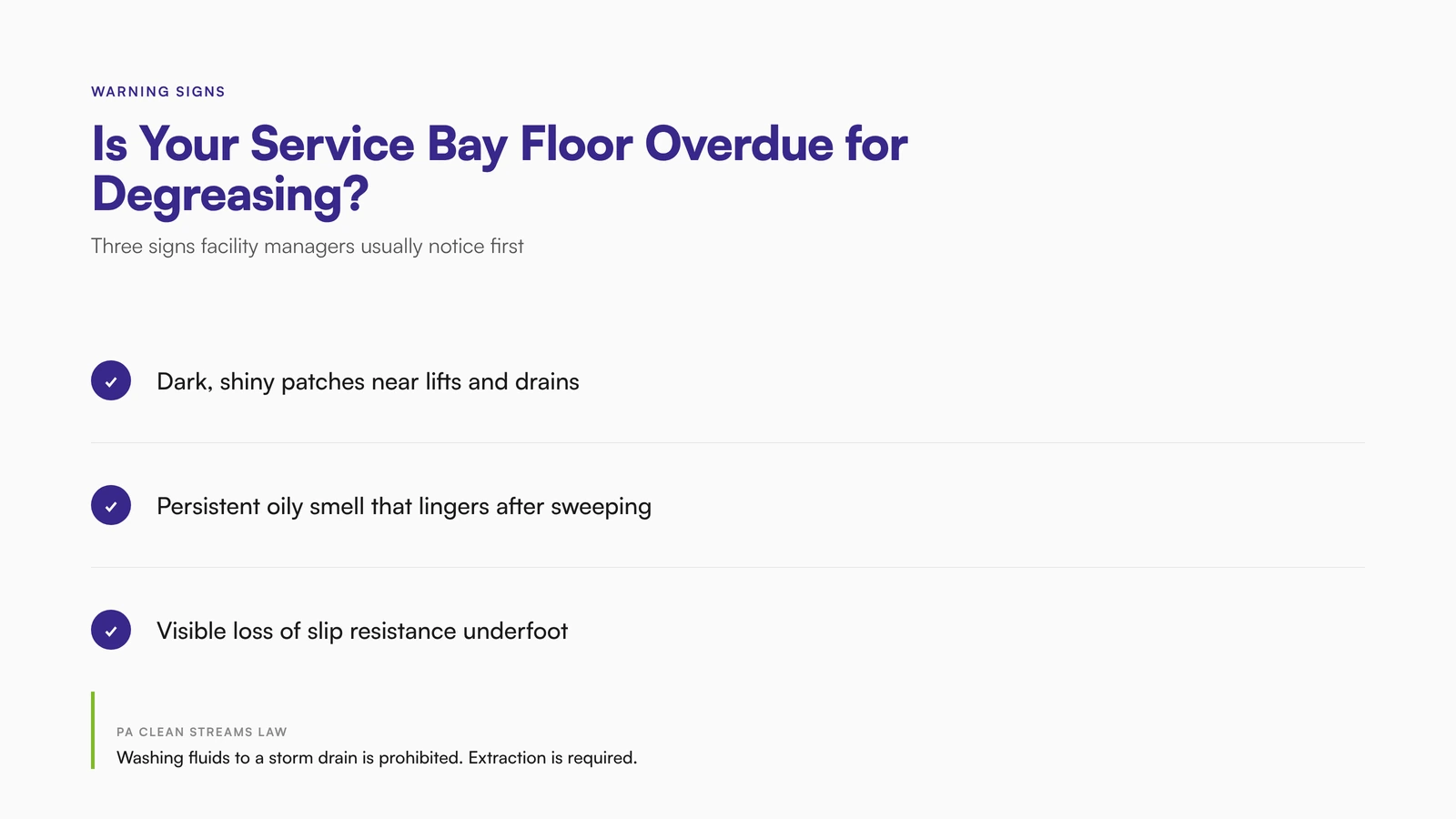
The signs of a service bay overdue for degreasing are usually visible before they become a liability. Dark, shiny patches near lifts and drains, a persistent oily smell that lingers after sweeping, and visible slip resistance loss underfoot are the three most common indicators. Facility managers often notice the floor "never looks clean" even right after a routine sweep, which is typically a sign that surface cleaning is being done without any actual degreasing behind it.
Why Mopping and Hosing Don't Remove Grease From a Service Bay Floor
Mopping and deck-brushing are the most common ways dealerships try to handle service bay grease in-house, and both have the same core problem. Rather than lifting grease off the floor, these methods typically push it toward the nearest floor drain, where it either clogs the drain line or passes through to wherever that drain discharges.
Hosing down a bay floor creates the same issue at a larger scale. Water mixed with oil and degreaser residue has to go somewhere, and if it reaches a storm drain, it becomes an illicit discharge under Pennsylvania's Clean Streams Law regardless of whether the dealership intended it. This is the gap between "the floor looks clean" and "the grease was actually removed and properly contained," and it's the main reason degreasing needs a different process than routine floor cleaning.
How Does Professional Service Bay Degreasing Work?
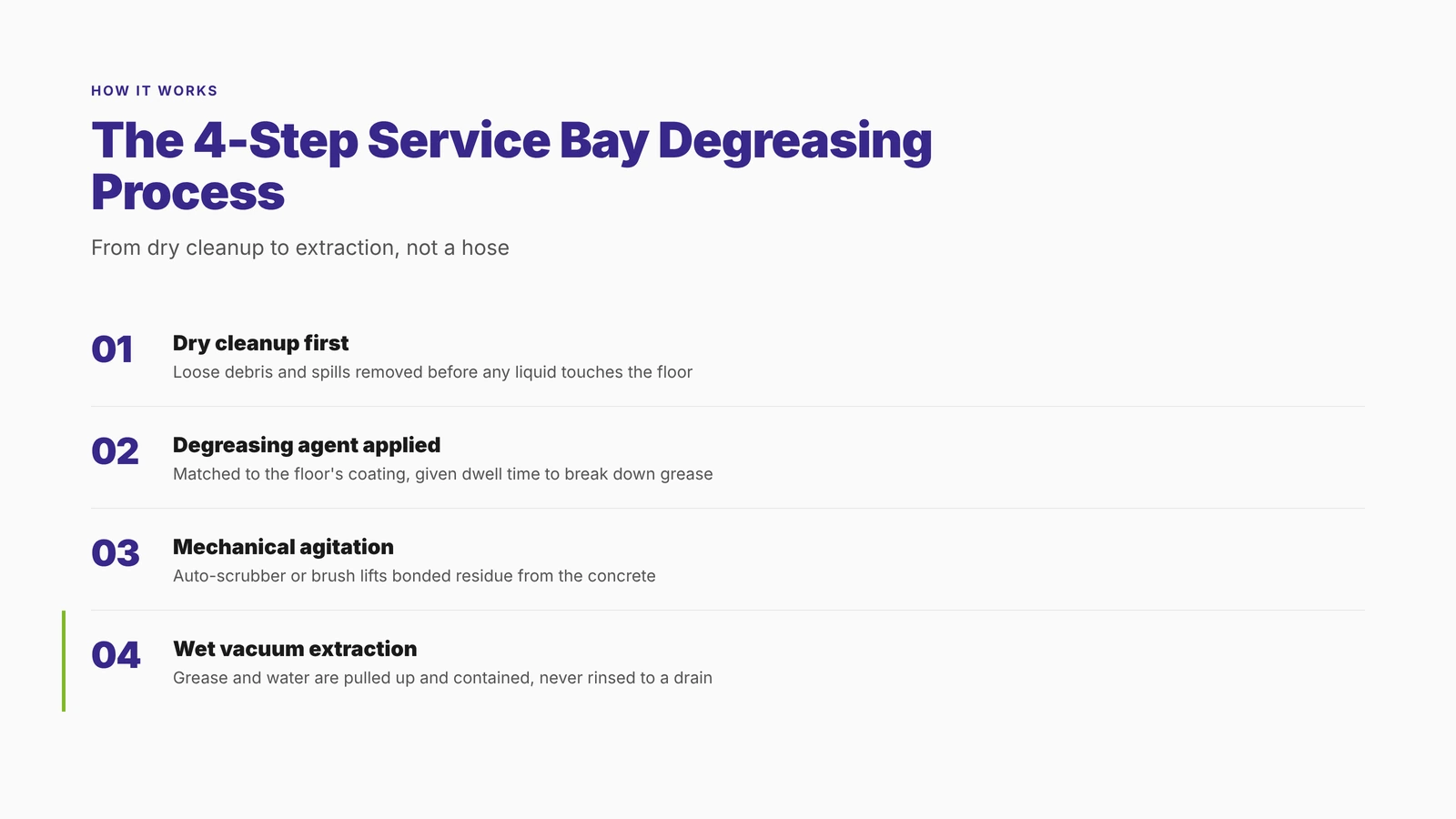
A professional service bay degreasing visit generally follows four steps:
Dry cleanup first: Loose debris, dry spills, and absorbent material get swept or vacuumed before any liquid touches the floor. State-funded guidance for Pennsylvania auto repair facilities recommends this dry-first approach specifically to limit how much liquid waste needs to be managed.
Degreasing agent application: A degreaser formulated for the floor's coating and the type of residue present is applied and given dwell time to break down bonded grease.
Mechanical agitation: Auto-scrubbers or agitating brushes work the degreaser into the residue, lifting it from the concrete surface.
Wet vacuum extraction, not hosing: The dissolved grease, degreaser, and water are extracted and contained for proper disposal rather than rinsed toward a drain.
Floor drains and oil interceptors in the bay are also inspected during this process, since a clogged or overwhelmed interceptor is often what turns a routine cleaning task into a compliance problem.
How Often Should a Service Bay Floor Be Degreased?
The right frequency depends on bay volume and the type of work performed. A bay handling frequent oil changes and fluid services accumulates residue faster than one used mostly for inspections or tire work, and a dealership running multiple bays at capacity needs a tighter schedule than a single-bay independent shop.
As a general framework, daily spot cleanup (sweeping, wiping fresh spills, managing drip pans) handles day-to-day buildup, while a full degreasing pass is typically scheduled on a weekly to monthly cycle depending on volume. High-traffic bays or those handling heavier fluid work often need degreasing closer to weekly, while lower-volume bays can often go longer between full passes without the floor becoming a hazard.
Seasonal factors matter for Reading, PA dealerships specifically. Winter months bring road salt and grit tracked in alongside fluid drips, and the combination accelerates both floor wear and residue buildup compared to the rest of the year. Dealerships that hold to a fixed monthly schedule year-round often find the floor looks noticeably worse by February than it did in October, which is a sign the winter cycle needs to tighten up rather than stay on the same calendar as the summer months.
Does Degreasing Damage an Epoxy-Coated Service Bay Floor?
Not when the right product and process are used, but this is a legitimate concern. Harsh solvent-based degreasers can break down the resin in an epoxy coating over time, dulling the finish or causing it to lift at the edges. A professional degreasing program identifies the floor's coating type before selecting a chemical, using a pH-balanced or coating-safe degreaser on epoxy and a stronger solvent-based product only on bare or sealed concrete that can tolerate it.
The agitation step matters here too. Aggressive wire-brush agitation can scratch an epoxy finish, while a properly calibrated auto-scrubber with the correct pad lifts residue without abrading the coating.
DIY Degreasing vs. a Professional Service Bay Program
In-house staff can manage daily spot cleanup, but most dealerships run into the same wall with full degreasing: the equipment (commercial extraction units, auto-scrubbers), the correct chemical selection for the specific floor coating, and the time to do it properly all compete with service bay uptime. A rushed in-house degreasing job that pushes residue toward a drain instead of extracting it also creates the exact compliance exposure described above.
There's also a scheduling conflict most facility managers underestimate. A full degreasing pass is hard to run during business hours without pulling a bay out of service, and staffing it after hours means either paying overtime or asking existing technicians to take on a task outside their training. A professional degreasing visit is scheduled around the dealership's service hours instead of competing with them, so the bay comes back into rotation clean without cutting into billable technician time.
Schedule your free on-site assessment
Ziva Cleaning Services builds service bay degreasing into a scheduled dealership cleaning program for Reading, PA dealerships, so the bay gets a proper degreasing pass on a set cycle instead of being handled reactively when it becomes a visible problem. We also cover OSHA and EPA compliance requirements specific to dealership cleaning for facility managers who want the fuller regulatory picture beyond floor care. For dealerships elsewhere in Berks County weighing the same service bay maintenance question, the same process and frequency guidance applies.
Schedule a free on-site assessment to see what a degreasing cycle would look like for your service bay.


