

Historic building post-construction cleaning in Reading, PA is a final clean that removes renovation dust without damaging original plaster, wood, brick or glass. Older buildings may contain lead paint or asbestos, so OSHA 29 CFR 1926.62 and 29 CFR 1926.1101 call for HEPA vacuuming instead of dry sweeping wherever those materials create dust.
How Is Post-Construction Cleaning Different in a Historic Building?
Post-construction cleaning in a historic building is different because the finishes being cleaned cannot be replaced if they are damaged. Ziva Cleaning Services cleans commercial buildings across Berks County, and in an older building cleaners should treat plaster, wood floors, millwork and masonry as surfaces to preserve, not only surfaces to clear of dust. That changes the products, the tools and the order of work.
Three conditions set these projects apart. The first is hidden material: older buildings may contain lead-based paint and asbestos, so hazard status has to be settled before anyone starts the final clean. The second is fragile surfaces: improper cleaning can permanently damage old masonry and wood, so the gentlest method that works is the rule. The third is outside review: in Reading, exterior changes in the local historic districts go through a city board, which shapes the project schedule.
None of this changes the goal of the final clean, which is a space ready for occupancy. It changes how cleaners get there. Our ready-for-occupancy turnover cleaning covers the stages from rough clean through handover. Our guide to how rough and final cleans divide the work explains the earlier stages, and the final clean exists mainly to control fine dust, which is covered in how fine dust affects a finished building.
Which Lead and Asbestos Rules Apply to Post-Renovation Cleaning?
Two OSHA construction standards govern cleanup dust from lead and asbestos in older buildings: 29 CFR 1926.62 for lead and 29 CFR 1926.1101 for asbestos. Both restrict dry sweeping and compressed air, which is why HEPA vacuuming comes first.
Standard | What it says about cleanup | Who handles it |
|---|---|---|
Lead, 29 CFR 1926.62(h) | Keep surfaces as free as practicable of lead accumulations. Vacuum or use methods that keep lead from becoming airborne. Sweep, shovel or brush only after vacuuming has been tried and found ineffective. Vacuums need HEPA filters. | The contractor whose work disturbs lead, with the cleaning crew following the same controls |
Asbestos, 29 CFR 1926.1101 | Use HEPA vacuums for debris and dust containing asbestos. No dry sweeping or other dry cleanup of that debris. Compressed air only with enclosed ventilation that captures the dust cloud. | A certified asbestos contractor |
Removing asbestos or lead hazards is specialist work. Certified specialists finish it before the final clean, and cleaners should start only after the general contractor confirms hazard status in writing. We do not remove asbestos or lead hazards.
Who Does What in a Historic Building Post-Construction Cleanup?
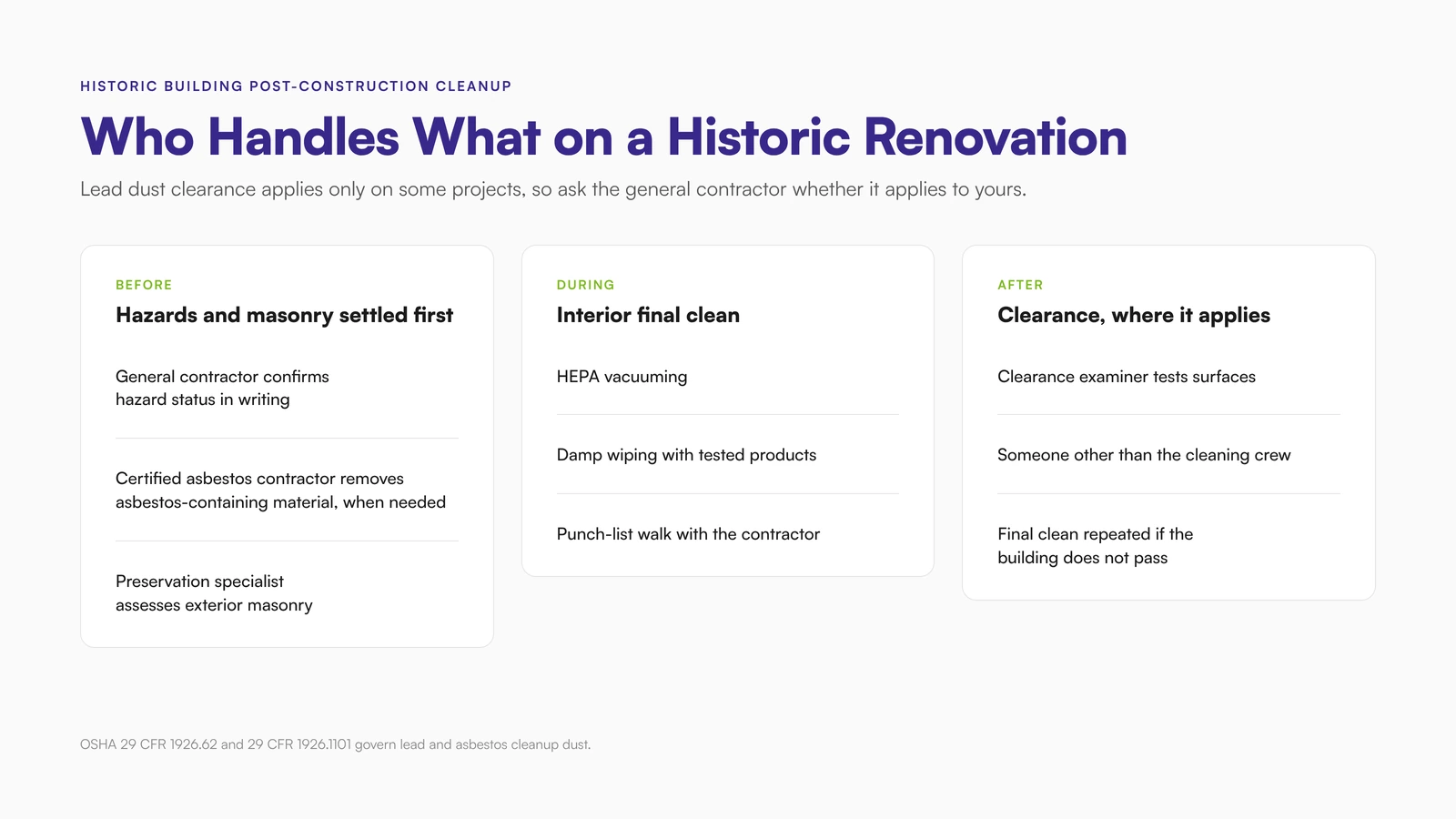
A historic renovation passes the building through several specialists before the final clean. Knowing who owns each task keeps the cleaning crew from being asked to do work it was not scoped for.
Role | What they handle |
|---|---|
General contractor or project manager | Runs the schedule, trade sign-offs and punch list, and confirms hazard status before cleaning starts |
Certified asbestos contractor (when needed) | Removes asbestos-containing material before the final clean |
Preservation specialist or architectural conservator | Assesses and guides cleaning of exterior historic masonry |
Clearance examiner (where lead dust clearance applies) | Tests surfaces after the final clean, and is someone other than the cleaning crew |
Commercial cleaning crew | Interior final clean: HEPA vacuuming, damp wiping with tested products, and the punch-list walk |
We clean interiors. We do not pressure wash historic masonry as part of a post-construction clean. An owner with exterior brick or stone to clean should have a preservation specialist assess it first.
How Do You Clean Plaster Dust in a Historic Building After Renovation?
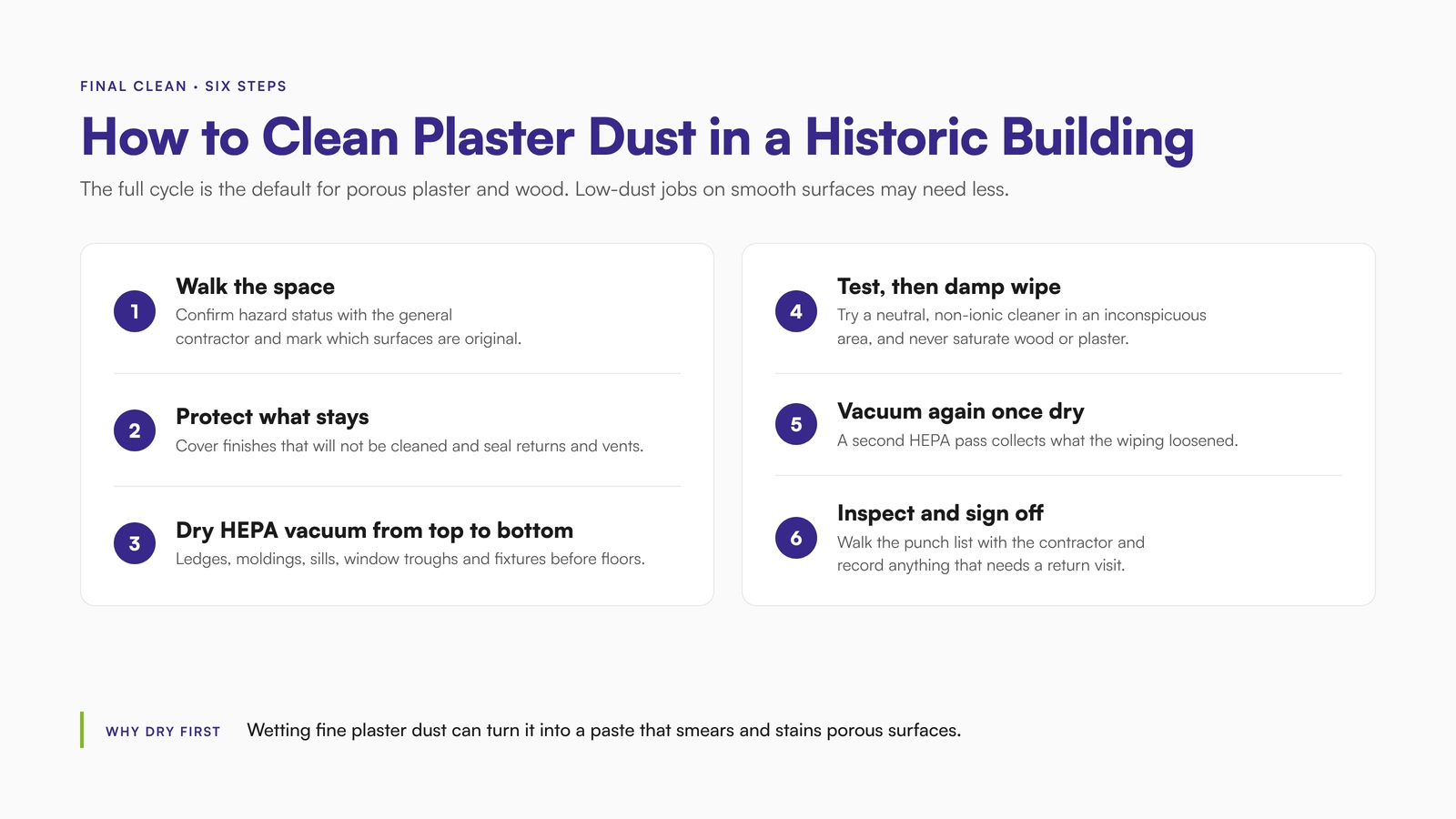
Clean plaster dust in a historic building by dry HEPA vacuuming first, then damp wiping with a tested product, then vacuuming again once surfaces dry. Dry removal comes first because wetting fine plaster dust can turn it into a paste that smears and stains porous surfaces.
Walk the space: Confirm hazard status with the general contractor and mark which surfaces are original.
Protect what stays: Cover finishes that will not be cleaned and seal returns and vents so dust is not pulled into the system.
Dry HEPA vacuum from top to bottom: Work through ledges, moldings, sills, window troughs and fixtures before floors.
Test, then damp wipe: Try a neutral, non-ionic cleaner in an inconspicuous area, and wipe without saturating wood or plaster.
Vacuum again once surfaces are dry: A second HEPA pass collects what the wiping loosened.
Inspect and sign off: Walk the punch list with the contractor and record anything that needs a return visit.
The order matters because dust that escapes the first pass settles on ledges and returns, which is why the final clean comes after the earlier stages and why the top-to-bottom vacuuming comes before any wiping.
Professionals do not all use the full cycle. A HEPA vacuum, wet wipe and second HEPA vacuum suits high-dust jobs with rough or porous surfaces, while low-dust jobs with smooth surfaces may need wet cleaning alone. Old plaster and wood are porous, so cleaners in historic interiors should default to the full cycle and relax it only when the surface and the dust load allow.
How Should You Clean Original Surfaces in a Historic Building After Construction?
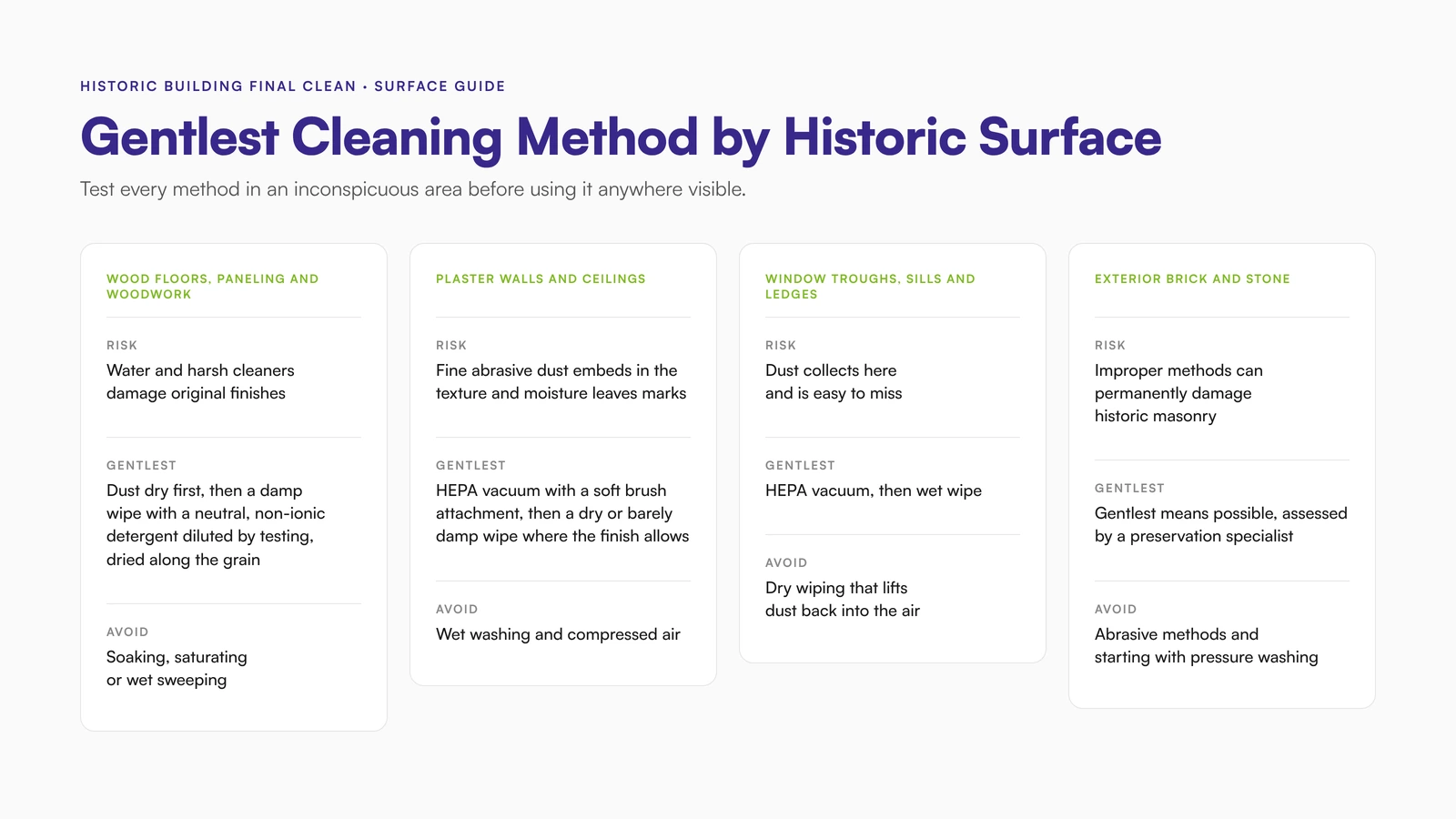
Clean original surfaces with the gentlest method that works, and test that method in an inconspicuous area before using it anywhere visible. The same rule applies to every surface below.
Surface | Main risk | Gentlest approach | Avoid |
|---|---|---|---|
Wood floors, paneling and woodwork | Water and harsh cleaners damage original finishes | Dust dry first, then a damp wipe with a neutral, non-ionic detergent diluted by testing, dried along the grain | Soaking, saturating or wet sweeping |
Plaster walls and ceilings | Fine abrasive dust embeds in the texture and moisture leaves marks | HEPA vacuum with a soft brush attachment, then a dry or barely damp wipe where the finish allows | Wet washing and compressed air |
Window troughs, sills and ledges | Dust collects here and is easy to miss | HEPA vacuum, then wet wipe | Dry wiping that lifts dust back into the air |
Exterior brick and stone | Improper methods can permanently damage historic masonry | Gentlest means possible, assessed by a preservation specialist | Abrasive methods and starting with pressure washing |
How Does Post-Construction Cleaning Fit a Historic Project Schedule in Reading, PA?
Post-construction cleaning on a historic project runs in three passes: a rough clean while trades work, a final clean after the last trade leaves, and a follow-up pass once settled dust shows up. Reading’s historic review applies to exterior work, so interior cleanup normally runs on the contractor’s schedule.
Reading has five historic districts, and four of them are locally regulated by the Historical Architectural Review Board (HARB): Callowhill, Prince, Centre Park and Penn’s Common. The fifth, the Queen Anne District, is a National Register district and is not subject to HARB review. In the four regulated districts, new construction and exterior alterations that can be seen from a public right of way need a Certificate of Appropriateness, which must be obtained before building permits. The Board meets on the third Tuesday of each month, applications are due ten working days before the meeting, and in most cases approval is issued at the hearing. The City’s review applies to exterior changes, so interior cleaning is not what it covers.
Cleanup also sets up the occupancy inspection. Our guide to preparing a building for its occupancy inspection covers the Berks County side of that handover. Cost depends on several factors, and what drives the price of a construction cleanup is set out in our cost guide.
What Should You Ask a Post-Construction Cleaning Contractor Before a Historic Building Handover?
Ask any cleaning contractor for a historic building these six questions before the final clean is scheduled:
Who confirms hazard status for lead and asbestos, and when do you start after that confirmation?
Which HEPA equipment and cleaning products do you use on original finishes?
Will you test each wet method in an inconspicuous area and get approval before using it?
What insurance and bonding do you carry for work in a historic building?
How do you document the punch-list walk and sign-off?
What happens if settled dust returns after handover?
A long equipment list says little about care for original finishes. The answers on testing, sequencing and sign-off tell you far more.
Get a Free On-Site Assessment
Planning a renovation or adaptive reuse in an older Reading building? Contact us for a customized estimate, and schedule your free on-site assessment so we can walk the space with your contractor before handover.


